Matrix of Hoeffding's D Statistics
hoeffd.RdComputes a matrix of Hoeffding's (1948) D statistics for all
possible pairs of columns of a matrix. D is a measure of the
distance between F(x,y) and G(x)H(y), where F(x,y)
is the joint CDF of X and Y, and G and H are
marginal CDFs. Missing values are deleted in pairs rather than deleting
all rows of x having any missing variables. The D
statistic is robust against a wide variety of alternatives to
independence, such as non-monotonic relationships. The larger the value
of D, the more dependent are X and Y (for many
types of dependencies). D used here is 30 times Hoeffding's
original D, and ranges from -0.5 to 1.0 if there are no ties in
the data. print.hoeffd prints the information derived by
hoeffd. The higher the value of D, the more dependent are
x and y. hoeffd also computes the mean and maximum
absolute values of the difference between the joint empirical CDF and
the product of the marginal empirical CDFs.
hoeffd(x, y)
# S3 method for class 'hoeffd'
print(x, ...)
Arguments
Value
a list with elements D, the
matrix of D statistics, n the
matrix of number of observations used in analyzing each pair of variables,
and P, the asymptotic P-values.
Pairs with fewer than 5 non-missing values have the D statistic set to NA.
The diagonals of n are the number of non-NAs for the single variable
corresponding to that row and column.
Details
Uses midranks in case of ties, as described by Hollander and Wolfe.
P-values are approximated by linear interpolation on the table
in Hollander and Wolfe, which uses the asymptotically equivalent
Blum-Kiefer-Rosenblatt statistic. For P<.0001 or >0.5, P values are
computed using a well-fitting linear regression function in log P vs.
the test statistic.
Ranks (but not bivariate ranks) are computed using efficient
algorithms (see reference 3).
References
Hoeffding W. (1948): A non-parametric test of independence. Ann Math Stat 19:546–57.
Hollander M. and Wolfe D.A. (1973). Nonparametric Statistical Methods, pp. 228–235, 423. New York: Wiley.
Press WH, Flannery BP, Teukolsky SA, Vetterling, WT (1988): Numerical Recipes in C. Cambridge: Cambridge University Press.
Examples
x <- c(-2, -1, 0, 1, 2)
y <- c(4, 1, 0, 1, 4)
z <- c(1, 2, 3, 4, NA)
q <- c(1, 2, 3, 4, 5)
hoeffd(cbind(x,y,z,q))
#> D
#> x y z q
#> x 1e+00 0e+00 3e+50 1e+00
#> y 0e+00 1e+00 3e+50 0e+00
#> z 3e+50 3e+50 1e+00 3e+50
#> q 1e+00 0e+00 3e+50 1e+00
#>
#> avg|F(x,y)-G(x)H(y)|
#> x y z q
#> x 0.00 0.04 0 0.16
#> y 0.04 0.00 0 0.04
#> z 0.00 0.00 0 0.00
#> q 0.16 0.04 0 0.00
#>
#> max|F(x,y)-G(x)H(y)|
#> x y z q
#> x 0.00 0.1 0 0.24
#> y 0.10 0.0 0 0.10
#> z 0.00 0.0 0 0.00
#> q 0.24 0.1 0 0.00
#>
#> n
#> x y z q
#> x 5 5 4 5
#> y 5 5 4 5
#> z 4 4 4 4
#> q 5 5 4 5
#>
#> P
#> x y z q
#> x 0.363 0.000 0.000
#> y 0.363 0.000 0.363
#> z 0.000 0.000 0.000
#> q 0.000 0.363 0.000
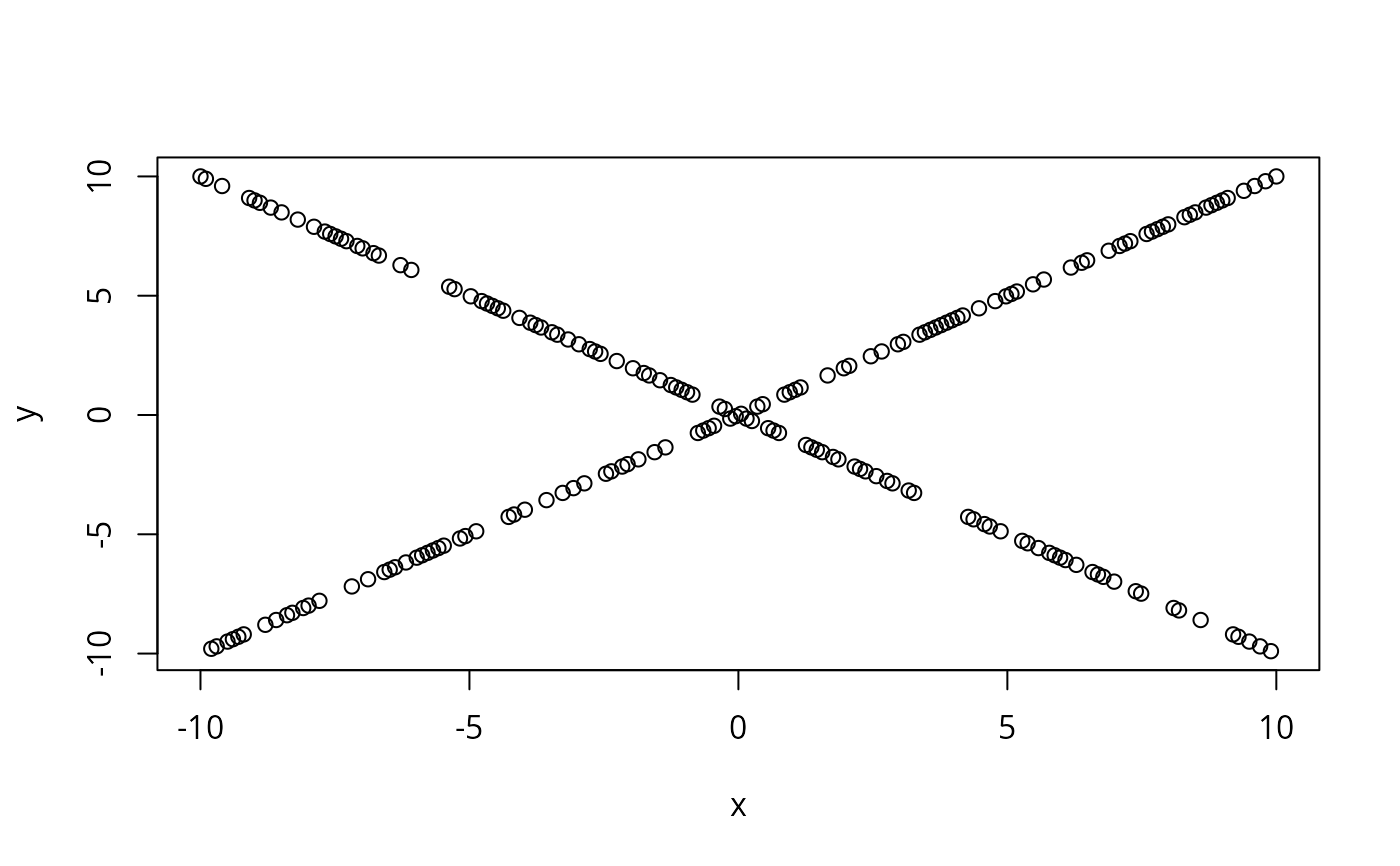
# Hoeffding's test can detect even one-to-many dependency
set.seed(1)
x <- seq(-10,10,length=200)
y <- x*sign(runif(200,-1,1))
plot(x,y)
 hoeffd(x,y)
#> D
#> x y
#> x 1.00 0.06
#> y 0.06 1.00
#>
#> avg|F(x,y)-G(x)H(y)|
#> x y
#> x 0.0000 0.0407
#> y 0.0407 0.0000
#>
#> max|F(x,y)-G(x)H(y)|
#> x y
#> x 0.0000 0.0763
#> y 0.0763 0.0000
#>
#> n= 200
#>
#> P
#> x y
#> x 0
#> y 0
hoeffd(x,y)
#> D
#> x y
#> x 1.00 0.06
#> y 0.06 1.00
#>
#> avg|F(x,y)-G(x)H(y)|
#> x y
#> x 0.0000 0.0407
#> y 0.0407 0.0000
#>
#> max|F(x,y)-G(x)H(y)|
#> x y
#> x 0.0000 0.0763
#> y 0.0763 0.0000
#>
#> n= 200
#>
#> P
#> x y
#> x 0
#> y 0