Store Descriptive Information About an Object
valueTags.RdFunctions get or set useful information about the contents of the object for later use.
valueTags(x)
valueTags(x) <- value

valueLabel(x)
valueLabel(x) <- value

valueName(x)
valueName(x) <- value

valueUnit(x)
valueUnit(x) <- value
Arguments
Value
valueTag returns NULL or a named list with each of the
named values name, label, unit set if they exists
in the object.
For valueTag<- returns list
For valueName, valueLable, and valueUnit returns
NULL or character vector of length 1.
For valueName<-, valueLabel<-, and valueUnit returns value
Details
These functions store the a short name of for the contents, a longer label that is useful for display, and the units of the contents that is useful for display.
valueTag is an accessor, and valueTag<- is a replacement
function for all of the value's information.
valueName is an accessor, and valueName<- is a
replacement function for the value's name. This name is used when a
plot or a latex table needs a short name and the variable name is not
useful.
valueLabel is an accessor, and valueLabel<- is a
replacement function for the value's label. The label is used in a
plots or latex tables when they need a descriptive name.
valueUnit is an accessor, and valueUnit<- is a
replacement function for the value's unit. The unit is used to add
unit information to the R output.
See also
Examples
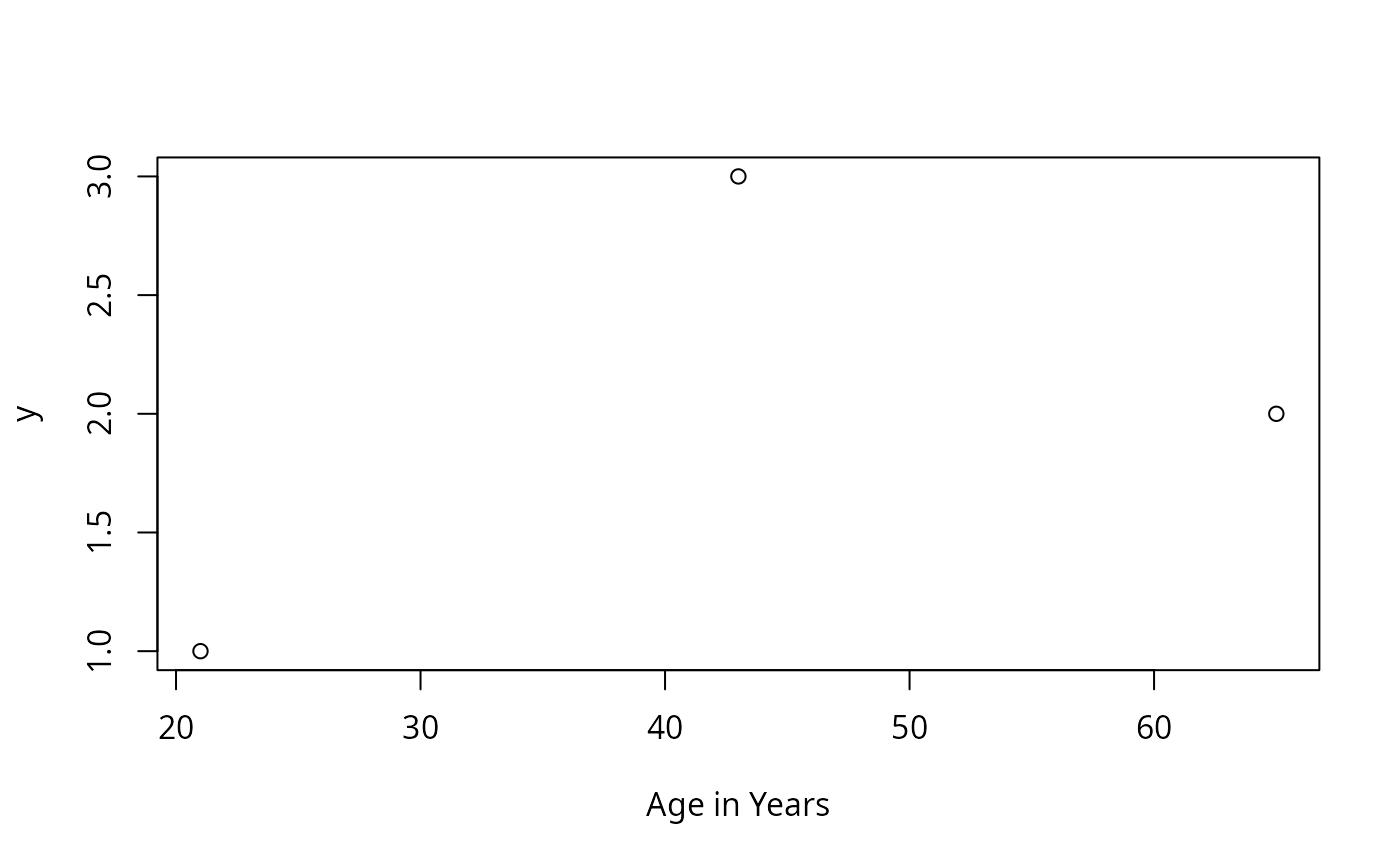
age <- c(21,65,43)
y <- 1:3
valueLabel(age) <- "Age in Years"
plot(age, y, xlab=valueLabel(age))
 x1 <- 1:10
x2 <- 10:1
valueLabel(x2) <- 'Label for x2'
valueUnit(x2) <- 'mmHg'
x2
#> Label for x2 [mmHgs]
#> [1] 10 9 8 7 6 5 4 3 2 1
x2[1:5]
#> Label for x2 [mmHgs]
#> [1] 10 9 8 7 6
dframe <- data.frame(x1, x2)
Label(dframe)
#> label(x1) <- ''
#> label(x2) <- 'Label for x2'
##In these examples of llist, note that labels are printed after
##variable names, because of print.labelled
a <- 1:3
b <- 4:6
valueLabel(b) <- 'B Label'
x1 <- 1:10
x2 <- 10:1
valueLabel(x2) <- 'Label for x2'
valueUnit(x2) <- 'mmHg'
x2
#> Label for x2 [mmHgs]
#> [1] 10 9 8 7 6 5 4 3 2 1
x2[1:5]
#> Label for x2 [mmHgs]
#> [1] 10 9 8 7 6
dframe <- data.frame(x1, x2)
Label(dframe)
#> label(x1) <- ''
#> label(x2) <- 'Label for x2'
##In these examples of llist, note that labels are printed after
##variable names, because of print.labelled
a <- 1:3
b <- 4:6
valueLabel(b) <- 'B Label'