Exponential Regression by Asymmetric Maximum Likelihood Estimation
amlexponential.RdExponential expectile regression estimated by maximizing an asymmetric likelihood function.
amlexponential(w.aml = 1, parallel = FALSE, imethod = 1, digw = 4,
               link = "loglink")
Arguments
- w.aml
Numeric, a vector of positive constants controlling the expectiles. The larger the value the larger the fitted expectile value (the proportion of points below the “w-regression plane”). The default value of unity results in the ordinary maximum likelihood (MLE) solution.
- parallel
If
w.amlhas more than one value then this argument allows the quantile curves to differ by the same amount as a function of the covariates. Setting this to beTRUEshould force the quantile curves to not cross (although they may not cross anyway). SeeCommonVGAMffArgumentsfor more information.- imethod
Integer, either 1 or 2 or 3. Initialization method. Choose another value if convergence fails.
- digw
Passed into
Roundas thedigitsargument for thew.amlvalues; used cosmetically for labelling.- link
See
exponentialand the warning below.
Details
The general methodology behind this VGAM family function
is given in Efron (1992) and full details can be obtained there.
This model is essentially an exponential regression model
(see exponential) but the usual deviance is
replaced by an
asymmetric squared error loss function; it is multiplied by
\(w.aml\) for positive residuals.
The solution is the set of regression coefficients that minimize the
sum of these deviance-type values over the data set, weighted by
the weights argument (so that it can contain frequencies).
Newton-Raphson estimation is used here.
Value
An object of class "vglmff" (see vglmff-class).
The object is used by modelling functions such as vglm
and vgam.
References
Efron, B. (1992). Poisson overdispersion estimates based on the method of asymmetric maximum likelihood. Journal of the American Statistical Association, 87, 98–107.
Note
On fitting, the extra slot has list components "w.aml"
and "percentile". The latter is the percent of observations
below the “w-regression plane”, which is the fitted values. Also,
the individual deviance values corresponding to each element of the
argument w.aml is stored in the extra slot.
For amlexponential objects, methods functions for the generic
functions qtplot and cdf have not been written yet.
See amlpoisson about comments on the jargon, e.g.,
expectiles etc.
In this documentation the word quantile can often be interchangeably replaced by expectile (things are informal here).
Warning
Note that the link argument of exponential and
amlexponential are currently different: one is the
rate parameter and the other is the mean (expectile) parameter.
If w.aml has more than one value then the value returned by
deviance is the sum of all the (weighted) deviances taken over
all the w.aml values. See Equation (1.6) of Efron (1992).
See also
exponential,
amlbinomial,
amlpoisson,
amlnormal,
extlogF1,
alaplace1,
lms.bcg,
deexp.
Examples
nn <- 2000
mydat <- data.frame(x = seq(0, 1, length = nn))
mydat <- transform(mydat,
mu = loglink(-0 + 1.5*x + 0.2*x^2, inverse = TRUE))
mydat <- transform(mydat, mu = loglink(0 - sin(8*x), inverse = TRUE))
mydat <- transform(mydat, y = rexp(nn, rate = 1/mu))
(fit <- vgam(y ~ s(x, df=5), amlexponential(w=c(0.001, 0.1, 0.5, 5, 60)),
mydat, trace = TRUE))
#> VGAM s.vam loop 1 : deviance = 15338.5261
#> VGAM s.vam loop 2 : deviance = 11922.2259
#> VGAM s.vam loop 3 : deviance = 11390.7305
#> VGAM s.vam loop 4 : deviance = 11303.912
#> VGAM s.vam loop 5 : deviance = 11254.9563
#> VGAM s.vam loop 6 : deviance = 11234.07
#> VGAM s.vam loop 7 : deviance = 11227.2618
#> VGAM s.vam loop 8 : deviance = 11226.0931
#> VGAM s.vam loop 9 : deviance = 11226.0089
#> VGAM s.vam loop 10 : deviance = 11226.0051
#> VGAM s.vam loop 11 : deviance = 11226.0046
#> VGAM s.vam loop 12 : deviance = 11226.0046
#>
#> Call:
#> vgam(formula = y ~ s(x, df = 5), family = amlexponential(w = c(0.001,
#> 0.1, 0.5, 5, 60)), data = mydat, trace = TRUE)
#>
#>
#> Degrees of Freedom: 10000 Total; 9969.71 Residual
#> Residual deviance: 11226
fit@extra
#> $w.aml
#> [1] 1e-03 1e-01 5e-01 5e+00 6e+01
#>
#> $M
#> [1] 5
#>
#> $n
#> [1] 2000
#>
#> $y.names
#> [1] "w.aml = 0.001" "w.aml = 0.1" "w.aml = 0.5" "w.aml = 5"
#> [5] "w.aml = 60"
#>
#> $individual
#> [1] TRUE
#>
#> $percentile
#> w.aml = 0.001 w.aml = 0.1 w.aml = 0.5 w.aml = 5 w.aml = 60
#> 4.40 32.85 53.65 82.15 96.15
#>
#> $deviance
#> w.aml = 0.001 w.aml = 0.1 w.aml = 0.5 w.aml = 5 w.aml = 60
#> 166.7813 1130.4200 1894.9898 3277.2637 4756.5499
#>
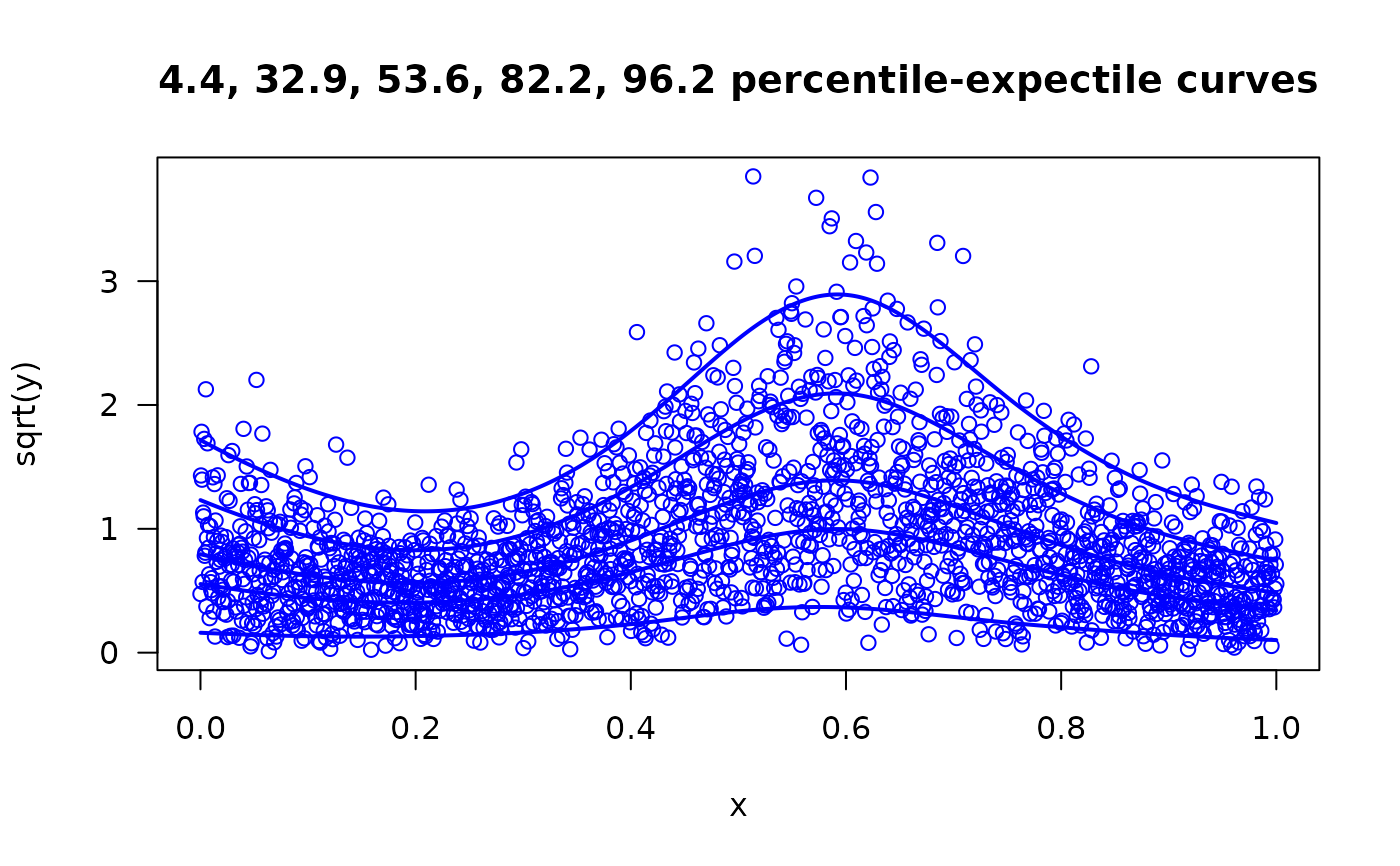
if (FALSE) # These plots are against the sqrt scale (to increase clarity)
par(mfrow = c(1,2))
# Quantile plot
with(mydat, plot(x, sqrt(y), col = "blue", las = 1, main =
paste(paste(round(fit@extra$percentile, digits = 1), collapse=", "),
"percentile-expectile curves")))
with(mydat, matlines(x, sqrt(fitted(fit)), lwd = 2, col = "blue", lty=1))
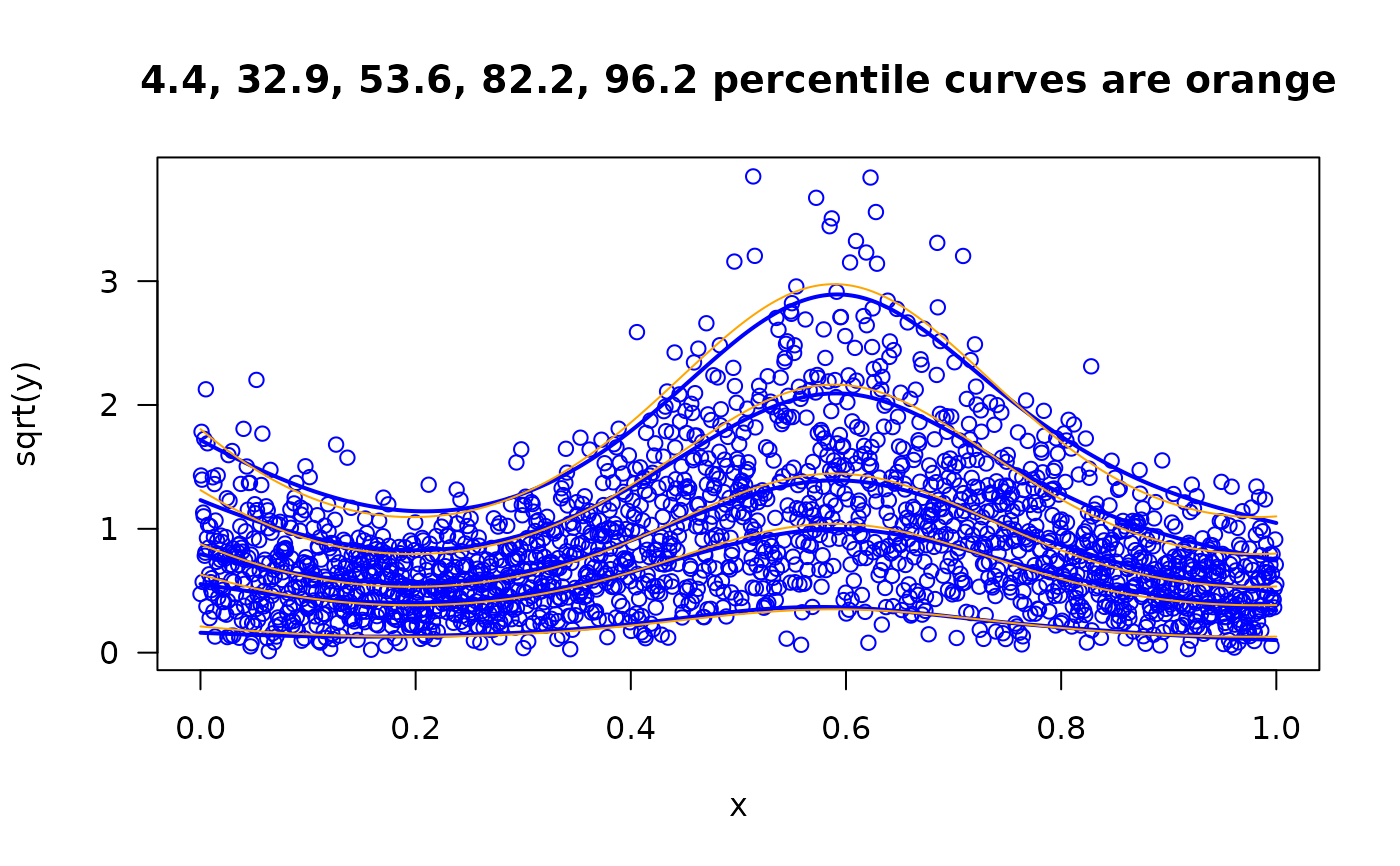
 # Compare the fitted expectiles with the quantiles
with(mydat, plot(x, sqrt(y), col = "blue", las = 1, main =
paste(paste(round(fit@extra$percentile, digits = 1), collapse=", "),
"percentile curves are orange")))
with(mydat, matlines(x, sqrt(fitted(fit)), lwd = 2, col = "blue", lty=1))
for (ii in fit@extra$percentile)
with(mydat, matlines(x, sqrt(qexp(p = ii/100, rate = 1/mu)),
col = "orange")) # \dontrun{}
# Compare the fitted expectiles with the quantiles
with(mydat, plot(x, sqrt(y), col = "blue", las = 1, main =
paste(paste(round(fit@extra$percentile, digits = 1), collapse=", "),
"percentile curves are orange")))
with(mydat, matlines(x, sqrt(fitted(fit)), lwd = 2, col = "blue", lty=1))
for (ii in fit@extra$percentile)
with(mydat, matlines(x, sqrt(qexp(p = ii/100, rate = 1/mu)),
col = "orange")) # \dontrun{}