Bivariate Logistic Distribution
bilogisUC.RdDensity, distribution function, quantile function and random generation for the 4-parameter bivariate logistic distribution.
dbilogis(x1, x2, loc1 = 0, scale1 = 1, loc2 = 0, scale2 = 1,
         log = FALSE)
pbilogis(q1, q2, loc1 = 0, scale1 = 1, loc2 = 0, scale2 = 1)
rbilogis(n, loc1 = 0, scale1 = 1, loc2 = 0, scale2 = 1)
Arguments
- x1, x2, q1, q2
vector of quantiles.
- n
number of observations. Same as
rlogis.- loc1, loc2
the location parameters \(l_1\) and \(l_2\).
- scale1, scale2
the scale parameters \(s_1\) and \(s_2\).
- log
Logical. If
log = TRUEthen the logarithm of the density is returned.
Value
dbilogis gives the density,
pbilogis gives the distribution function, and
rbilogis generates random deviates (a two-column matrix).
References
Gumbel, E. J. (1961). Bivariate logistic distributions. Journal of the American Statistical Association, 56, 335–349.
Details
See bilogis, the VGAM family function for
estimating the four parameters by maximum likelihood estimation,
for the formula of the cumulative distribution function and
other details.
Note
Gumbel (1961) proposed two bivariate logistic distributions with
logistic distribution marginals, which he called Type I and Type II.
The Type I is this one.
The Type II belongs to the Morgenstern type.
The biamhcop distribution has, as a special case,
this distribution, which is when the random variables are
independent.
See also
Examples
if (FALSE) par(mfrow = c(1, 3))
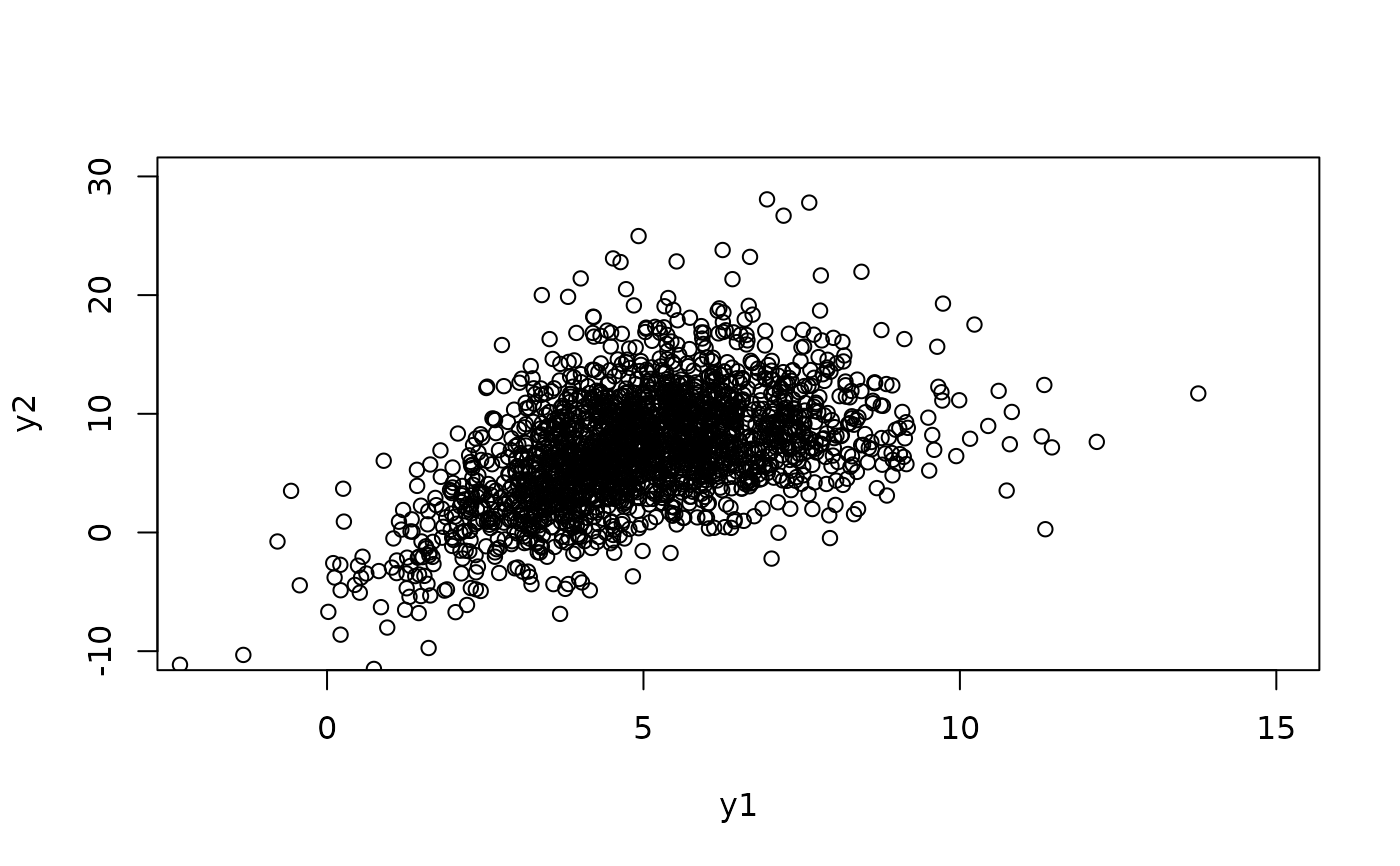
ymat <- rbilogis(n = 2000, loc1 = 5, loc2 = 7, scale2 = exp(1))
myxlim <- c(-2, 15); myylim <- c(-10, 30)
plot(ymat, xlim = myxlim, ylim = myylim)
 N <- 100
x1 <- seq(myxlim[1], myxlim[2], len = N)
x2 <- seq(myylim[1], myylim[2], len = N)
ox <- expand.grid(x1, x2)
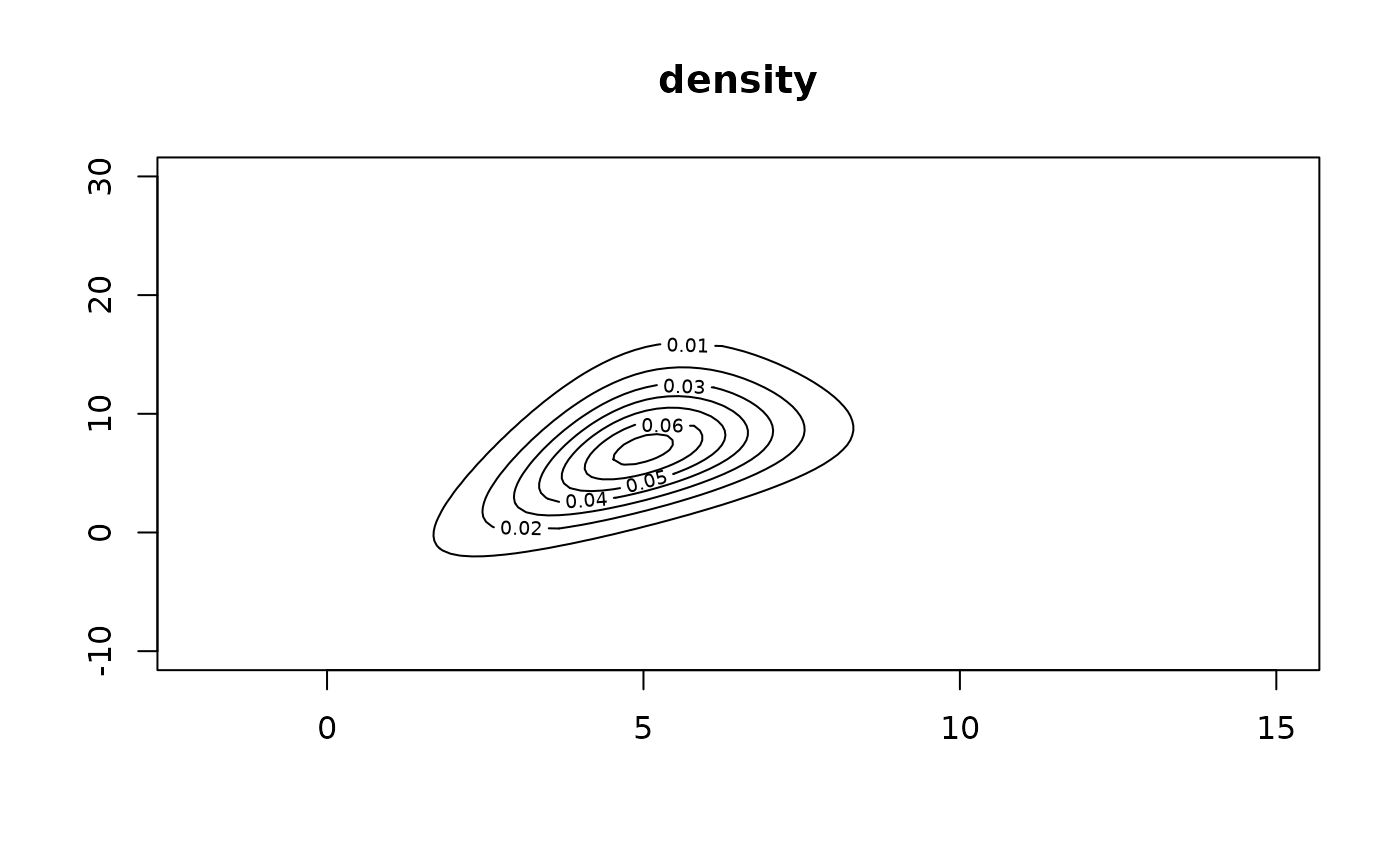
z <- dbilogis(ox[,1], ox[,2], loc1 = 5, loc2 = 7, scale2 = exp(1))
contour(x1, x2, matrix(z, N, N), main = "density")
N <- 100
x1 <- seq(myxlim[1], myxlim[2], len = N)
x2 <- seq(myylim[1], myylim[2], len = N)
ox <- expand.grid(x1, x2)
z <- dbilogis(ox[,1], ox[,2], loc1 = 5, loc2 = 7, scale2 = exp(1))
contour(x1, x2, matrix(z, N, N), main = "density")
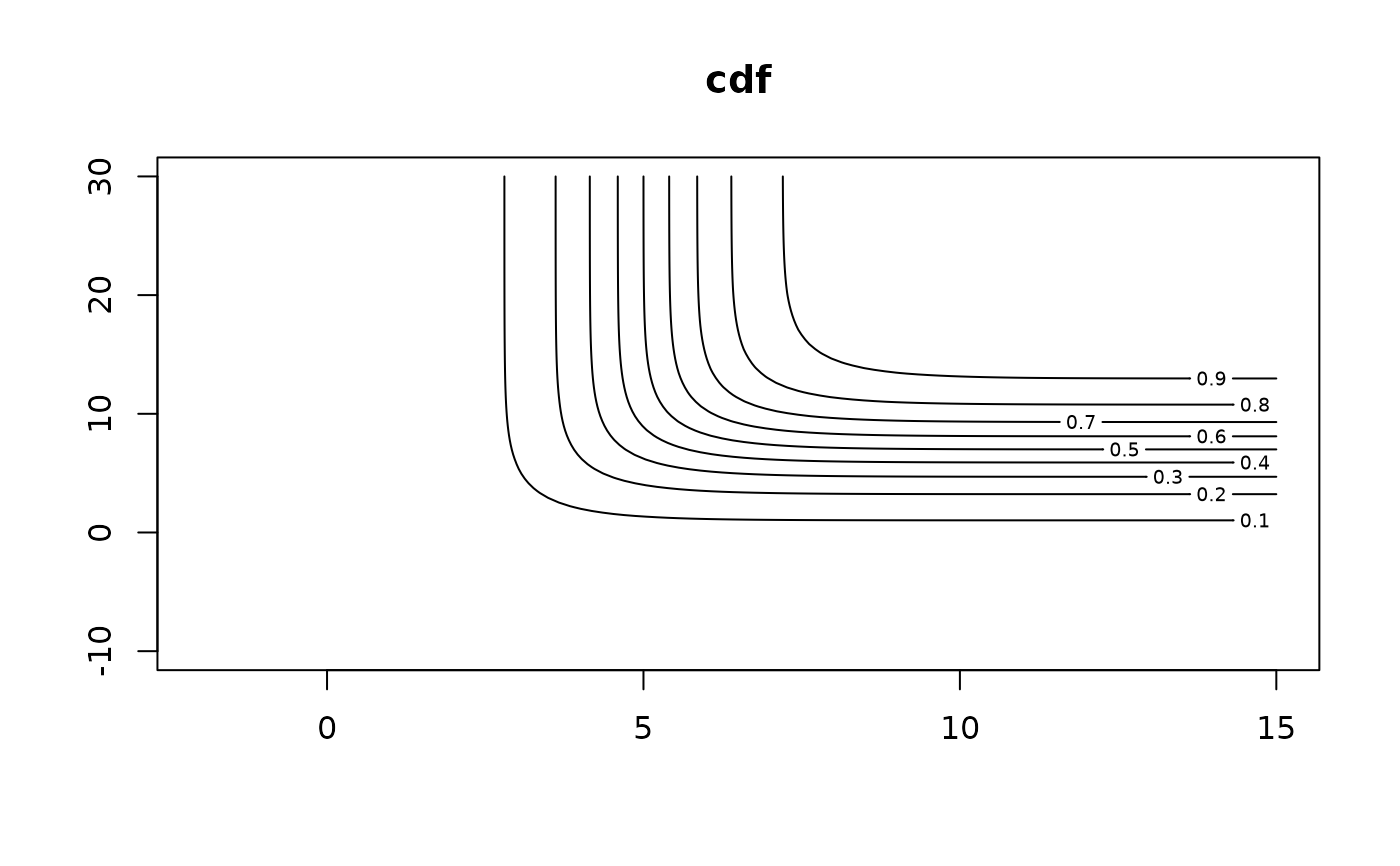
 z <- pbilogis(ox[,1], ox[,2], loc1 = 5, loc2 = 7, scale2 = exp(1))
contour(x1, x2, matrix(z, N, N), main = "cdf") # \dontrun{}
z <- pbilogis(ox[,1], ox[,2], loc1 = 5, loc2 = 7, scale2 = exp(1))
contour(x1, x2, matrix(z, N, N), main = "cdf") # \dontrun{}