The Laplace Distribution
laplaceUC.RdDensity, distribution function, quantile function and random
generation for the Laplace distribution with location parameter
location and scale parameter scale.
dlaplace(x, location = 0, scale = 1, log = FALSE)
plaplace(q, location = 0, scale = 1, lower.tail = TRUE, log.p = FALSE)
qlaplace(p, location = 0, scale = 1, lower.tail = TRUE, log.p = FALSE)
rlaplace(n, location = 0, scale = 1)
Arguments
- x, q
vector of quantiles.
- p
vector of probabilities.
- n
number of observations. Same as in
runif.- location
the location parameter \(a\), which is the mean.
- scale
the scale parameter \(b\). Must consist of positive values.
- log
Logical. If
log = TRUEthen the logarithm of the density is returned.- lower.tail, log.p
Details
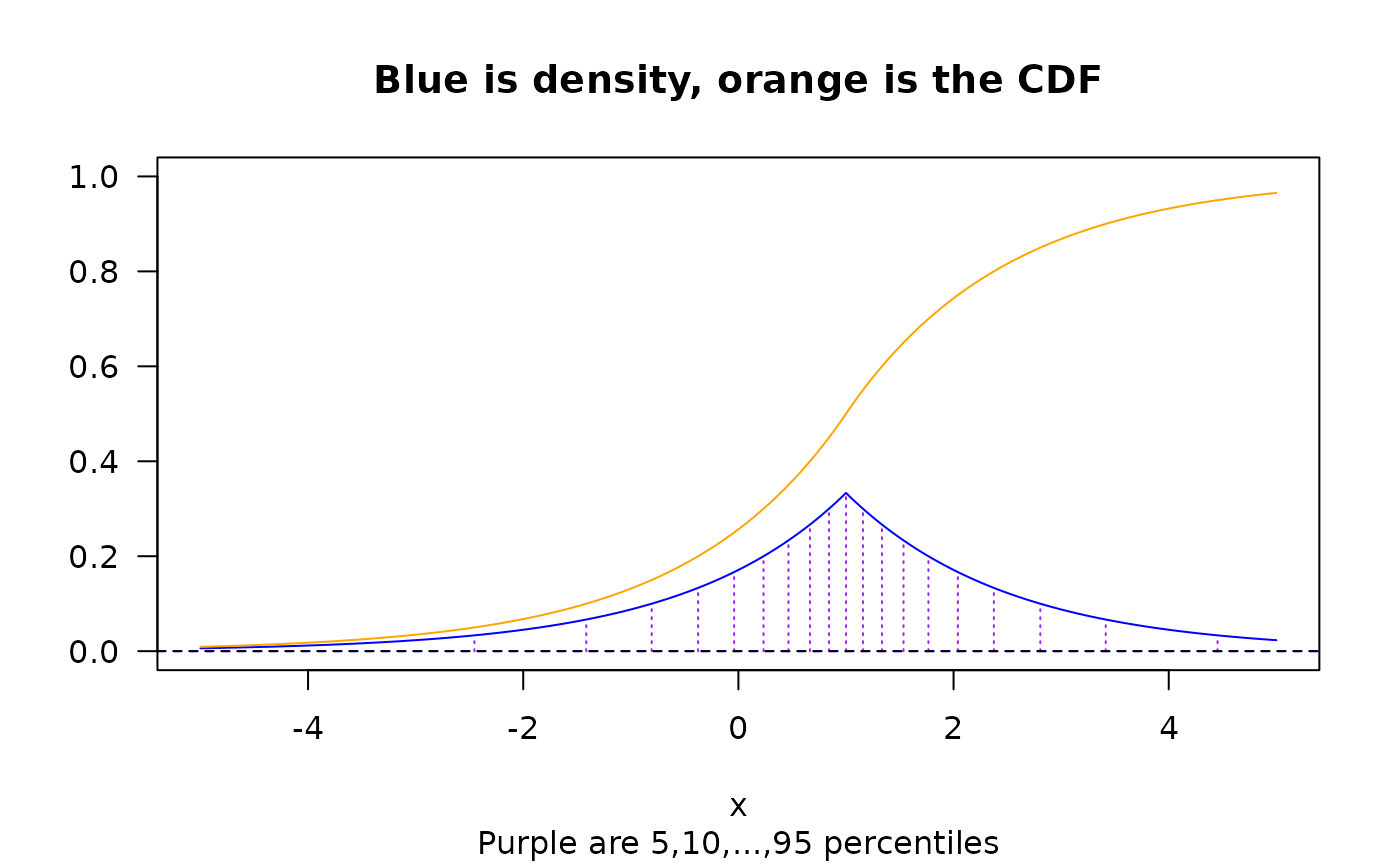
The Laplace distribution is often known as the double-exponential distribution and, for modelling, has heavier tail than the normal distribution. The Laplace density function is $$f(y) = \frac{1}{2b} \exp \left( - \frac{|y-a|}{b} \right) $$ where \(-\infty<y<\infty\), \(-\infty<a<\infty\) and \(b>0\). The mean is \(a\) and the variance is \(2b^2\).
See laplace, the VGAM family function
for estimating the two parameters by maximum likelihood estimation,
for formulae and details.
Apart from n, all the above arguments may be vectors and
are recyled to the appropriate length if necessary.
Value
dlaplace gives the density,
plaplace gives the distribution function,
qlaplace gives the quantile function, and
rlaplace generates random deviates.
References
Forbes, C., Evans, M., Hastings, N. and Peacock, B. (2011). Statistical Distributions, Hoboken, NJ, USA: John Wiley and Sons, Fourth edition.
See also
Examples
loc <- 1; b <- 2
y <- rlaplace(n = 100, loc = loc, scale = b)
mean(y) # sample mean
#> [1] 1.376246
loc # population mean
#> [1] 1
var(y) # sample variance
#> [1] 7.528536
2 * b^2 # population variance
#> [1] 8
if (FALSE) loc <- 0; b <- 1.5; x <- seq(-5, 5, by = 0.01)
plot(x, dlaplace(x, loc, b), type = "l", col = "blue",
main = "Blue is density, orange is the CDF", ylim = c(0,1),
sub = "Purple are 5,10,...,95 percentiles", las = 1, ylab = "")
abline(h = 0, col = "blue", lty = 2)
lines(qlaplace(seq(0.05,0.95,by = 0.05), loc, b),
dlaplace(qlaplace(seq(0.05, 0.95, by = 0.05), loc, b), loc, b),
col = "purple", lty = 3, type = "h")
lines(x, plaplace(x, loc, b), type = "l", col = "orange")
abline(h = 0, lty = 2) # \dontrun{}
 plaplace(qlaplace(seq(0.05, 0.95, by = 0.05), loc, b), loc, b)
#> [1] 0.05 0.10 0.15 0.20 0.25 0.30 0.35 0.40 0.45 0.50 0.55 0.60 0.65 0.70 0.75
#> [16] 0.80 0.85 0.90 0.95
plaplace(qlaplace(seq(0.05, 0.95, by = 0.05), loc, b), loc, b)
#> [1] 0.05 0.10 0.15 0.20 0.25 0.30 0.35 0.40 0.45 0.50 0.55 0.60 0.65 0.70 0.75
#> [16] 0.80 0.85 0.90 0.95