Rayleigh Regression Family Function
rayleigh.RdEstimating the parameter of the Rayleigh distribution by maximum likelihood estimation. Right-censoring is allowed.
rayleigh(lscale = "loglink", nrfs = 1/3 + 0.01,
            oim.mean = TRUE, zero = NULL, parallel = FALSE,
            type.fitted = c("mean", "percentiles", "Qlink"),
            percentiles = 50)
cens.rayleigh(lscale = "loglink", oim = TRUE)
Arguments
- lscale
Parameter link function applied to the scale parameter \(b\). See
Linksfor more choices. A log link is the default because \(b\) is positive.- nrfs
Numeric, of length one, with value in \([0,1]\). Weighting factor between Newton-Raphson and Fisher scoring. The value 0 means pure Newton-Raphson, while 1 means pure Fisher scoring. The default value uses a mixture of the two algorithms, and retaining positive-definite working weights.
- oim.mean
Logical, used only for intercept-only models.
TRUEmeans the mean of the OIM elements are used as working weights. IfTRUEthen this argument has top priority for working out the working weights.FALSEmeans use another algorithm.- oim
Logical. For censored data only,
TRUEmeans the Newton-Raphson algorithm, andFALSEmeans Fisher scoring.- zero, parallel
Details at
CommonVGAMffArguments.- type.fitted, percentiles
See
CommonVGAMffArgumentsfor information. Using"Qlink"is for quantile-links in VGAMextra.
Details
The Rayleigh distribution, which is used in physics, has a probability density function that can be written $$f(y) = y \exp(-0.5 (y/b)^2)/b^2$$ for \(y > 0\) and \(b > 0\). The mean of \(Y\) is \(b \sqrt{\pi / 2}\) (returned as the fitted values) and its variance is \(b^2 (4-\pi)/2\).
The VGAM family function cens.rayleigh handles
right-censored data (the true value is greater than the observed
value). To indicate which type of censoring, input extra =
list(rightcensored = vec2) where vec2 is a logical vector the
same length as the response. If the component of this list is missing
then the logical values are taken to be FALSE. The fitted
object has this component stored in the extra slot.
The VGAM family function rayleigh handles multiple
responses.
Warning
The theory behind the argument oim is not fully complete.
Value
An object of class "vglmff" (see vglmff-class).
The object is used by modelling functions such as vglm,
rrvglm
and vgam.
References
Forbes, C., Evans, M., Hastings, N. and Peacock, B. (2011). Statistical Distributions, Hoboken, NJ, USA: John Wiley and Sons, Fourth edition.
Note
The poisson.points family function is
more general so that if ostatistic = 1 and dimension = 2
then it coincides with rayleigh.
Other related distributions are the Maxwell
and Weibull distributions.
See also
Examples
nn <- 1000; Scale <- exp(2)
rdata <- data.frame(ystar = rrayleigh(nn, scale = Scale))
fit <- vglm(ystar ~ 1, rayleigh, data = rdata, trace = TRUE)
#> Iteration 1: loglikelihood = -2931.7335
#> Iteration 2: loglikelihood = -2931.7322
#> Iteration 3: loglikelihood = -2931.7322
head(fitted(fit))
#> [,1]
#> 1 9.304225
#> 2 9.304225
#> 3 9.304225
#> 4 9.304225
#> 5 9.304225
#> 6 9.304225
with(rdata, mean(ystar))
#> [1] 9.362191
coef(fit, matrix = TRUE)
#> loglink(scale)
#> (Intercept) 2.004677
Coef(fit)
#> scale
#> 7.423698
# Censored data
rdata <- transform(rdata, U = runif(nn, 5, 15))
rdata <- transform(rdata, y = pmin(U, ystar))
if (FALSE) par(mfrow = c(1, 2))
hist(with(rdata, ystar)); hist(with(rdata, y)) # \dontrun{}
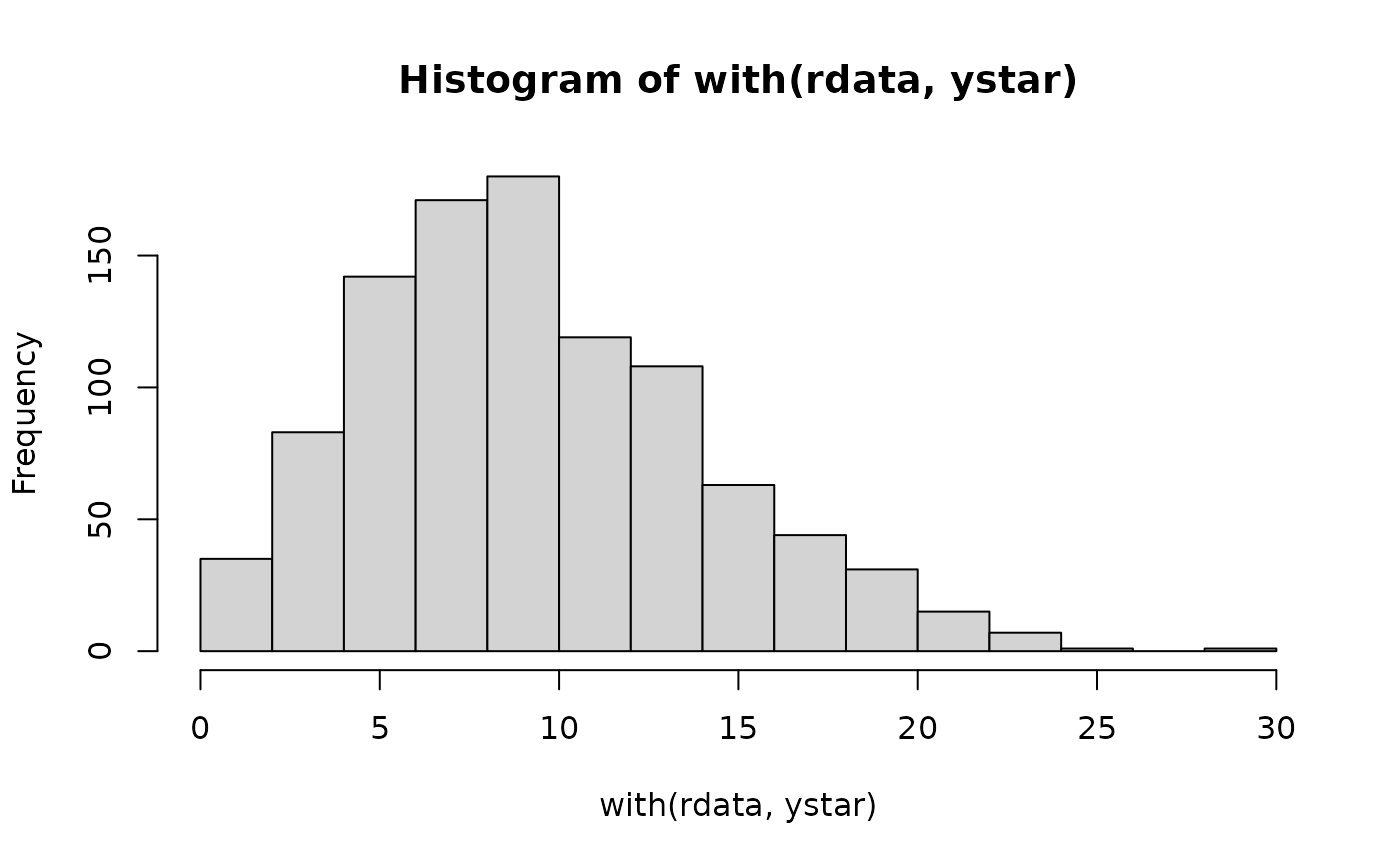
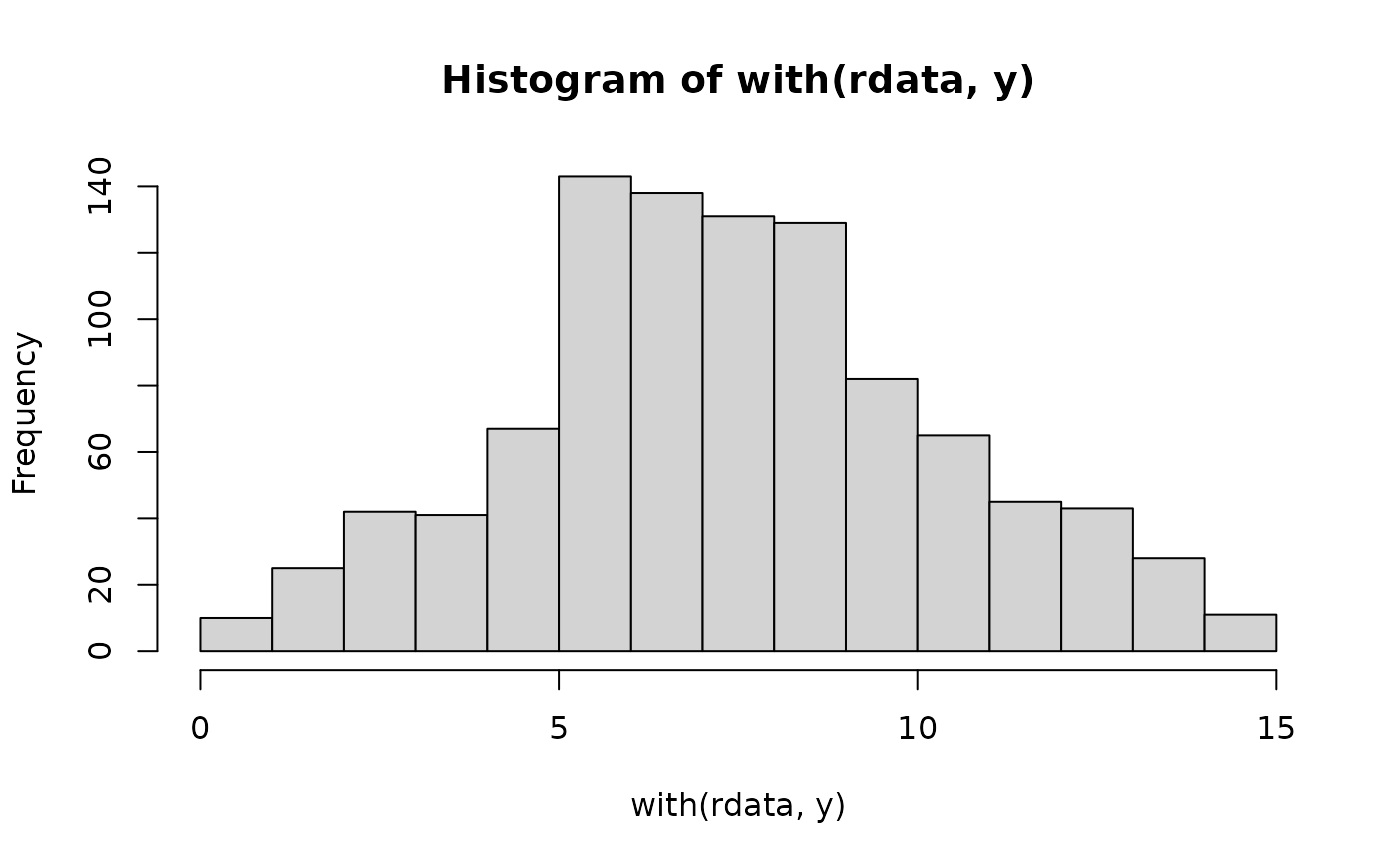 extra <- with(rdata, list(rightcensored = ystar > U))
fit <- vglm(y ~ 1, cens.rayleigh, data = rdata, trace = TRUE,
extra = extra, crit = "coef")
#> Iteration 1: coefficients = 1.7723656
#> Iteration 2: coefficients = 1.9362991
#> Iteration 3: coefficients = 1.9863006
#> Iteration 4: coefficients = 2.0029459
#> Iteration 5: coefficients = 2.0086811
#> Iteration 6: coefficients = 2.0106812
#> Iteration 7: coefficients = 2.0113817
#> Iteration 8: coefficients = 2.0116274
#> Iteration 9: coefficients = 2.0117137
#> Iteration 10: coefficients = 2.0117439
#> Iteration 11: coefficients = 2.0117545
#> Iteration 12: coefficients = 2.0117583
#> Iteration 13: coefficients = 2.0117596
#> Iteration 14: coefficients = 2.01176
#> Iteration 15: coefficients = 2.0117602
table(fit@extra$rightcen)
#>
#> FALSE TRUE
#> 571 429
coef(fit, matrix = TRUE)
#> loglink(scale)
#> (Intercept) 2.01176
head(fitted(fit))
#> [,1]
#> 1 9.37036
#> 2 9.37036
#> 3 9.37036
#> 4 9.37036
#> 5 9.37036
#> 6 9.37036
extra <- with(rdata, list(rightcensored = ystar > U))
fit <- vglm(y ~ 1, cens.rayleigh, data = rdata, trace = TRUE,
extra = extra, crit = "coef")
#> Iteration 1: coefficients = 1.7723656
#> Iteration 2: coefficients = 1.9362991
#> Iteration 3: coefficients = 1.9863006
#> Iteration 4: coefficients = 2.0029459
#> Iteration 5: coefficients = 2.0086811
#> Iteration 6: coefficients = 2.0106812
#> Iteration 7: coefficients = 2.0113817
#> Iteration 8: coefficients = 2.0116274
#> Iteration 9: coefficients = 2.0117137
#> Iteration 10: coefficients = 2.0117439
#> Iteration 11: coefficients = 2.0117545
#> Iteration 12: coefficients = 2.0117583
#> Iteration 13: coefficients = 2.0117596
#> Iteration 14: coefficients = 2.01176
#> Iteration 15: coefficients = 2.0117602
table(fit@extra$rightcen)
#>
#> FALSE TRUE
#> 571 429
coef(fit, matrix = TRUE)
#> loglink(scale)
#> (Intercept) 2.01176
head(fitted(fit))
#> [,1]
#> 1 9.37036
#> 2 9.37036
#> 3 9.37036
#> 4 9.37036
#> 5 9.37036
#> 6 9.37036