Zero-Inflated Poisson Distribution
zipoisUC.RdDensity, distribution function, quantile function and random
generation for the zero-inflated and zero-deflated Poisson
distribution with parameter pstr0.
dzipois(x, lambda, pstr0 = 0, log = FALSE)
pzipois(q, lambda, pstr0 = 0)
qzipois(p, lambda, pstr0 = 0)
rzipois(n, lambda, pstr0 = 0)
Arguments
- x, q
vector of quantiles.
- p
vector of probabilities.
- n
number of observations. Must be a single positive integer.
- lambda
Vector of positive means.
- pstr0
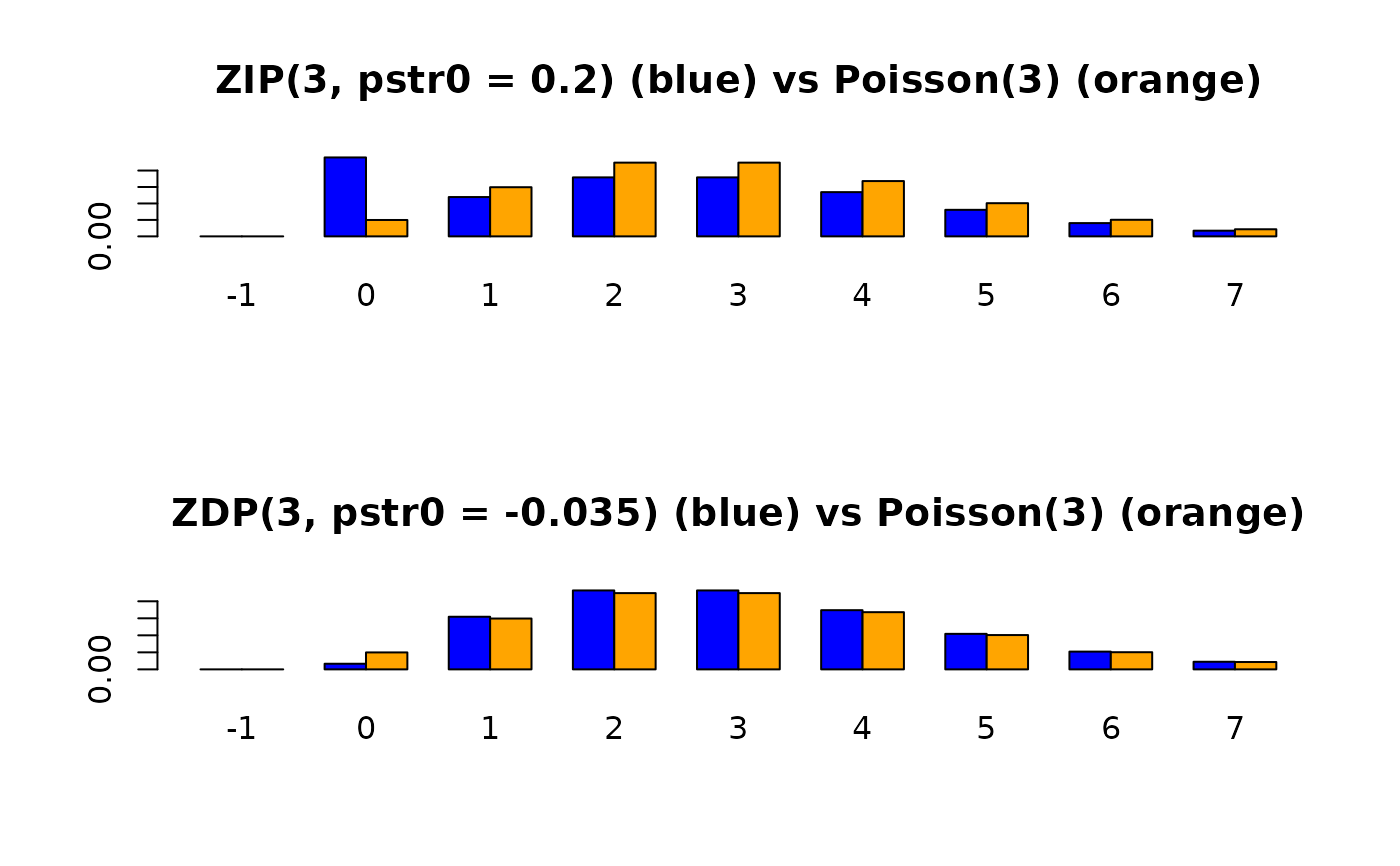
Probability of a structural zero (i.e., ignoring the Poisson distribution), called \(\phi\). The default value of \(\phi = 0\) corresponds to the response having an ordinary Poisson distribution. If \(\phi\) lies in (0, 1) then this is known as the zero-inflated Poisson (ZIP) distribution. This argument may be negative to allow for 0-deflation, hence its interpretation as a probability ceases.
- log
Logical. Return the logarithm of the answer?
Details
The probability function of \(Y\) is 0 with probability \(\phi\), and \(Poisson(\lambda)\) with probability \(1-\phi\). Thus $$P(Y=0) =\phi + (1-\phi) P(W=0)$$ where \(W\) is distributed \(Poisson(\lambda)\).
Value
dzipois gives the density,
pzipois gives the distribution function,
qzipois gives the quantile function, and
rzipois generates random deviates.
Note
The argument pstr0 is recycled to the required length,
and must have values which lie in the interval \([0,1]\).
These functions actually allow for the
zero-deflated Poisson (ZDP) distribution.
Here, pstr0 is also permitted
to lie in the interval [-1/expm1(lambda), 0]. The
resulting probability of a zero count is less than
the nominal Poisson value, and the use of pstr0 to
stand for the probability of a structural zero loses its
meaning.
When pstr0 equals -1/expm1(lambda)
this corresponds to the positive-Poisson distribution
(e.g., see Gaitdpois), also
called the zero-truncated Poisson or ZTP.
The zero-modified Poisson (ZMP) is a combination of the ZIP and ZDP and ZTP distributions. The family function
Examples
lambda <- 3; pstr0 <- 0.2; x <- (-1):7
(ii <- dzipois(x, lambda, pstr0 = pstr0))
#> [1] 0.00000000 0.23982965 0.11948896 0.17923345 0.17923345 0.13442508 0.08065505
#> [8] 0.04032753 0.01728323
max(abs(cumsum(ii) - pzipois(x, lambda, pstr0 = pstr0)))  # 0?
#> [1] 2.220446e-16
table(rzipois(100, lambda, pstr0 = pstr0))
#>
#>  0  1  2  3  4  5  6  7  9 10
#> 29 13 17 15 11  8  3  2  1  1

table(qzipois(runif(100), lambda, pstr0))
#>
#>  0  1  2  3  4  5  6  8
#> 25 11 11 21 19  8  3  2
round(dzipois(0:10, lambda, pstr0 = pstr0) * 100)  # Similar?
#>  [1] 24 12 18 18 13  8  4  2  1  0  0

if (FALSE)  x <- 0:10
par(mfrow = c(2, 1))  # Zero-inflated Poisson
barplot(rbind(dzipois(x, lambda, pstr0 = pstr0), dpois(x, lambda)),
        beside = TRUE, col = c("blue", "orange"),
        main = paste0("ZIP(", lambda,
                      ", pstr0 = ", pstr0, ") (blue) vs",
                      " Poisson(", lambda, ") (orange)"),
        names.arg = as.character(x))

deflat.limit <- -1 / expm1(lambda)  # Zero-deflated Poisson
newpstr0 <- round(deflat.limit / 1.5, 3)
barplot(rbind(dzipois(x, lambda, pstr0 = newpstr0),
                dpois(x, lambda)),
        beside = TRUE, col = c("blue","orange"),
        main = paste0("ZDP(", lambda, ", pstr0 = ", newpstr0, ")",
                     " (blue) vs Poisson(", lambda, ") (orange)"),
        names.arg = as.character(x))  # \dontrun{}