Finite Mixtures of Beta Regression for Rates and Proportions
betamix.RdFit finite mixtures of beta regression models for rates and proportions via maximum likelihood with the EM algorithm using a parametrization with mean (depending through a link function on the covariates) and precision parameter (called phi).
Usage
betamix(formula, data, k, subset, na.action, weights, offset,
  link = c("logit", "probit", "cloglog", "cauchit", "log",
    "loglog"), link.phi = "log",
  control = betareg.control(...), cluster = NULL,
  FLXconcomitant = NULL, FLXcontrol = list(), verbose = FALSE,
  nstart = if (is.null(cluster)) 3 else 1, which = "BIC",
  ID, fixed, extra_components, ...)

extraComponent(type = c("uniform", "betareg"), coef, delta,
  link = "logit", link.phi = "log")
Arguments
- formula
symbolic description of the model (of type
y ~ xory ~ x | z; for details seebetareg).- data, subset, na.action
arguments controlling formula processing via
model.frame.- weights
optional numeric vector of integer case weights.
- offset
optional numeric vector with an a priori known component to be included in the linear predictor for the mean.
- k
a vector of integers indicating the number of components of the finite mixture; passed in turn to the
kargument ofstepFlexmix.- link
character specification of the link function in the mean model (mu). Currently,
"logit","probit","cloglog","cauchit","log","loglog"are supported. Alternatively, an object of class"link-glm"can be supplied.- link.phi
character specification of the link function in the precision model (phi). Currently,
"identity","log","sqrt"are supported. The default is"log"unlessformulais of typey ~ xwhere the default is"identity"(for backward compatibility). Alternatively, an object of class"link-glm"can be supplied.- control
a list of control arguments specified via
betareg.control.- cluster
Either a matrix with
kcolumns of initial cluster membership probabilities for each observation; or a factor or integer vector with the initial cluster assignments of observations at the start of the EM algorithm. Default is random assignment intokclusters.- FLXconcomitant
concomitant variable model; object of class
FLXP. Default is the object returned by callingFLXPconstant. The argumentFLXconcomitantcan be omitted ifformulais a three-part formula of typey ~ x | z | w, wherewspecificies the concomitant variables.- FLXcontrol
object of class
"FLXcontrol"or a named list; controls the EM algorithm and passed in turn to thecontrolargument offlexmix.- verbose
a logical; if
TRUEprogress information is shown for different starts of the EM algorithm.- nstart
for each value of
krunstepFlexmixnstarttimes and keep only the solution with maximum likelihood.- which
number of model to get if
kis a vector of integers longer than one. If character, interpreted as number of components or name of an information criterion.- ID
grouping variable indicating if observations are from the same individual, i.e. the component membership is restricted to be the same for these observations.
- fixed
symbolic description of the model for the parameters fixed over components (of type
~ x | z).- extra_components
a list containing objects returned by
extraComponent().- ...
arguments passed to
betareg.control.- type
specifies if the component follows a uniform distribution or a beta regression model.
- coef
a vector with the coefficients to determine the midpoint of the uniform distribution or names list with the coefficients for the mean and precision of the beta regression model.
- delta
numeric; half-length of the interval of the uniform distribution.
Details
The arguments and the model specification are similar to
betareg. Internally stepFlexmix
is called with suitable arguments to fit the finite mixture model with
the EM algorithm. See Grün et al. (2012) for more details.
extra_components is a list where each element corresponds to a
component where the parameters are fixed a-priori.
Value
An object of class "flexmix" containing the best model with
respect to the log likelihood or the one selected according to
which if k is a vector of integers longer than 1.
References
Cribari-Neto F, Zeileis A (2010). Beta Regression in R. Journal of Statistical Software, 34(2), 1–24. doi:10.18637/jss.v034.i02
Grün B, Kosmidis I, Zeileis A (2012). Extended Beta Regression in R: Shaken, Stirred, Mixed, and Partitioned. Journal of Statistical Software, 48(11), 1–25. doi:10.18637/jss.v048.i11
Grün B, Leisch F (2008). FlexMix Version 2: Finite Mixtures with Concomitant Variables and Varying and Constant Parameters. Journal of Statistical Software, 28(4), 1–35. doi:10.18637/jss.v028.i04
Leisch F (2004). FlexMix: A General Framework for Finite Mixture Models and Latent Class Regression in R. Journal of Statistical Software, 11(8), 1–18. doi:10.18637/jss.v011.i08
Examples
options(digits = 4)
## data with two groups of dyslexic and non-dyslexic children
data("ReadingSkills", package = "betareg")
suppressWarnings(RNGversion("3.5.0"))
set.seed(4040)
## try to capture accuracy ~ iq relationship (without using dyslexia
## information) using two beta regression components and one additional
## extra component for a perfect reading score
rs_mix <- betamix(accuracy ~ iq, data = ReadingSkills, k = 3,
nstart = 10, extra_components = extraComponent(type = "uniform",
coef = 0.99, delta = 0.01))
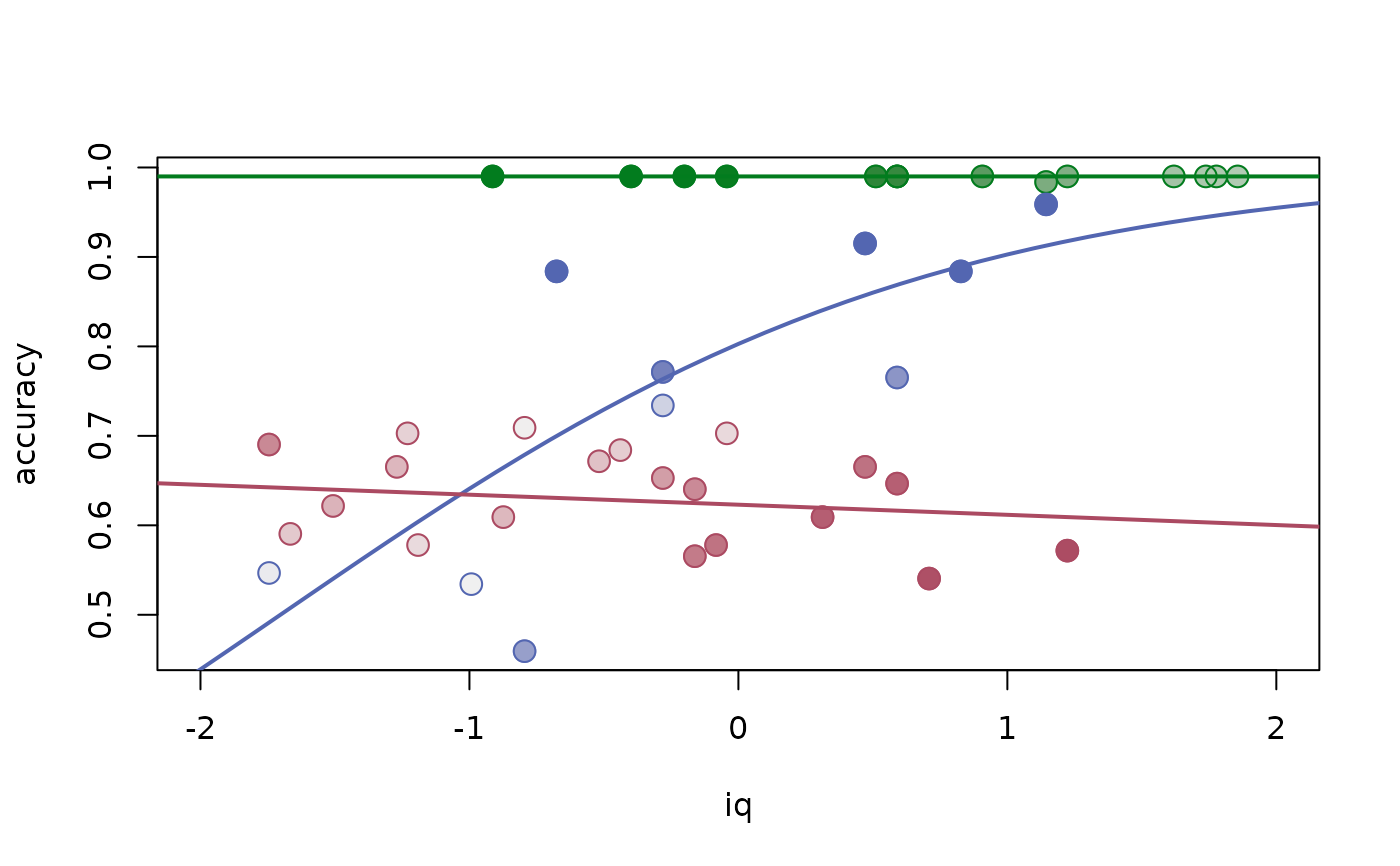
## visualize result
## intensities based on posterior probabilities
prob <- 2 * (posterior(rs_mix)[cbind(1:nrow(ReadingSkills),
clusters(rs_mix))] - 0.5)
## associated HCL colors
col0 <- hcl(c(260, 0, 130), 65, 45, fixup = FALSE)
col1 <- col0[clusters(rs_mix)]
col2 <- hcl(c(260, 0, 130)[clusters(rs_mix)], 65 * abs(prob)^1.5,
95 - 50 * abs(prob)^1.5, fixup = FALSE)
## scatter plot
plot(accuracy ~ iq, data = ReadingSkills, col = col2, pch = 19,
cex = 1.5, xlim = c(-2, 2))
points(accuracy ~ iq, data = ReadingSkills, cex = 1.5, pch = 1,
col = col1)
## fitted lines
iq <- -30:30/10
cf <- rbind(coef(rs_mix, model = "mean", component = 1:2),
c(qlogis(0.99), 0))
for(i in 1:3)
lines(iq, plogis(cf[i, 1] + cf[i, 2] * iq), lwd = 2,
col = col0[i])
 ## refit the model including a concomitant variable model using the
## dyslexia information with some noise to avoid complete separation
## between concomitant variable and component memberships
set.seed(4040)
w <- rnorm(nrow(ReadingSkills),
c(-1, 1)[as.integer(ReadingSkills$dyslexia)])
## The argument FLXconcomitant can be omitted when specifying
## the model via a three part formula given by
## accuracy ~ iq | 1 | w
## The posteriors from the previously fitted model are used
## for initialization.
library("flexmix")
rs_mix2 <- betamix(accuracy ~ iq, data = ReadingSkills,
extra_components = extraComponent(type = "uniform",
coef = 0.99, delta = 0.01), cluster = posterior(rs_mix),
FLXconcomitant = FLXPmultinom(~w))
coef(rs_mix2, which = "concomitant")
#> (Intercept) w
#> 1 0.0000 0.0000
#> 2 0.8114 1.0778
#> 3 -0.1195 -0.3488
summary(rs_mix2, which = "concomitant")
#> $Comp.2
#> Estimate Std. Error z value Pr(>|z|)
#> (Intercept) 0.821 0.882 0.93 0.35
#> w 1.078 0.497 2.17 0.03 *
#> ---
#> Signif. codes: 0 ‘***’ 0.001 ‘**’ 0.01 ‘*’ 0.05 ‘.’ 0.1 ‘ ’ 1
#>
#> $Comp.3
#> Estimate Std. Error z value Pr(>|z|)
#> (Intercept) -0.113 0.812 -0.14 0.89
#> w -0.346 0.452 -0.77 0.44
#>
## refit the model including a concomitant variable model using the
## dyslexia information with some noise to avoid complete separation
## between concomitant variable and component memberships
set.seed(4040)
w <- rnorm(nrow(ReadingSkills),
c(-1, 1)[as.integer(ReadingSkills$dyslexia)])
## The argument FLXconcomitant can be omitted when specifying
## the model via a three part formula given by
## accuracy ~ iq | 1 | w
## The posteriors from the previously fitted model are used
## for initialization.
library("flexmix")
rs_mix2 <- betamix(accuracy ~ iq, data = ReadingSkills,
extra_components = extraComponent(type = "uniform",
coef = 0.99, delta = 0.01), cluster = posterior(rs_mix),
FLXconcomitant = FLXPmultinom(~w))
coef(rs_mix2, which = "concomitant")
#> (Intercept) w
#> 1 0.0000 0.0000
#> 2 0.8114 1.0778
#> 3 -0.1195 -0.3488
summary(rs_mix2, which = "concomitant")
#> $Comp.2
#> Estimate Std. Error z value Pr(>|z|)
#> (Intercept) 0.821 0.882 0.93 0.35
#> w 1.078 0.497 2.17 0.03 *
#> ---
#> Signif. codes: 0 ‘***’ 0.001 ‘**’ 0.01 ‘*’ 0.05 ‘.’ 0.1 ‘ ’ 1
#>
#> $Comp.3
#> Estimate Std. Error z value Pr(>|z|)
#> (Intercept) -0.113 0.812 -0.14 0.89
#> w -0.346 0.452 -0.77 0.44
#>