Beta Regression Trees
betatree.RdFit beta regression trees via model-based recursive partitioning.
Usage
betatree(formula, partition,
  data, subset = NULL, na.action = na.omit, weights, offset, cluster,
  link = "logit", link.phi = "log", control = betareg.control(),
  ...)
Arguments
- formula
symbolic description of the model of type
y ~ xory ~ x | z, specifying the variables influencing mean and precision ofy, respectively. For details seebetareg.- partition
symbolic description of the partitioning variables, e.g.,
~ p1 + p2. The argumentpartitioncan be omitted ifformulais a three-part formula of typey ~ x | z | p1 + p2.- data, subset, na.action, weights, offset, cluster
arguments controlling data/model processing passed to
mob.- link
character specification of the link function in the mean model (mu). Currently,
"logit","probit","cloglog","cauchit","log","loglog"are supported. Alternatively, an object of class"link-glm"can be supplied.- link.phi
character specification of the link function in the precision model (phi). Currently,
"identity","log","sqrt"are supported. Alternatively, an object of class"link-glm"can be supplied.- control
a list of control arguments for the beta regression specified via
betareg.control.- ...
further control arguments for the recursive partitioning passed to
mob_control.
Details
Beta regression trees are an application of model-based recursive partitioning
(implemented in mob, see Zeileis et al. 2008) to
beta regression (implemented in betareg, see Cribari-Neto
and Zeileis 2010). See also Grün at al. (2012) for more details.
Various methods are provided for "betatree" objects, most of them
inherit their behavior from "mob" objects (e.g., print, summary,
coef, etc.). The plot method employs the node_bivplot
panel-generating function.
References
Cribari-Neto F, Zeileis A (2010). Beta Regression in R. Journal of Statistical Software, 34(2), 1–24. doi:10.18637/jss.v034.i02
Grün B, Kosmidis I, Zeileis A (2012). Extended Beta Regression in R: Shaken, Stirred, Mixed, and Partitioned. Journal of Statistical Software, 48(11), 1–25. doi:10.18637/jss.v048.i11
Zeileis A, Hothorn T, Hornik K (2008). Model-Based Recursive Partitioning. Journal of Computational and Graphical Statistics, 17(2), 492–514.
Examples
options(digits = 4)
suppressWarnings(RNGversion("3.5.0"))
## data with two groups of dyslexic and non-dyslexic children
data("ReadingSkills", package = "betareg")
## additional random noise (not associated with reading scores)
set.seed(1071)
ReadingSkills$x1 <- rnorm(nrow(ReadingSkills))
ReadingSkills$x2 <- runif(nrow(ReadingSkills))
ReadingSkills$x3 <- factor(rnorm(nrow(ReadingSkills)) > 0)
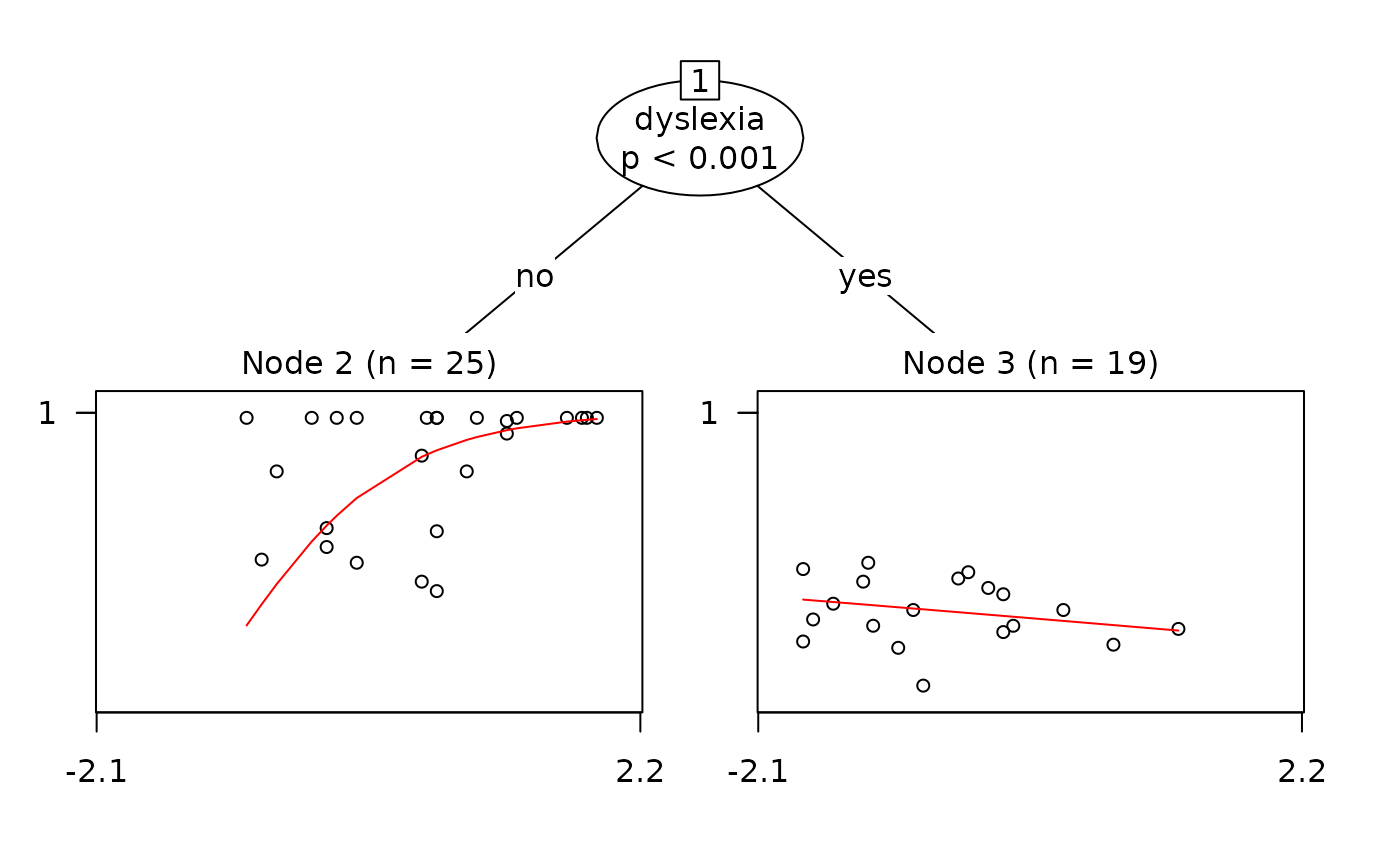
## fit beta regression tree: in each node
## - accurcay's mean and precision depends on iq
## - partitioning is done by dyslexia and the noise variables x1, x2, x3
## only dyslexia is correctly selected for splitting
bt <- betatree(accuracy ~ iq | iq, ~ dyslexia + x1 + x2 + x3,
data = ReadingSkills, minsize = 10)
plot(bt)
 ## inspect result
coef(bt)
#> (Intercept) iq (phi)_(Intercept) (phi)_iq
#> 2 1.6565 1.46571 1.273 2.048
#> 3 0.3809 -0.08623 4.808 0.826
if(require("strucchange")) sctest(bt)
#> Loading required package: strucchange
#> Loading required package: sandwich
#> $`1`
#> dyslexia x1 x2 x3
#> statistic 2.269e+01 8.5251 5.5699 1.0568
#> p.value 5.848e-04 0.9095 0.9987 0.9999
#>
#> $`2`
#> dyslexia x1 x2 x3
#> statistic 0 6.4116 4.5170 4.2308
#> p.value NA 0.8412 0.9752 0.7566
#>
#> $`3`
#> NULL
#>
## IGNORE_RDIFF_BEGIN
summary(bt, node = 2)
#>
#> Call:
#> betatree(formula = accuracy ~ iq | iq, data = ReadingSkills)
#>
#> Quantile residuals:
#> Min 1Q Median 3Q Max
#> -2.495 -0.437 0.210 0.953 1.090
#>
#> Coefficients (mean model with logit link):
#> Estimate Std. Error z value Pr(>|z|)
#> (Intercept) 1.657 0.286 5.78 7.3e-09 ***
#> iq 1.466 0.248 5.92 3.2e-09 ***
#>
#> Phi coefficients (precision model with log link):
#> Estimate Std. Error z value Pr(>|z|)
#> (Intercept) 1.273 0.307 4.15 3.4e-05 ***
#> iq 2.048 0.331 6.19 5.9e-10 ***
#> ---
#> Signif. codes: 0 '***' 0.001 '**' 0.01 '*' 0.05 '.' 0.1 ' ' 1
#>
#> Type of estimator: ML (maximum likelihood)
#> Log-likelihood: 39.4 on 4 Df
#> Pseudo R-squared: 0.149
#> Number of iterations: 17 (BFGS) + 1 (Fisher scoring)
summary(bt, node = 3)
#>
#> Call:
#> betatree(formula = accuracy ~ iq | iq, data = ReadingSkills)
#>
#> Quantile residuals:
#> Min 1Q Median 3Q Max
#> -2.426 -0.631 -0.067 0.778 1.555
#>
#> Coefficients (mean model with logit link):
#> Estimate Std. Error z value Pr(>|z|)
#> (Intercept) 0.3809 0.0486 7.83 4.8e-15 ***
#> iq -0.0862 0.0549 -1.57 0.12
#>
#> Phi coefficients (precision model with log link):
#> Estimate Std. Error z value Pr(>|z|)
#> (Intercept) 4.808 0.414 11.61 <2e-16 ***
#> iq 0.826 0.395 2.09 0.036 *
#> ---
#> Signif. codes: 0 '***' 0.001 '**' 0.01 '*' 0.05 '.' 0.1 ' ' 1
#>
#> Type of estimator: ML (maximum likelihood)
#> Log-likelihood: 27.3 on 4 Df
#> Pseudo R-squared: 0.0391
#> Number of iterations: 16 (BFGS) + 2 (Fisher scoring)
## IGNORE_RDIFF_END
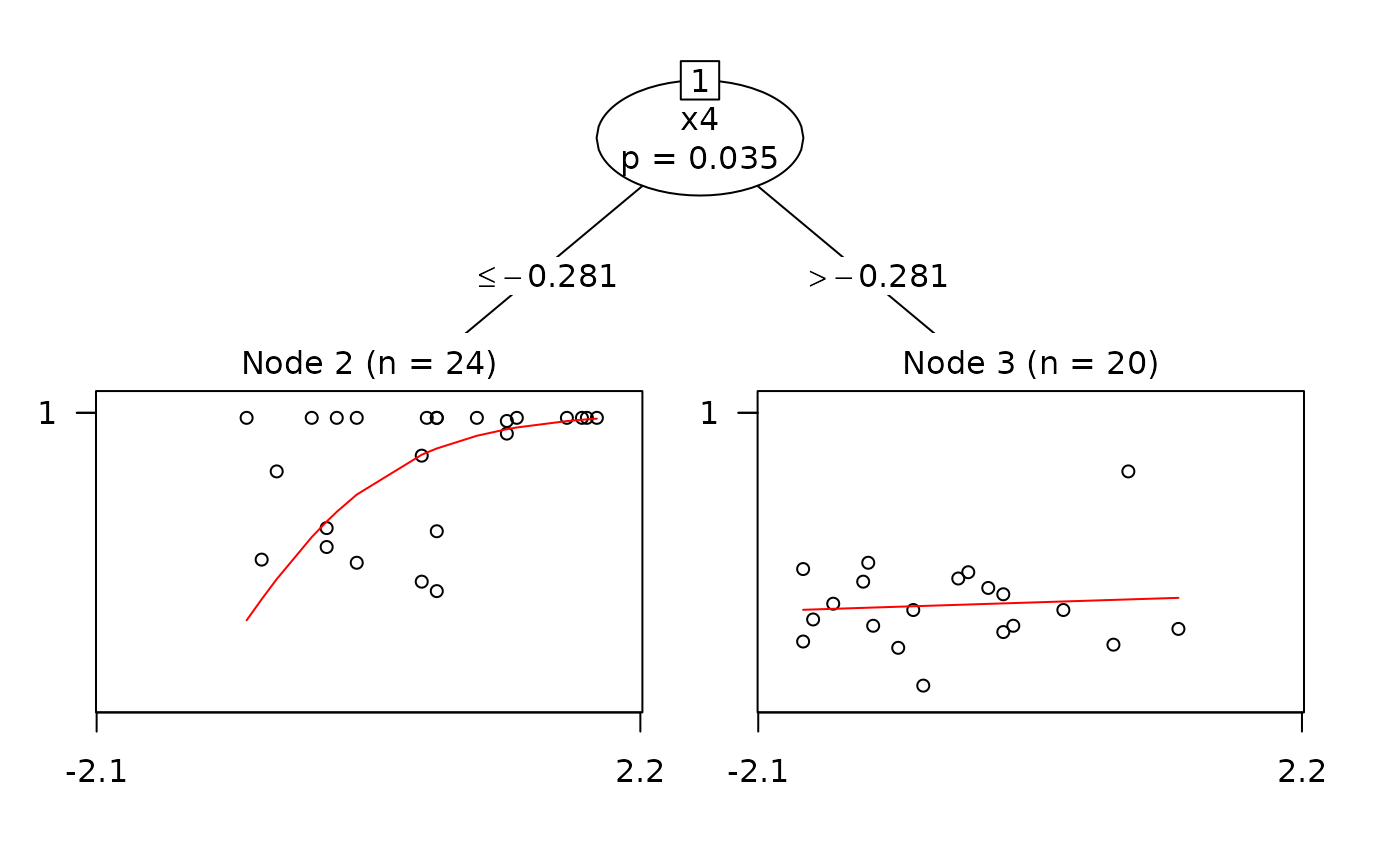
## add a numerical variable with relevant information for splitting
ReadingSkills$x4 <- rnorm(nrow(ReadingSkills), c(-1.5, 1.5)[ReadingSkills$dyslexia])
bt2 <- betatree(accuracy ~ iq | iq, ~ x1 + x2 + x3 + x4,
data = ReadingSkills, minsize = 10)
plot(bt2)
## inspect result
coef(bt)
#> (Intercept) iq (phi)_(Intercept) (phi)_iq
#> 2 1.6565 1.46571 1.273 2.048
#> 3 0.3809 -0.08623 4.808 0.826
if(require("strucchange")) sctest(bt)
#> Loading required package: strucchange
#> Loading required package: sandwich
#> $`1`
#> dyslexia x1 x2 x3
#> statistic 2.269e+01 8.5251 5.5699 1.0568
#> p.value 5.848e-04 0.9095 0.9987 0.9999
#>
#> $`2`
#> dyslexia x1 x2 x3
#> statistic 0 6.4116 4.5170 4.2308
#> p.value NA 0.8412 0.9752 0.7566
#>
#> $`3`
#> NULL
#>
## IGNORE_RDIFF_BEGIN
summary(bt, node = 2)
#>
#> Call:
#> betatree(formula = accuracy ~ iq | iq, data = ReadingSkills)
#>
#> Quantile residuals:
#> Min 1Q Median 3Q Max
#> -2.495 -0.437 0.210 0.953 1.090
#>
#> Coefficients (mean model with logit link):
#> Estimate Std. Error z value Pr(>|z|)
#> (Intercept) 1.657 0.286 5.78 7.3e-09 ***
#> iq 1.466 0.248 5.92 3.2e-09 ***
#>
#> Phi coefficients (precision model with log link):
#> Estimate Std. Error z value Pr(>|z|)
#> (Intercept) 1.273 0.307 4.15 3.4e-05 ***
#> iq 2.048 0.331 6.19 5.9e-10 ***
#> ---
#> Signif. codes: 0 '***' 0.001 '**' 0.01 '*' 0.05 '.' 0.1 ' ' 1
#>
#> Type of estimator: ML (maximum likelihood)
#> Log-likelihood: 39.4 on 4 Df
#> Pseudo R-squared: 0.149
#> Number of iterations: 17 (BFGS) + 1 (Fisher scoring)
summary(bt, node = 3)
#>
#> Call:
#> betatree(formula = accuracy ~ iq | iq, data = ReadingSkills)
#>
#> Quantile residuals:
#> Min 1Q Median 3Q Max
#> -2.426 -0.631 -0.067 0.778 1.555
#>
#> Coefficients (mean model with logit link):
#> Estimate Std. Error z value Pr(>|z|)
#> (Intercept) 0.3809 0.0486 7.83 4.8e-15 ***
#> iq -0.0862 0.0549 -1.57 0.12
#>
#> Phi coefficients (precision model with log link):
#> Estimate Std. Error z value Pr(>|z|)
#> (Intercept) 4.808 0.414 11.61 <2e-16 ***
#> iq 0.826 0.395 2.09 0.036 *
#> ---
#> Signif. codes: 0 '***' 0.001 '**' 0.01 '*' 0.05 '.' 0.1 ' ' 1
#>
#> Type of estimator: ML (maximum likelihood)
#> Log-likelihood: 27.3 on 4 Df
#> Pseudo R-squared: 0.0391
#> Number of iterations: 16 (BFGS) + 2 (Fisher scoring)
## IGNORE_RDIFF_END
## add a numerical variable with relevant information for splitting
ReadingSkills$x4 <- rnorm(nrow(ReadingSkills), c(-1.5, 1.5)[ReadingSkills$dyslexia])
bt2 <- betatree(accuracy ~ iq | iq, ~ x1 + x2 + x3 + x4,
data = ReadingSkills, minsize = 10)
plot(bt2)
 ## inspect result
coef(bt2)
#> (Intercept) iq (phi)_(Intercept) (phi)_iq
#> 2 1.7060 1.47402 1.293 2.0841
#> 3 0.5048 0.03391 3.131 -0.7684
if(require("strucchange")) sctest(bt2)
#> $`1`
#> x1 x2 x3 x4
#> statistic 8.5251 5.5699 1.0568 19.94405
#> p.value 0.9095 0.9987 0.9999 0.03485
#>
#> $`2`
#> x1 x2 x3 x4
#> statistic 8.9467 3.5888 3.5677 4.7049
#> p.value 0.5964 0.9985 0.9197 0.9848
#>
#> $`3`
#> x1 x2 x3 x4
#> statistic 5.5413 1.2373 4.8649 4.9921
#> p.value 0.6595 0.9997 0.7619 0.7432
#>
## IGNORE_RDIFF_BEGIN
summary(bt2, node = 2)
#>
#> Call:
#> betatree(formula = accuracy ~ iq | iq, data = ReadingSkills)
#>
#> Quantile residuals:
#> Min 1Q Median 3Q Max
#> -2.583 -0.393 0.177 0.923 1.054
#>
#> Coefficients (mean model with logit link):
#> Estimate Std. Error z value Pr(>|z|)
#> (Intercept) 1.706 0.292 5.85 4.9e-09 ***
#> iq 1.474 0.248 5.95 2.7e-09 ***
#>
#> Phi coefficients (precision model with log link):
#> Estimate Std. Error z value Pr(>|z|)
#> (Intercept) 1.293 0.312 4.14 3.4e-05 ***
#> iq 2.084 0.333 6.25 4.0e-10 ***
#> ---
#> Signif. codes: 0 '***' 0.001 '**' 0.01 '*' 0.05 '.' 0.1 ' ' 1
#>
#> Type of estimator: ML (maximum likelihood)
#> Log-likelihood: 38.6 on 4 Df
#> Pseudo R-squared: 0.163
#> Number of iterations: 17 (BFGS) + 1 (Fisher scoring)
summary(bt2, node = 3)
#>
#> Call:
#> betatree(formula = accuracy ~ iq | iq, data = ReadingSkills)
#>
#> Quantile residuals:
#> Min 1Q Median 3Q Max
#> -2.070 -0.584 -0.156 0.639 2.188
#>
#> Coefficients (mean model with logit link):
#> Estimate Std. Error z value Pr(>|z|)
#> (Intercept) 0.5048 0.1245 4.05 5e-05 ***
#> iq 0.0339 0.0998 0.34 0.73
#>
#> Phi coefficients (precision model with log link):
#> Estimate Std. Error z value Pr(>|z|)
#> (Intercept) 3.131 0.370 8.45 <2e-16 ***
#> iq -0.768 0.359 -2.14 0.032 *
#> ---
#> Signif. codes: 0 '***' 0.001 '**' 0.01 '*' 0.05 '.' 0.1 ' ' 1
#>
#> Type of estimator: ML (maximum likelihood)
#> Log-likelihood: 22.4 on 4 Df
#> Pseudo R-squared: 0.0378
#> Number of iterations: 16 (BFGS) + 1 (Fisher scoring)
## IGNORE_RDIFF_END
## inspect result
coef(bt2)
#> (Intercept) iq (phi)_(Intercept) (phi)_iq
#> 2 1.7060 1.47402 1.293 2.0841
#> 3 0.5048 0.03391 3.131 -0.7684
if(require("strucchange")) sctest(bt2)
#> $`1`
#> x1 x2 x3 x4
#> statistic 8.5251 5.5699 1.0568 19.94405
#> p.value 0.9095 0.9987 0.9999 0.03485
#>
#> $`2`
#> x1 x2 x3 x4
#> statistic 8.9467 3.5888 3.5677 4.7049
#> p.value 0.5964 0.9985 0.9197 0.9848
#>
#> $`3`
#> x1 x2 x3 x4
#> statistic 5.5413 1.2373 4.8649 4.9921
#> p.value 0.6595 0.9997 0.7619 0.7432
#>
## IGNORE_RDIFF_BEGIN
summary(bt2, node = 2)
#>
#> Call:
#> betatree(formula = accuracy ~ iq | iq, data = ReadingSkills)
#>
#> Quantile residuals:
#> Min 1Q Median 3Q Max
#> -2.583 -0.393 0.177 0.923 1.054
#>
#> Coefficients (mean model with logit link):
#> Estimate Std. Error z value Pr(>|z|)
#> (Intercept) 1.706 0.292 5.85 4.9e-09 ***
#> iq 1.474 0.248 5.95 2.7e-09 ***
#>
#> Phi coefficients (precision model with log link):
#> Estimate Std. Error z value Pr(>|z|)
#> (Intercept) 1.293 0.312 4.14 3.4e-05 ***
#> iq 2.084 0.333 6.25 4.0e-10 ***
#> ---
#> Signif. codes: 0 '***' 0.001 '**' 0.01 '*' 0.05 '.' 0.1 ' ' 1
#>
#> Type of estimator: ML (maximum likelihood)
#> Log-likelihood: 38.6 on 4 Df
#> Pseudo R-squared: 0.163
#> Number of iterations: 17 (BFGS) + 1 (Fisher scoring)
summary(bt2, node = 3)
#>
#> Call:
#> betatree(formula = accuracy ~ iq | iq, data = ReadingSkills)
#>
#> Quantile residuals:
#> Min 1Q Median 3Q Max
#> -2.070 -0.584 -0.156 0.639 2.188
#>
#> Coefficients (mean model with logit link):
#> Estimate Std. Error z value Pr(>|z|)
#> (Intercept) 0.5048 0.1245 4.05 5e-05 ***
#> iq 0.0339 0.0998 0.34 0.73
#>
#> Phi coefficients (precision model with log link):
#> Estimate Std. Error z value Pr(>|z|)
#> (Intercept) 3.131 0.370 8.45 <2e-16 ***
#> iq -0.768 0.359 -2.14 0.032 *
#> ---
#> Signif. codes: 0 '***' 0.001 '**' 0.01 '*' 0.05 '.' 0.1 ' ' 1
#>
#> Type of estimator: ML (maximum likelihood)
#> Log-likelihood: 22.4 on 4 Df
#> Pseudo R-squared: 0.0378
#> Number of iterations: 16 (BFGS) + 1 (Fisher scoring)
## IGNORE_RDIFF_END