Wald test used to test the joint nullity of a set of coefficients.
wald(x, keep = NULL, drop = NULL, print = TRUE, vcov, se, cluster, ...)Arguments
- x
A
fixestobject. Obtained using the methodsfemlm,feolsorfeglm.- keep
Character vector. This element is used to display only a subset of variables. This should be a vector of regular expressions (see
base::regexhelp for more info). Each variable satisfying any of the regular expressions will be kept. This argument is applied post aliasing (see argumentdict). Example: you have the variablex1tox55and want to display onlyx1tox9, then you could usekeep = "x[[:digit:]]$". If the first character is an exclamation mark, the effect is reversed (e.g. keep = "!Intercept" means: every variable that does not contain “Intercept” is kept). See details.- drop
Character vector. This element is used if some variables are not to be displayed. This should be a vector of regular expressions (see
base::regexhelp for more info). Each variable satisfying any of the regular expressions will be discarded. This argument is applied post aliasing (see argumentdict). Example: you have the variablex1tox55and want to display onlyx1tox9, then you could usedrop = "x[[:digit:]]{2}". If the first character is an exclamation mark, the effect is reversed (e.g. drop = "!Intercept" means: every variable that does not contain “Intercept” is dropped). See details.Logical, default is
TRUE. IfTRUE, then a verbose description of the test is prompted on the R console. Otherwise only a named vector containing the test statistics is returned.- vcov
Versatile argument to specify the VCOV. In general, it is either a character scalar equal to a VCOV type, either a formula of the form:
vcov_type ~ variables. The VCOV types implemented are: "iid", "hetero" (or "HC1"), "cluster", "twoway", "NW" (or "newey_west"), "DK" (or "driscoll_kraay"), and "conley". It also accepts object fromvcov_cluster,vcov_NW,NW,vcov_DK,DK,vcov_conleyandconley. It also accepts covariance matrices computed externally. Finally it accepts functions to compute the covariances. See thevcovdocumentation in the vignette.- se
Character scalar. Which kind of standard error should be computed: “standard”, “hetero”, “cluster”, “twoway”, “threeway” or “fourway”? By default if there are clusters in the estimation:
se = "cluster", otherwisese = "iid". Note that this argument is deprecated, you should usevcovinstead.- cluster
Tells how to cluster the standard-errors (if clustering is requested). Can be either a list of vectors, a character vector of variable names, a formula or an integer vector. Assume we want to perform 2-way clustering over
var1andvar2contained in the data.framebaseused for the estimation. All the followingclusterarguments are valid and do the same thing:cluster = base[, c("var1", "var2")],cluster = c("var1", "var2"),cluster = ~var1+var2. If the two variables were used as fixed-effects in the estimation, you can leave it blank withvcov = "twoway"(assumingvar1[resp.var2] was the 1st [resp. 2nd] fixed-effect). You can interact two variables using^with the following syntax:cluster = ~var1^var2orcluster = "var1^var2".- ...
Any other element to be passed to
summary.fixest.
Value
A named vector containing the following elements is returned: stat, p, df1,
and df2. They correspond to the test statistic, the p-value, the first and
second degrees of freedoms.
If no valid coefficient is found, the value NA is returned.
Details
The type of VCOV matrix plays a crucial role in this test. Use the arguments se and
cluster to change the type of VCOV for the test.
Examples
data(airquality)
est = feols(Ozone ~ Solar.R + Wind + poly(Temp, 3), airquality)
#> NOTE: 42 observations removed because of NA values (LHS: 37, RHS: 7).
# Testing the joint nullity of the Temp polynomial
wald(est, "poly")
#> Wald test, H0: joint nullity of poly(Temp, 3)1, poly(Temp, 3)2 and poly(Temp, 3)3
#> stat = 23.1, p-value = 1.452e-11, on 3 and 105 DoF, VCOV: IID.
# Same but with clustered SEs
wald(est, "poly", cluster = "Month")
#> Warning: The VCOV matrix is not positive semi-definite and was 'fixed' (see ?vcov).
#> Wald test, H0: joint nullity of poly(Temp, 3)1, poly(Temp, 3)2 and poly(Temp, 3)3
#> stat = 170.3, p-value < 2.2e-16, on 3 and 105 DoF, VCOV: Clustered (Month).
# Now: all vars but the polynomial and the intercept
wald(est, drop = "Inte|poly")
#> Wald test, H0: joint nullity of Solar.R and Wind
#> stat = 19.1, p-value = 8.538e-8, on 2 and 105 DoF, VCOV: IID.
#
# Toy example: testing pre-trends
#
data(base_did)
est_did = feols(y ~ x1 + i(period, treat, 5) | id + period, base_did)
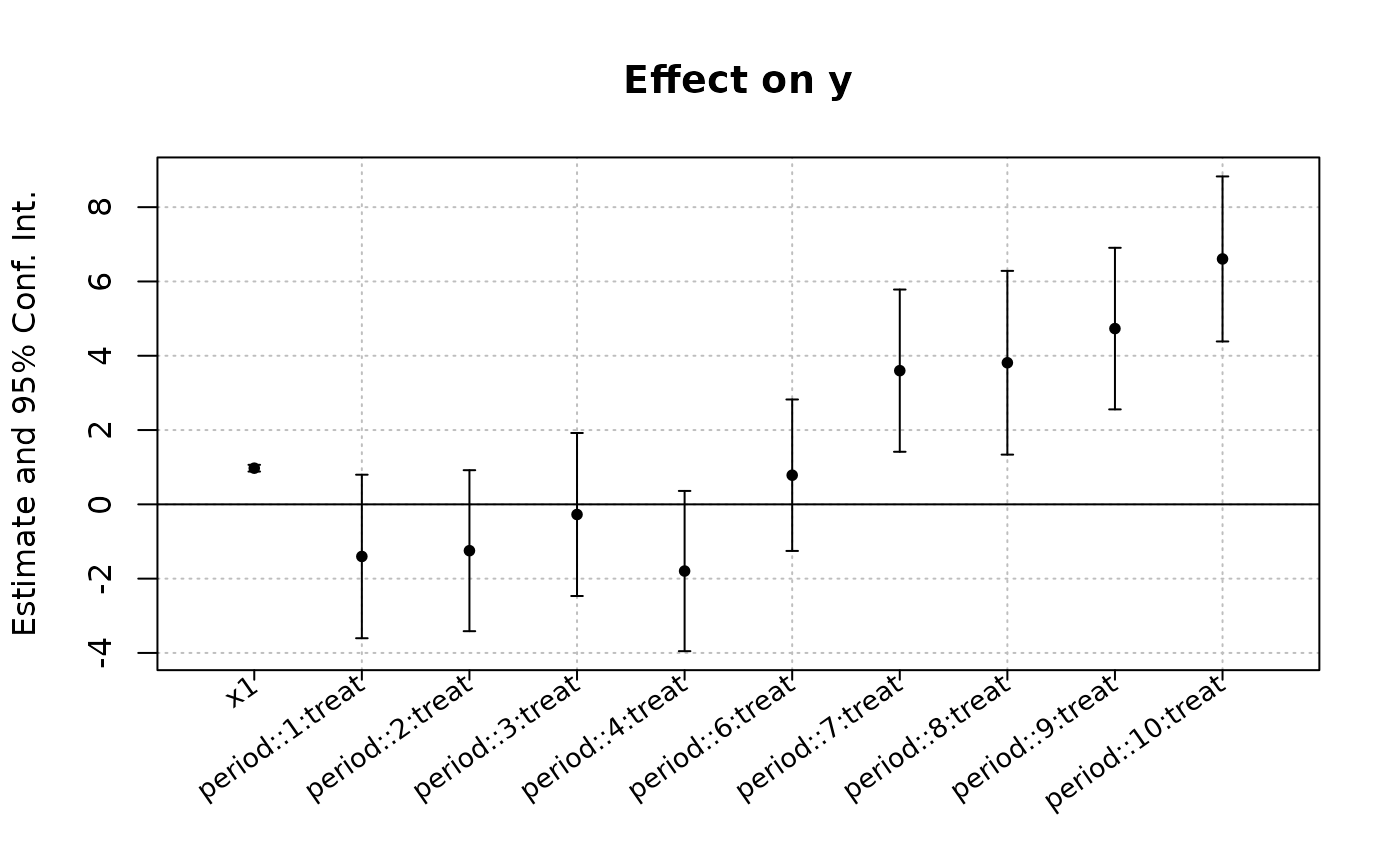
# The graph of the coefficients
coefplot(est_did)
 # The pre-trend test
wald(est_did, "period::[1234]$")
#> [1] NA
# If "period::[1234]$" looks weird to you, check out
# regular expressions: e.g. see ?regex.
# Learn it, you won't regret it!
# The pre-trend test
wald(est_did, "period::[1234]$")
#> [1] NA
# If "period::[1234]$" looks weird to you, check out
# regular expressions: e.g. see ?regex.
# Learn it, you won't regret it!