Kernel smoothing of a matrix of time series
smoothG.RdIt applies the required kernel smoothing to the moment function in order for the GEL estimator to be valid. It is used by the gel function.
Arguments
- x
a \(n\times q\) matrix of time series, where n is the sample size.
- bw
The method to compute the bandwidth parameter. By default, it uses the bandwidth proposed by Andrews(1991). As an alternative, we can choose bw=bwNeweyWest (without "") which is proposed by Newey-West(1996).
- prewhite
logical or integer. Should the estimating functions be prewhitened? If
TRUEor greater than 0 a VAR model of orderas.integer(prewhite)is fitted viaarwith method"ols"anddemean = FALSE.- ar.method
character. The
methodargument passed toarfor prewhitening.- weights
The smoothing weights can be computed by
weightsAndrewsof it can be provided manually. If provided, it has to be a \(r\times 1\)vector (see details).- approx
a character specifying the approximation method if the bandwidth has to be chosen by
bwAndrews.- tol
numeric. Weights that exceed
tolare used for computing the covariance matrix, all other weights are treated as 0.- kernel
The choice of kernel
Details
The sample moment conditions \(\sum_{t=1}^n g(\theta,x_t)\) is replaced by: \(\sum_{t=1}^n g^k(\theta,x_t)\), where \(g^k(\theta,x_t)=\sum_{i=-r}^r k(i) g(\theta,x_{t+i})\), where \(r\) is a truncated parameter that depends on the bandwidth and \(k(i)\) are normalized weights so that they sum to 1.
If the vector of weights is provided, it gives only one side weights. For exemple, if you provide the vector (1,.5,.25), \(k(i)\) will become \((.25,.5,1,.5,.25)/(.25+.5+1+.5+.25) = (.1,.2,.4,.2,.1)\)
Value
smoothx: A \(q \times q\) matrix containing an estimator of the asymptotic variance of \(\sqrt{n} \bar{x}\), where \(\bar{x}\) is \(q\times 1\)vector with typical element \(\bar{x}_i = \frac{1}{n}\sum_{j=1}^nx_{ji}\). This function is called by gel but can also be used by itself.
kern_weights: Vector of weights used for the smoothing.
References
Anatolyev, S. (2005), GMM, GEL, Serial Correlation, and Asymptotic Bias. Econometrica, 73, 983-1002.
Andrews DWK (1991), Heteroskedasticity and Autocorrelation Consistent Covariance Matrix Estimation. Econometrica, 59, 817–858.
Kitamura, Yuichi (1997), Empirical Likelihood Methods With Weakly Dependent Processes. The Annals of Statistics, 25, 2084-2102.
Zeileis A (2006), Object-oriented Computation of Sandwich Estimators. Journal of Statistical Software, 16(9), 1–16. URL doi:10.18637/jss.v016.i09 .
Examples
g <- function(tet, x)
  {
  n <- nrow(x)
  u <- (x[7:n] - tet[1] - tet[2]*x[6:(n-1)] - tet[3]*x[5:(n-2)])
  f <- cbind(u, u*x[4:(n-3)], u*x[3:(n-4)], u*x[2:(n-5)], u*x[1:(n-6)])
  return(f)
  }
n = 500
phi<-c(.2, .7)
thet <- 0.2
sd <- .2
x <- matrix(arima.sim(n = n, list(order = c(2, 0, 1), ar = phi, ma = thet, sd = sd)), ncol = 1)
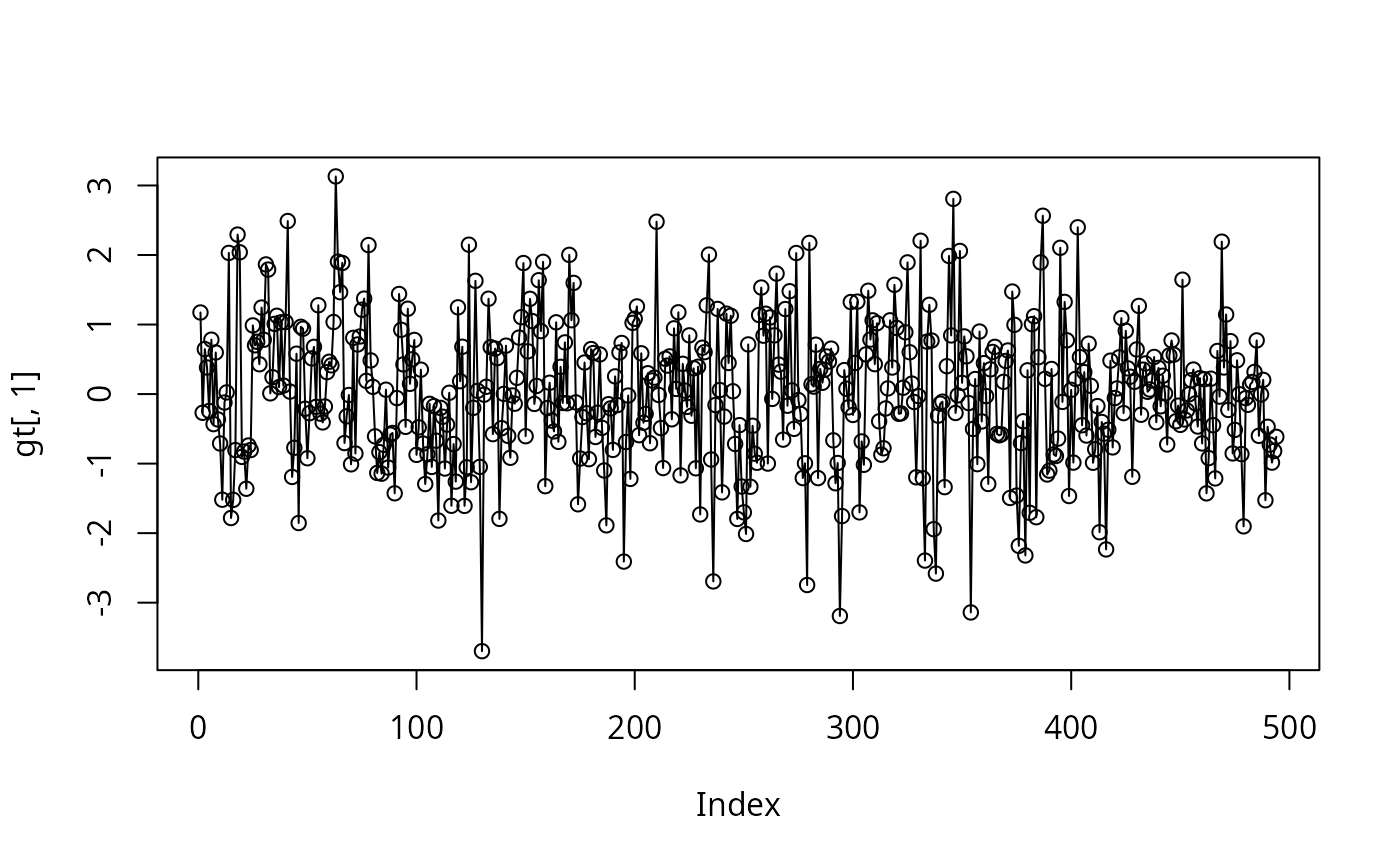
gt <- g(c(0, phi), x)
sgt <- smoothG(gt)$smoothx
plot(gt[,1])
lines(sgt[,1])