Display marginal distributions
marginal.plot.RdDisplay marginal distributions of several variables, which may be numeric and/or categorical, on one plot.
marginal.plot(x,
              data = NULL,
              groups = NULL,
              reorder = !is.table(x),
              plot.points = FALSE,
              ref = TRUE, cut = 0,
              origin = 0, <!-- %ylim = c(0, NA), -->
              xlab = NULL, ylab = NULL,
              type = c("p", if (is.null(groups)) "h"),
              ...,
              subset = TRUE,
              as.table = TRUE,
              subscripts = TRUE,
              default.scales = list(
                relation = "free",
                abbreviate = TRUE, minlength = 5,
                rot = 30, cex = 0.75, tick.number = 3,
                y = list(draw = FALSE)),
             layout = NULL,
             lattice.options = list(
               layout.heights = list(
                 axis.xlab.padding = list(x = 0),
                 xlab.key.padding = list(x = 0))))
Arguments
- x
a data frame or table, or a formula of which the first term is a data frame or table. Otherwise coerced with
as.data.frame.- data
an optional data source in which groups and subset may be be evaluated.
- groups
term, to be evaluated in
data, that is used as a grouping variable.- reorder
whether to reorder factor variables by frequency.
- subset
data subset expression, evaluated in
data.- plot.points, ref, cut
passed to
panel.densityplot.- origin, type
passed to
panel.dotplot.- xlab, ylab, as.table, subscripts
see
xyplot.- default.scales, layout, lattice.options
see
xyplot.- ...
passed to
panel.densityplotand/orpanel.dotplot.
Details
In the case of mixed numeric and categorical variables,
the trellis objects from dotplot() and densityplot()
are merged.
Value
a trellis object.
See also
Examples
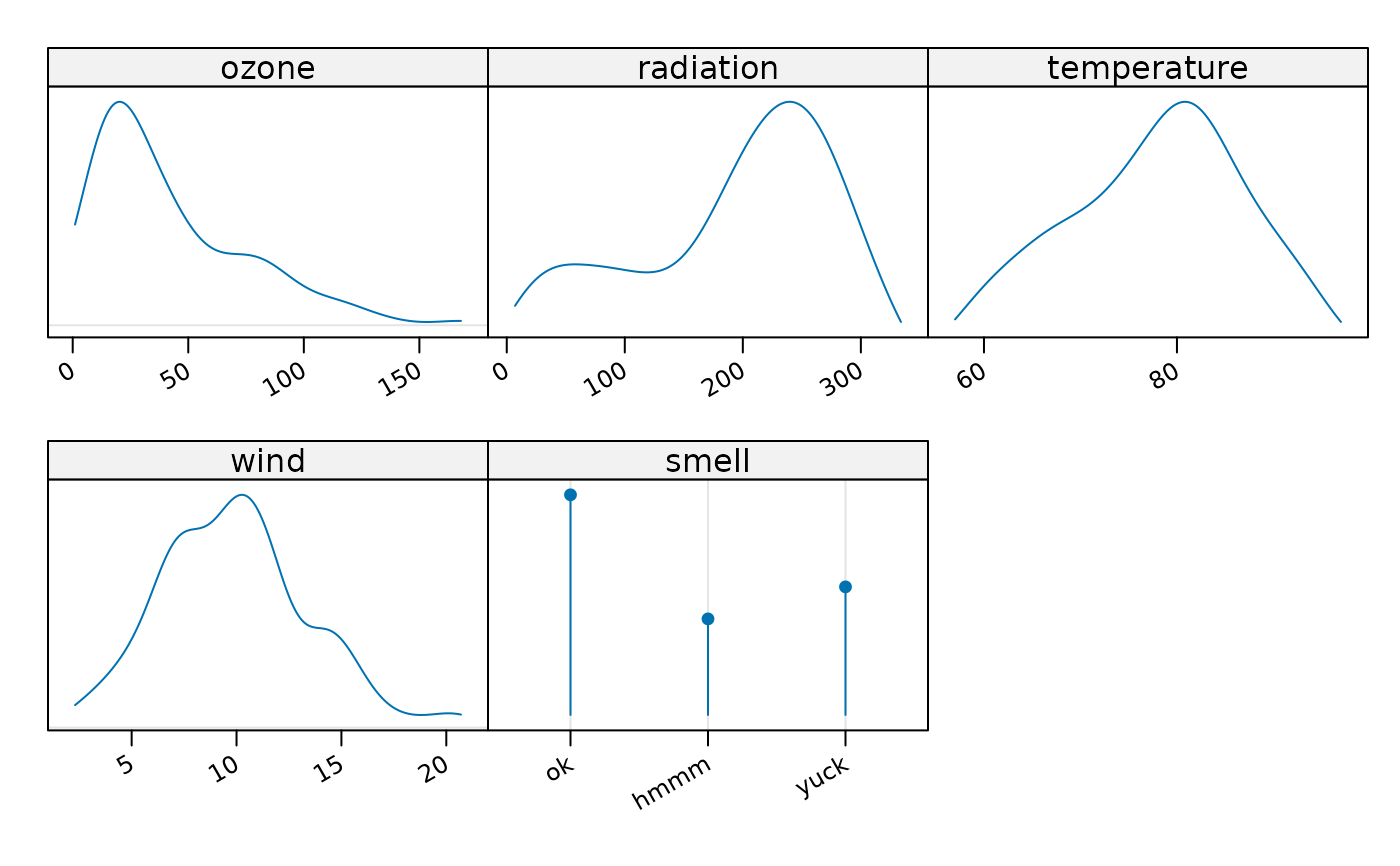
enviro <- environmental
## make an ordered factor (so it will not be reordered)
enviro$smell <- cut(enviro$ozone, breaks = c(0, 30, 50, Inf),
labels = c("ok", "hmmm", "yuck"), ordered = TRUE)
marginal.plot(enviro)
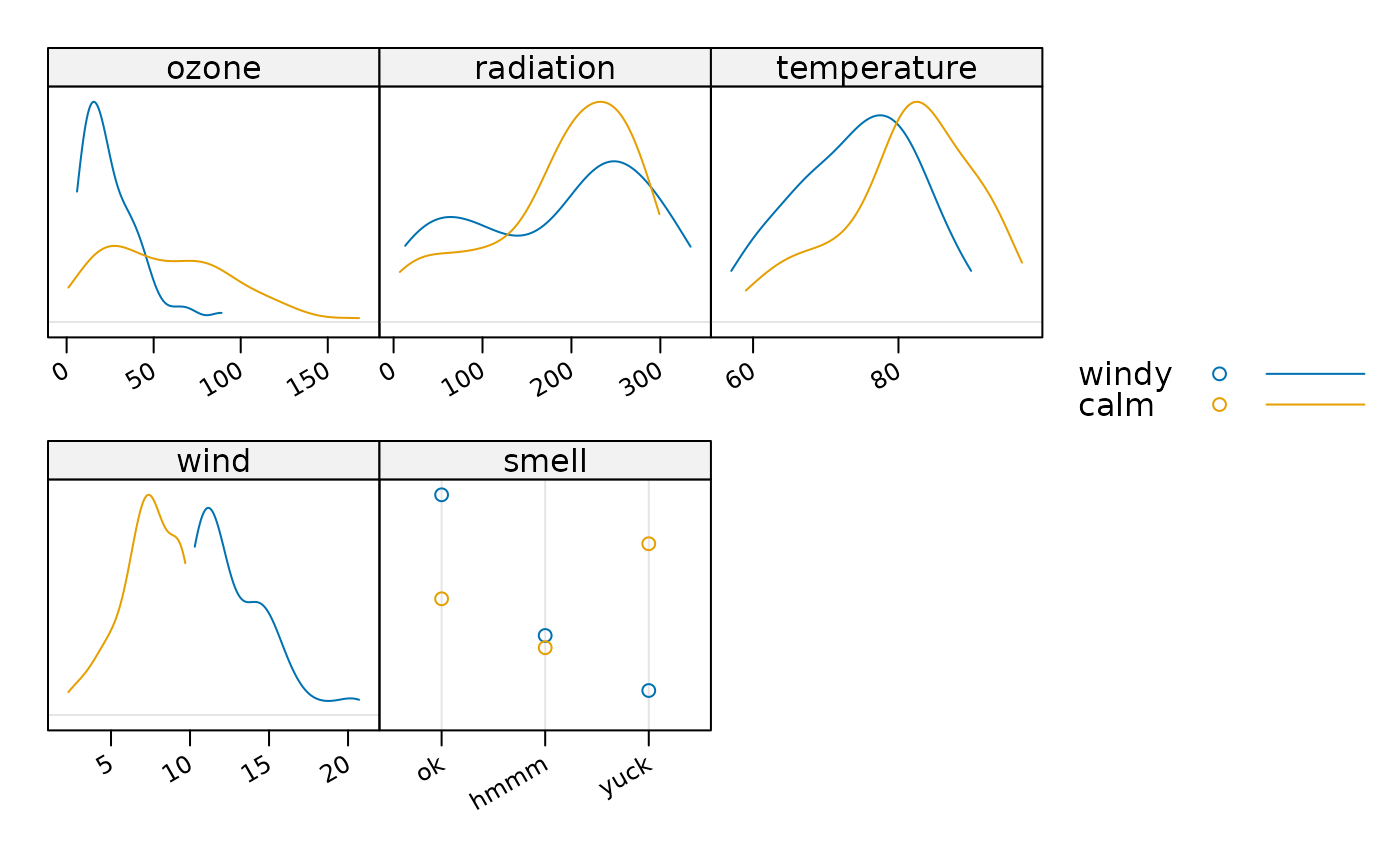
 ## using groups
enviro$is.windy <- factor(enviro$wind > 10,
levels = c(TRUE, FALSE), labels = c("windy", "calm"))
marginal.plot(enviro[,1:5], data = enviro, groups = is.windy,
auto.key = list(lines = TRUE))
## using groups
enviro$is.windy <- factor(enviro$wind > 10,
levels = c(TRUE, FALSE), labels = c("windy", "calm"))
marginal.plot(enviro[,1:5], data = enviro, groups = is.windy,
auto.key = list(lines = TRUE))
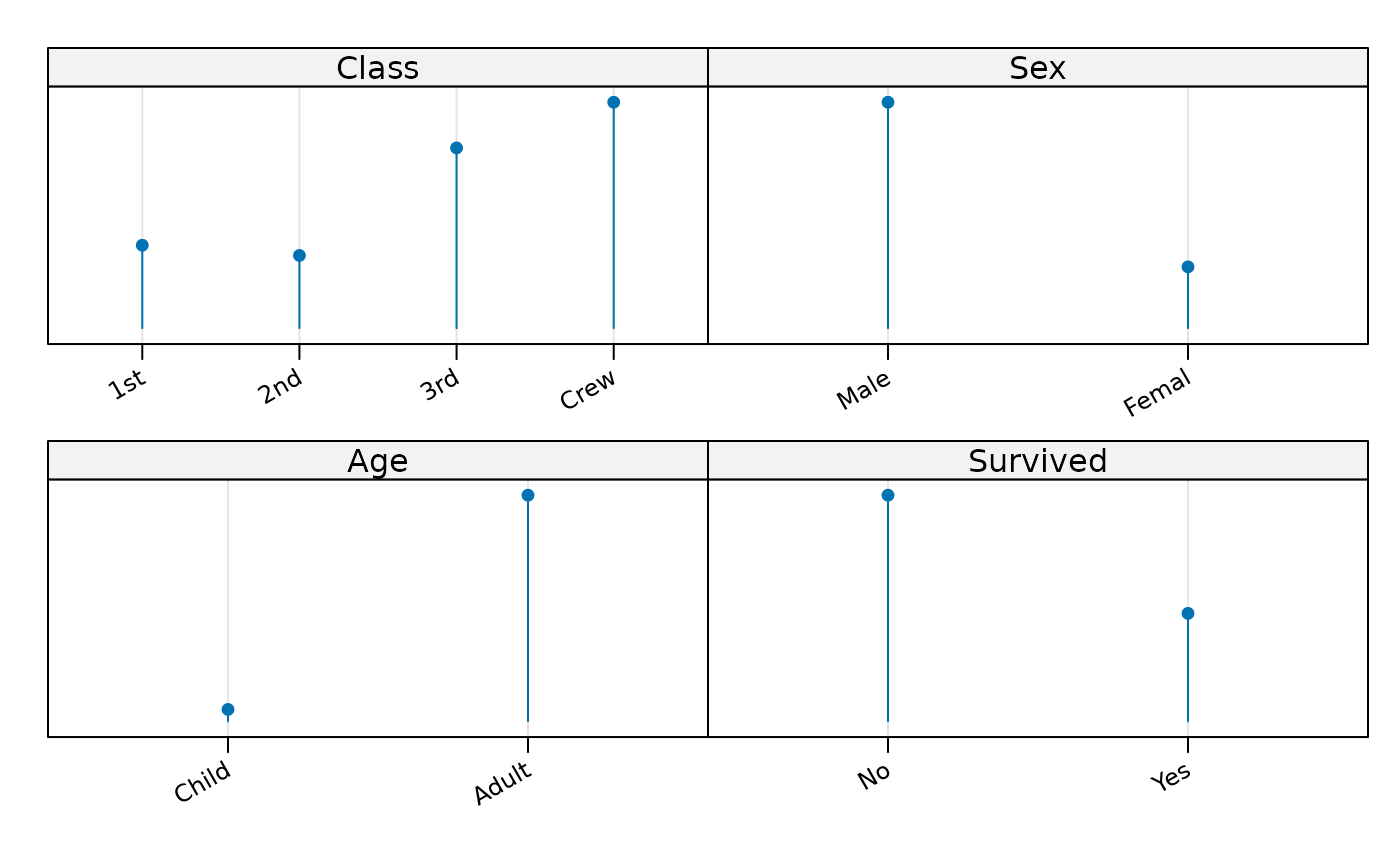
 ## support for tables
marginal.plot(Titanic)
## support for tables
marginal.plot(Titanic)
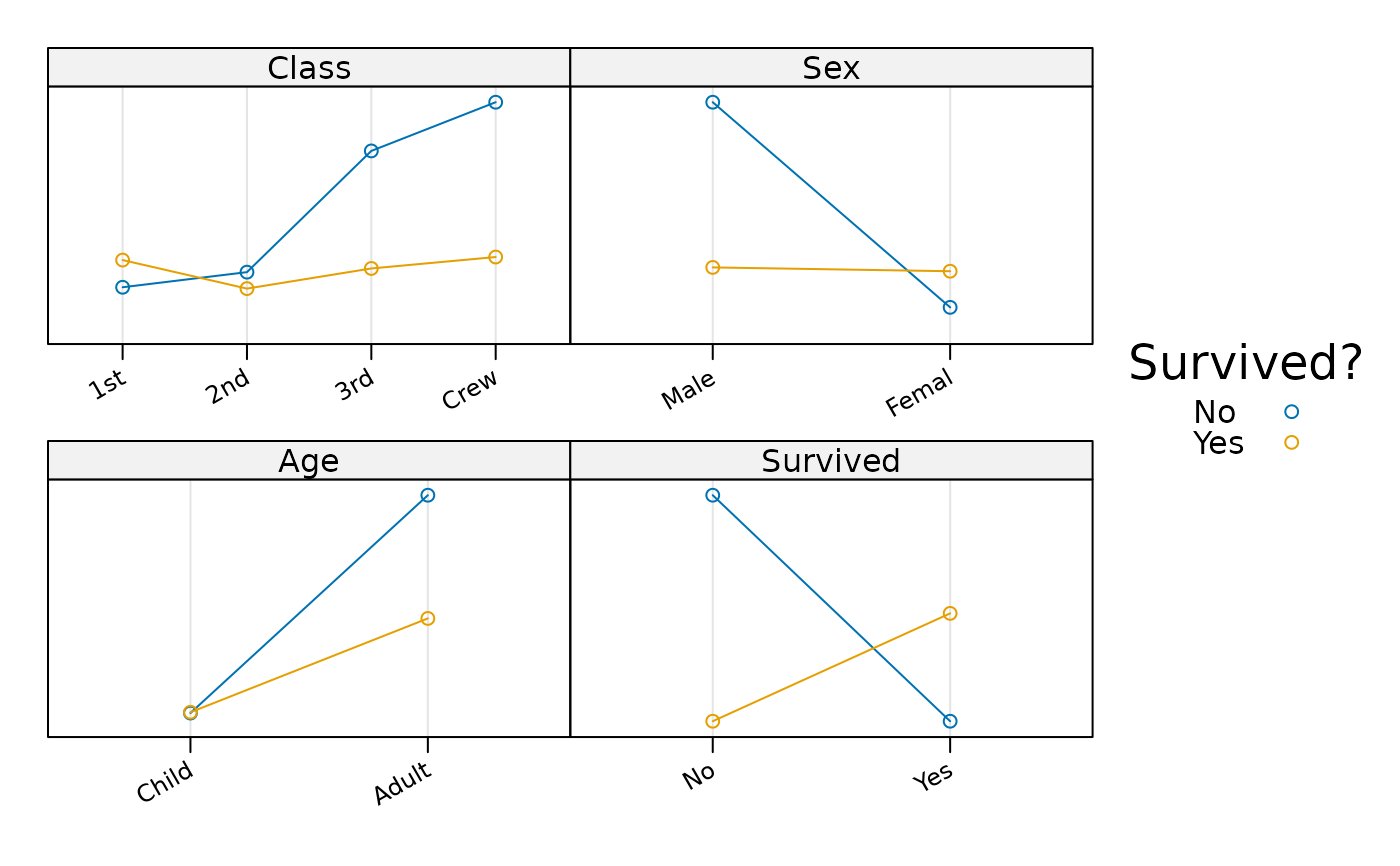
 ## table with groups
marginal.plot(~ Titanic, data = Titanic, groups = Survived,
type = "b", auto.key = list(title = "Survived?"))
## table with groups
marginal.plot(~ Titanic, data = Titanic, groups = Survived,
type = "b", auto.key = list(title = "Survived?"))