Are points inside boundary?
inSide.RdAssesses whether points are inside a boundary. The boundary must enclose the domain, but may include islands.
inSide(bnd,x,y,xname=NULL,yname=NULL)Arguments
- bnd
This should have two equal length columns with names matching whatever is supplied in
xandy. This may contain several sections of boundary separated byNA. Alternativelybndmay be a list, each element of which contains 2 columns named as above. See below for details.- x
x co-ordinates of points to be tested.
- y
y co-ordinates of points to be tested.
- xname
name of variable in
bndthatxrelates to. Defaults to name of variable supplied asx.- yname
name of variable in
bndthatyrelates to. Defaults to name of variable supplied asy.
Details
Segments of boundary are separated by NAs, or are in separate list elements.
The boundary co-ordinates are taken to define nodes which are joined by straight line segments in
order to create the boundary. Each segment is assumed to
define a closed loop, and the last point in a segment will be assumed to be
joined to the first. Loops must not intersect (no test is made for
this).
The method used is to count how many times a line, in the y-direction from a point, crosses a boundary segment. An odd number of crossings defines an interior point. Hence in geographic applications it would be usual to have an outer boundary loop, possibly with some inner `islands' completely enclosed in the outer loop.
The routine calls compiled C code and operates by an exhaustive search for
each point in x, y.
Value
The function returns a logical array of the same dimension as x and
y. TRUE indicates that the corresponding x, y point lies
inside the boundary.
Examples
require(mgcv)
m <- 300;n <- 150
xm <- seq(-1,4,length=m);yn <- seq(-1,1,length=n)
x <- rep(xm,n);y <- rep(yn,rep(m,n))
er <- matrix(fs.test(x,y),m,n)
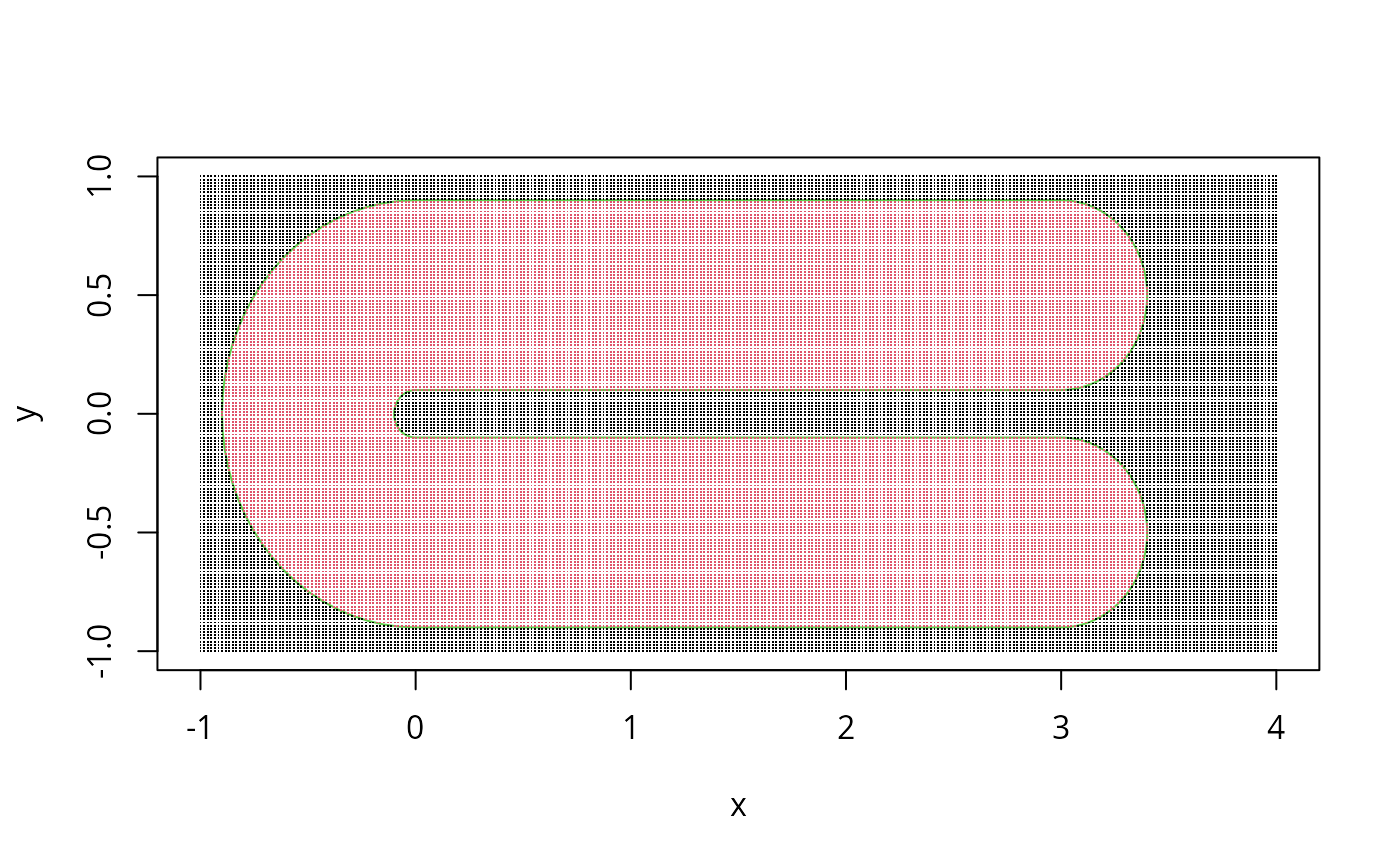
bnd <- fs.boundary()
in.bnd <- inSide(bnd,x,y)
plot(x,y,col=as.numeric(in.bnd)+1,pch=".")
lines(bnd$x,bnd$y,col=3)
points(x,y,col=as.numeric(in.bnd)+1,pch=".")
 ## check boundary details ...
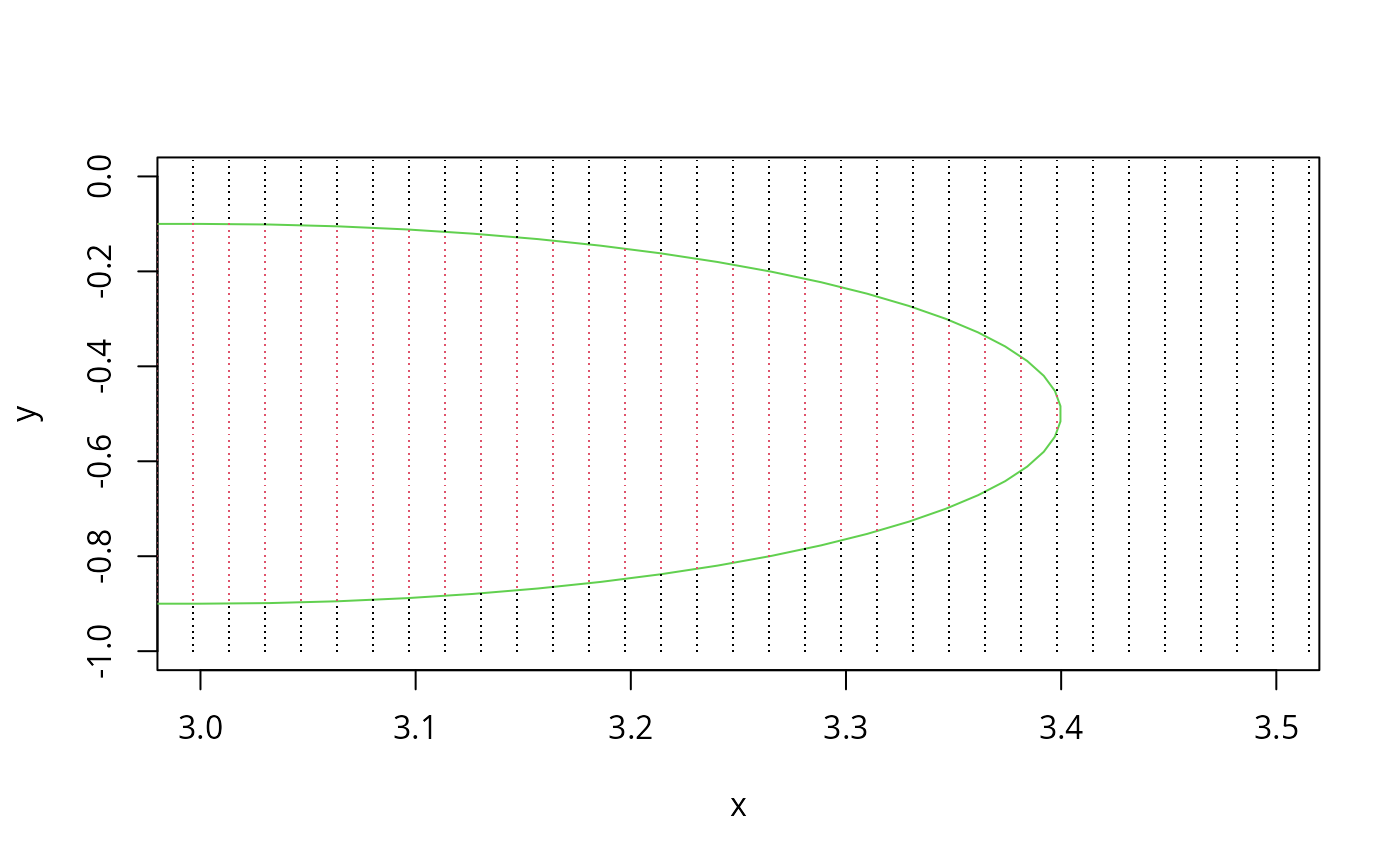
plot(x,y,col=as.numeric(in.bnd)+1,pch=".",ylim=c(-1,0),xlim=c(3,3.5))
lines(bnd$x,bnd$y,col=3)
points(x,y,col=as.numeric(in.bnd)+1,pch=".")
## check boundary details ...
plot(x,y,col=as.numeric(in.bnd)+1,pch=".",ylim=c(-1,0),xlim=c(3,3.5))
lines(bnd$x,bnd$y,col=3)
points(x,y,col=as.numeric(in.bnd)+1,pch=".")
 ## alternatively, give the names of x and y
d <- data.frame(x, y); rm(x, y)
in.bnd2 <- inSide(bnd, d$x, d$y, xname="x", yname="y")
all.equal(in.bnd, in.bnd2)
#> [1] TRUE
## alternatively, give the names of x and y
d <- data.frame(x, y); rm(x, y)
in.bnd2 <- inSide(bnd, d$x, d$y, xname="x", yname="y")
all.equal(in.bnd, in.bnd2)
#> [1] TRUE