Provides an easy mechanism for creating simple "mathematical" functions via a formula interface.
makeFun(object, ...)

# S3 method for class '`function`'
makeFun(
  object,
  ...,
  strict.declaration = TRUE,
  use.environment = TRUE,
  suppress.warnings = FALSE
)

# S3 method for class 'formula'
makeFun(
  object,
  ...,
  strict.declaration = TRUE,
  use.environment = TRUE,
  suppress.warnings = TRUE
)

# S3 method for class 'lm'
makeFun(object, ..., transformation = NULL)

# S3 method for class 'glm'
makeFun(object, ..., type = c("response", "link"), transformation = NULL)

# S3 method for class 'nls'
makeFun(object, ..., transformation = NULL)
Arguments
- object
an object from which to create a function. This should generally be specified without naming.
- ...
additional arguments in the form
var = valthat set default values for the inputs to the function.- strict.declaration
if
TRUE(the default), an error is thrown if default values are given for variables not appearing in theobjectformula.- use.environment
if
TRUE, then variables implicitly defined in theobjectformula can take default values from the environment at the timemakeFunis called. A warning message alerts the user to this situation, unlesssuppress.warningsisTRUE.- suppress.warnings
A logical indicating whether warnings should be suppressed.
- transformation
a function used to transform the response. This can be useful to invert a transformation used on the response when creating the model. If
NULL, an attempt will be made to infer the transformation from the model formula. A few simple transformations (log,log2,sqrt) are recognized. For other transformations,transformationshould be provided explicitly.- type
one of
'response'(default) or'link'specifying scale to be used for value of function returned.
Value
a function
Details
The definition of the function is given by the left side of a two-sided formula or the right side of a one-sided formula. The right side lists at least one of the inputs to the function. The inputs to the function are all variables appearing on either the left or right sides of the formula. Those appearing in the right side will occur in the order specified. Those not appearing in the right side will appear in an unspecified order.
When creating a function from a model created with lm, glm, or nls,
the function produced is a wrapper around the corresponding version of predict.
This means that having variables in the model with names that match arguments of
predict will lead to potentially ambiguous situations and should be avoided.
Examples
f <- makeFun( sin(x^2 * b) ~ x & y & a); f
#> function (x, y, a, b)
#> sin(x^2 * b)
#> <environment: 0x55c1a1f9bfa0>
g <- makeFun( sin(x^2 * b) ~ x & y & a, a = 2 ); g
#> function (x, y, a = 2, b)
#> sin(x^2 * b)
#> <environment: 0x55c1a1f9bfa0>
h <- makeFun( a * sin(x^2 * b) ~ b & y, a = 2, y = 3); h
#> function (b, a = 2, y = 3, x)
#> a * sin(x^2 * b)
#> <environment: 0x55c1a1f9bfa0>
ff <- makeFun(~ a*x^b + y ); ff # one sided formula
#> function (x, y, a, b)
#> a * x^b + y
#> <environment: 0x55c1a173cca0>
gg <- makeFun(cos(a*x^b + y) ~ . ); gg # dummy right-hand side
#> function (x, y, a, b)
#> cos(a * x^b + y)
#> <environment: 0x55c1a2316098>
if (require(mosaicData)) {
model <- lm( log(length) ~ log(width), data = KidsFeet)
f <- makeFun(model, transformation = exp)
f(8.4)
head(KidsFeet, 1)
}
#> name birthmonth birthyear length width sex biggerfoot domhand
#> 1 David 5 88 24.4 8.4 B L R
if (require(mosaicData)) {
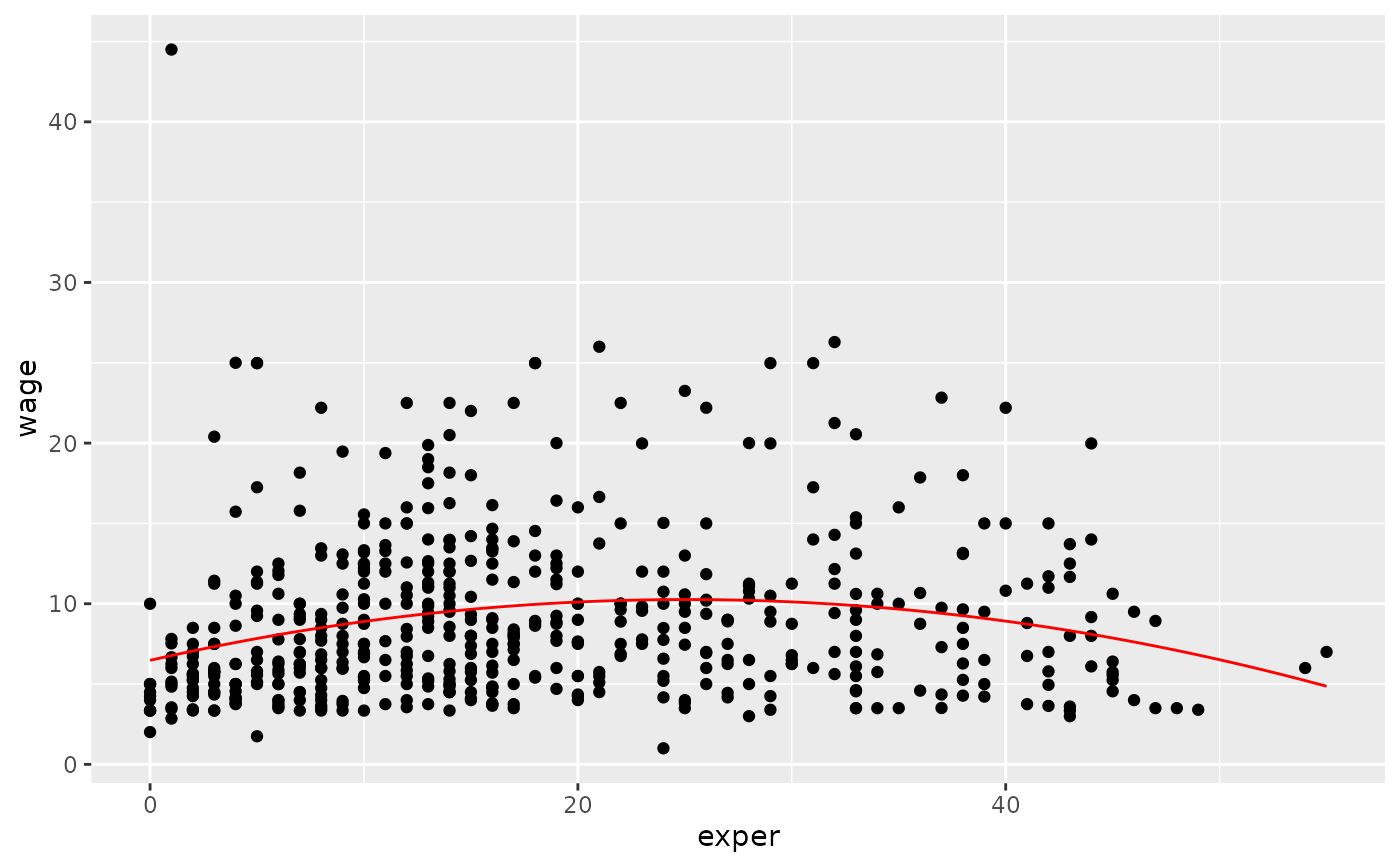
model <- lm(wage ~ poly(exper, degree = 2), data = CPS85)
fit <- makeFun(model)
if (require(ggformula)) {
gf_point(wage ~ exper, data = CPS85) |>
gf_fun(fit(exper) ~ exper, color = "red")
}
}
 if (require(mosaicData)) {
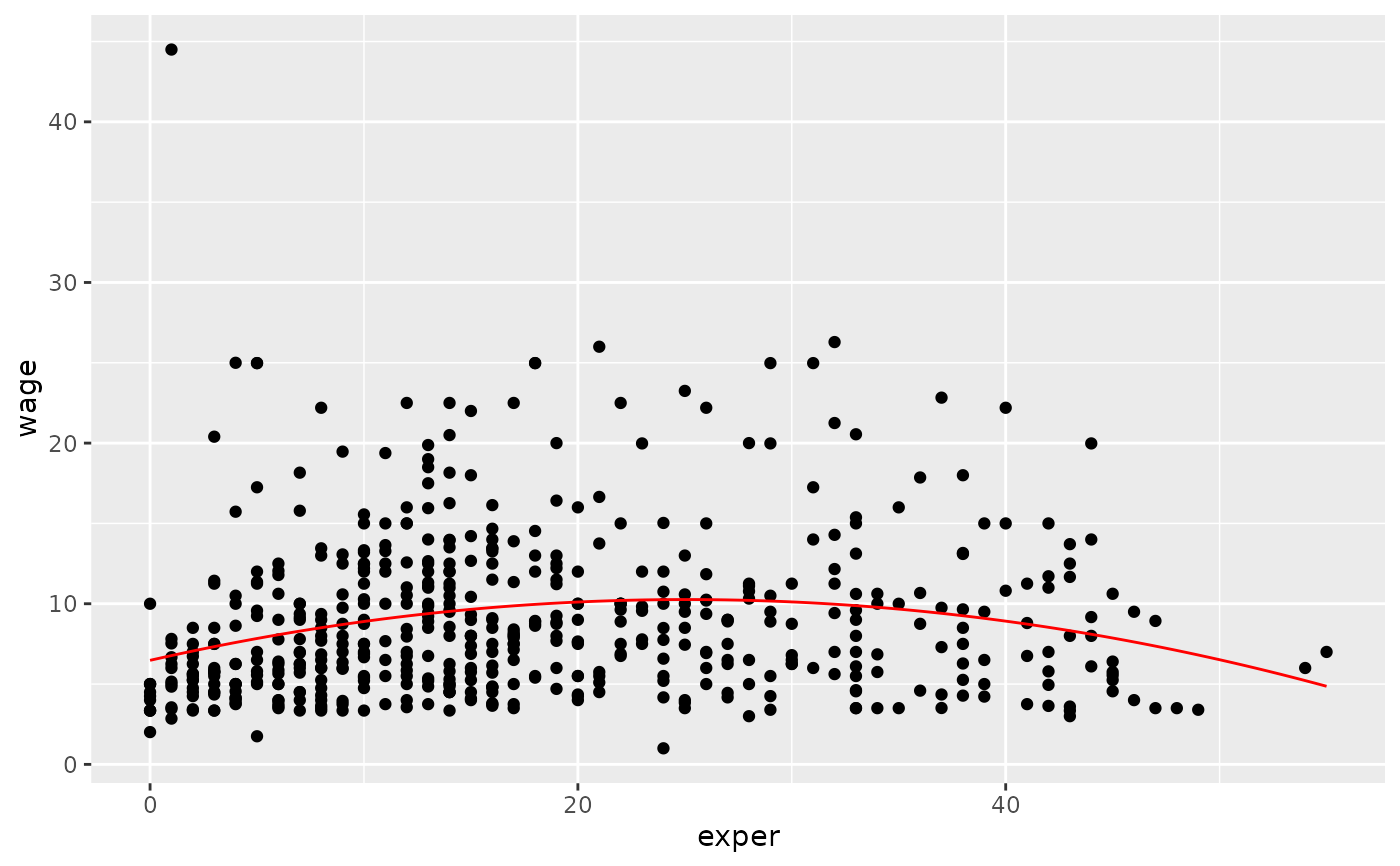
model <- glm(wage ~ poly(exper, degree = 2), data = CPS85, family = gaussian)
fit <- makeFun(model)
if (require(ggformula)) {
gf_jitter(wage ~ exper, data = CPS85) |>
gf_fun(fit(exper) ~ exper, color = "red")
gf_jitter(wage ~ exper, data = CPS85) |>
gf_function(fun = fit, color = "blue")
}
}
if (require(mosaicData)) {
model <- glm(wage ~ poly(exper, degree = 2), data = CPS85, family = gaussian)
fit <- makeFun(model)
if (require(ggformula)) {
gf_jitter(wage ~ exper, data = CPS85) |>
gf_fun(fit(exper) ~ exper, color = "red")
gf_jitter(wage ~ exper, data = CPS85) |>
gf_function(fun = fit, color = "blue")
}
}
 if (require(mosaicData)) {
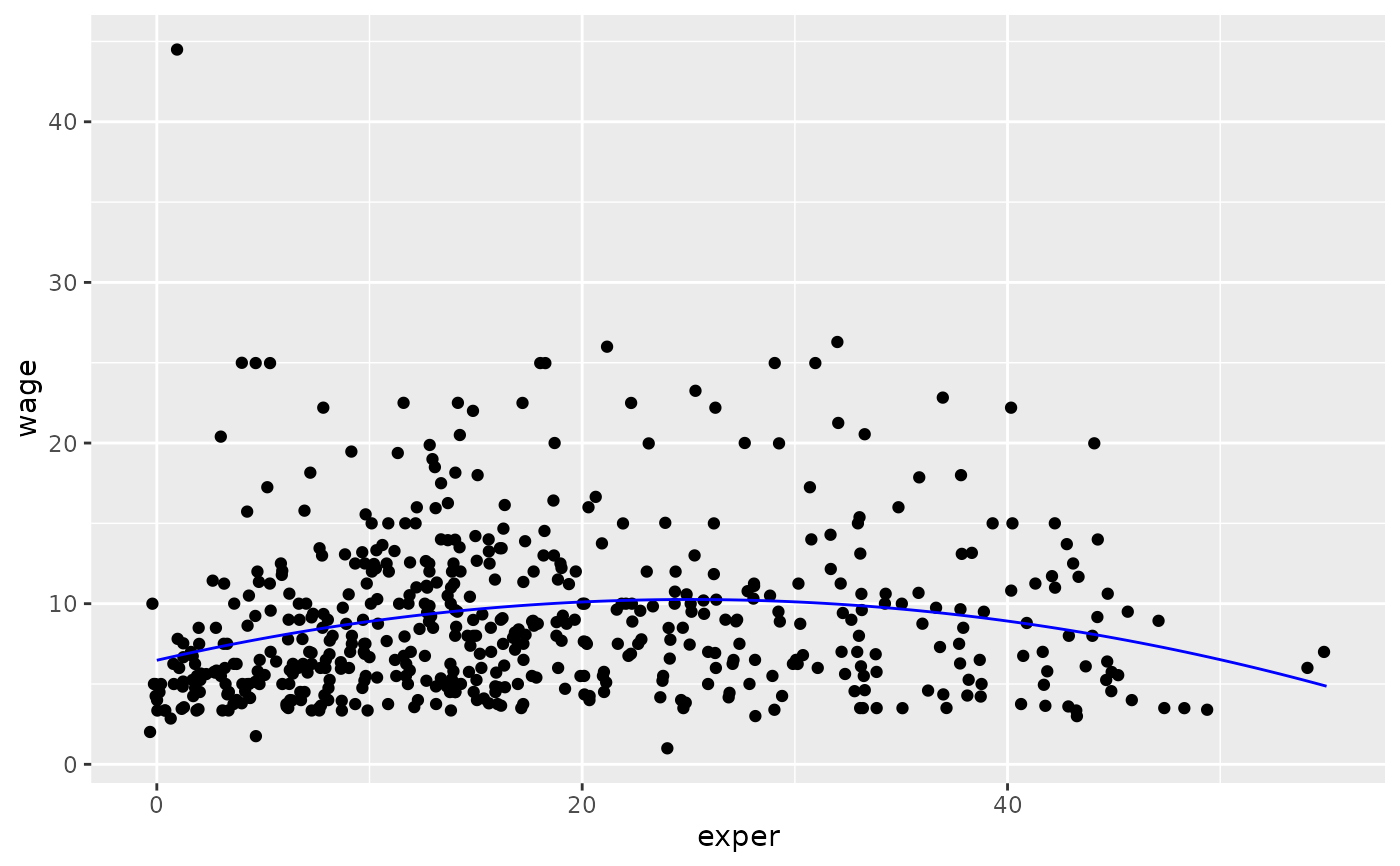
model <- nls( wage ~ A + B * exper + C * exper^2, data = CPS85, start = list(A = 1, B = 1, C = 1) )
fit <- makeFun(model)
if (require(ggformula)) {
gf_point(wage ~ exper, data = CPS85) |>
gf_fun(fit(exper) ~ exper, color = "red")
}
}
if (require(mosaicData)) {
model <- nls( wage ~ A + B * exper + C * exper^2, data = CPS85, start = list(A = 1, B = 1, C = 1) )
fit <- makeFun(model)
if (require(ggformula)) {
gf_point(wage ~ exper, data = CPS85) |>
gf_fun(fit(exper) ~ exper, color = "red")
}
}