Trace AIC and BIC vs. Penalty
pentrace.RdFor an ordinary unpenalized fit from lrm, orm, or ols and for a vector or list of penalties,
fits a series of logistic or linear models using penalized maximum likelihood
estimation, and saves the effective degrees of freedom, Akaike Information
Criterion (\(AIC\)), Schwarz Bayesian Information Criterion (\(BIC\)), and
Hurvich and Tsai's corrected \(AIC\) (\(AIC_c\)). Optionally
pentrace can
use the nlminb function to solve for the optimum penalty factor or
combination of factors penalizing different kinds of terms in the model.
The effective.df function prints the original and effective
degrees of freedom for a penalized fit or for an unpenalized fit and
the best penalization determined from a previous invocation of
pentrace if method="grid" (the default).
The effective d.f. is computed separately for each class of terms in
the model (e.g., interaction, nonlinear).
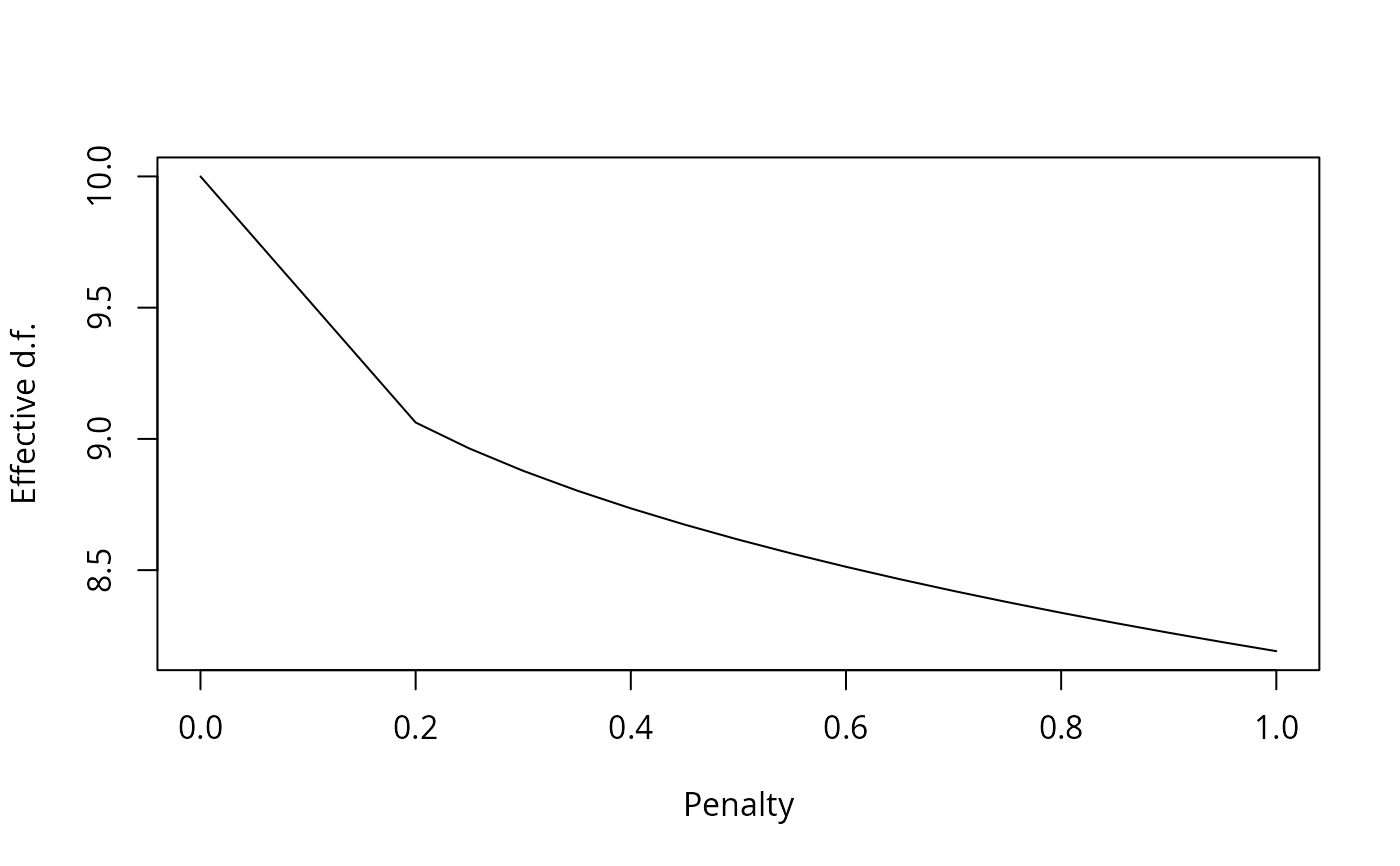
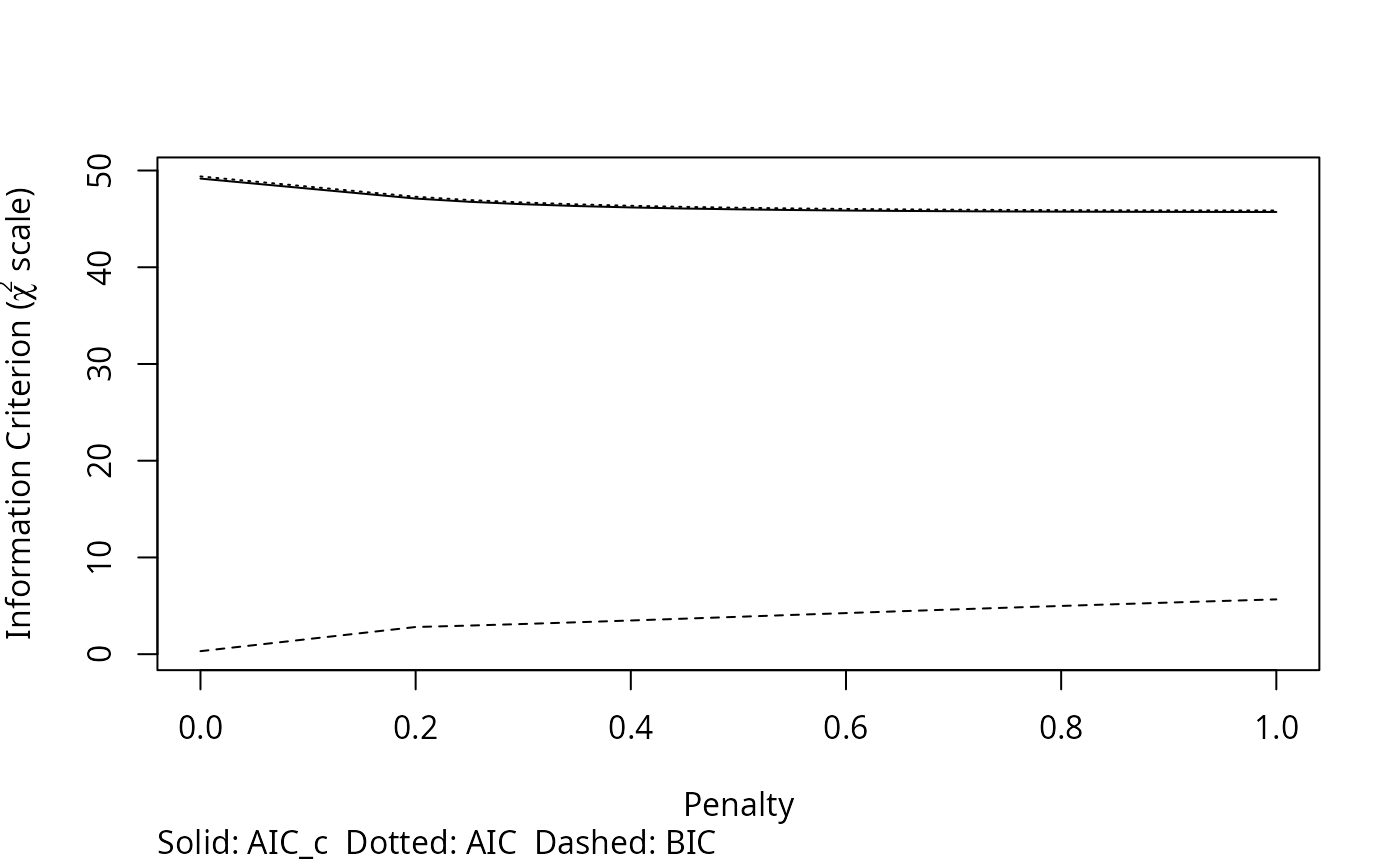
A plot method exists to plot the results, and a print method exists
to print the most pertinent components. Both \(AIC\) and \(BIC\)
may be plotted if
there is only one penalty factor type specified in penalty. Otherwise,
the first two types of penalty factors are plotted, showing only the \(AIC\).
pentrace(fit, penalty, penalty.matrix,
         method=c('grid','optimize'),
         which=c('aic.c','aic','bic'), target.df=NULL,
         fitter, pr=FALSE, tol=.Machine$double.eps,
         keep.coef=FALSE, complex.more=TRUE, verbose=FALSE, maxit=20,
         subset, noaddzero=FALSE, ...)

effective.df(fit, object)

# S3 method for class 'pentrace'
print(x, ...)

# S3 method for class 'pentrace'
plot(x, method=c('points','image'),
     which=c('effective.df','aic','aic.c','bic'), pch=2, add=FALSE,
     ylim, ...)
Arguments
- fit
a result from
lrm,orm, orolswithx=TRUE, y=TRUEand without usingpenaltyorpenalty.matrix(or optionally using penalization in the case ofeffective.df)- penalty
can be a vector or a list. If it is a vector, all types of terms in the model will be penalized by the same amount, specified by elements in
penalty, with a penalty of zero automatically added.penaltycan also be a list in the format documented in thelrmfunction, except that elements of the list can be vectors. Theexpand.gridfunction is invoked bypentraceto generate all possible combinations of penalties. For example, specifyingpenalty=list(simple=1:2, nonlinear=1:3)will generate 6 combinations to try, so that the analyst can attempt to determine whether penalizing more complex terms in the model more than the linear or categorical variable terms will be beneficial. Ifcomplex.more=TRUE, it is assumed that the variables given inpenaltyare listed in order from less complex to more complex. Withmethod="optimize"penaltyspecifies an initial guess for the penalty or penalties. If all term types are to be equally penalized,penaltyshould be a single number, otherwise it should be a list containing single numbers as elements, e.g.,penalty=list(simple=1, nonlinear=2). Experience has shown that the optimization algorithm is more likely to find a reasonable solution when the starting value specified inpenaltyis too large rather than too small.- object
an object returned by
pentrace. Foreffective.df,objectcan be omitted if thefitwas penalized.- penalty.matrix
see
lrm- method
The default is
method="grid"to print various indexes for all combinations of penalty parameters given by the user. Specifymethod="optimize"to havepentraceusenlminbto solve for the combination of penalty parameters that gives the maximum value of the objective named inwhich, or, iftarget.dfis given, to find the combination that yieldstarget.dfeffective total degrees of freedom for the model. Whentarget.dfis specified,methodis set to"optimize"automatically. Forplot.pentracethis parameter applies only if more than one penalty term-type was used. The default is to use open triangles whose sizes are proportional to the ranks of the AICs, plotting the first two penalty factors respectively on the x and y axes. Usemethod="image"to plot an image plot.- which
the objective to maximize for either
method. Default is"aic.c"(corrected AIC). Forplot.pentrace,whichis a vector of names of criteria to show; default is to plot all 4 types, with effective d.f. in its own separate plot- target.df
applies only to
method="optimize". Seemethod.target.dfmakes sense mainly when a single type of penalty factor is specified.- fitter
a fitting function. Default is
lrm.fit(lm.pfitis always used forols).- pr
set to
TRUEto print intermediate results- tol
tolerance for declaring a matrix singular (see
lrm.fit, solvet)- keep.coef
set to
TRUEto store matrix of regression coefficients for all the fits (corresponding to increasing values ofpenalty) in objectCoefficientsin the returned list. Rows correspond to penalties, columns to regression parameters.- complex.more
By default if
penaltyis a list, combinations of penalties for which complex terms are penalized less than less complex terms will be dropped afterexpand.gridis invoked. Setcomplex.more=FALSEto allow more complex terms to be penalized less. Currently this option is ignored formethod="optimize".- verbose
set to
TRUEto print number of intercepts and sum of effective degrees of freedom- maxit
maximum number of iterations to allow in a model fit (default=12). This is passed to the appropriate fitter function with the correct argument name. Increase
maxitif you had to when fitting the original unpenalized model.- subset
a logical or integer vector specifying rows of the design and response matrices to subset in fitting models. This is most useful for bootstrapping
pentraceto see if the best penalty can be estimated with little error so that variation due to selecting the optimal penalty can be safely ignored when bootstrapping standard errors of regression coefficients and measures of predictive accuracy. See an example below.- noaddzero
set to
TRUEto not add an unpenalized model to the list of models to fit- x
a result from
pentrace- pch
used for
method="points"- add
set to
TRUEto add to an existing plot. In that case, the effective d.f. plot is not re-drawn, but the AIC/BIC plot is added to.- ylim
2-vector of y-axis limits for plots other than effective d.f.
- ...
other arguments passed to
plot,lines, orimage, or to the fitter
Value
a list of class "pentrace"
with elements penalty, df, objective, fit, var.adj, diag, results.all, and
optionally Coefficients.
The first 6 elements correspond to the fit that had the best objective
as named in the which argument, from the sequence of fits tried.
Here fit is the fit object from fitter which was a penalized fit,
diag is the diagonal of the matrix used to compute the effective
d.f., and var.adj is Gray (1992) Equation 2.9, which is an improved
covariance matrix for the penalized beta. results.all is a data
frame whose first few variables are the components of penalty and
whose other columns are df, aic, bic, aic.c. results.all thus
contains a summary of results for all fits attempted. When
method="optimize", only two components are returned: penalty and
objective, and the object does not have a class.
References
Gray RJ: Flexible methods for analyzing survival data using splines, with applications to breast cancer prognosis. JASA 87:942–951, 1992.
Hurvich CM, Tsai, CL: Regression and time series model selection in small samples. Biometrika 76:297–307, 1989.
Examples
n <- 1000 # define sample size
set.seed(17) # so can reproduce the results
age <- rnorm(n, 50, 10)
blood.pressure <- rnorm(n, 120, 15)
cholesterol <- rnorm(n, 200, 25)
sex <- factor(sample(c('female','male'), n,TRUE))
# Specify population model for log odds that Y=1
L <- .4*(sex=='male') + .045*(age-50) +
(log(cholesterol - 10)-5.2)*(-2*(sex=='female') + 2*(sex=='male'))
# Simulate binary y to have Prob(y=1) = 1/[1+exp(-L)]
y <- ifelse(runif(n) < plogis(L), 1, 0)
f <- lrm(y ~ blood.pressure + sex * (age + rcs(cholesterol,4)),
x=TRUE, y=TRUE)
p <- pentrace(f, seq(.2,1,by=.05))
plot(p)
 p$diag # may learn something about fractional effective d.f.
#> [1] 1
# for each original parameter
pentrace(f, list(simple=c(0,.2,.4), nonlinear=c(0,.2,.4,.8,1)))
#>
#> Best penalty:
#>
#> simple nonlinear df
#> 0 0 10
#>
#> simple nonlinear df aic bic aic.c
#> 0.0 0.0 10.0000 49.389 0.31126 49.166
#> 0.0 0.2 9.2803 48.315 2.76959 48.122
#> 0.2 0.2 9.0625 47.286 2.81000 47.102
#> 0.0 0.4 8.9605 47.187 3.21069 47.006
#> 0.2 0.4 8.8176 46.673 3.39800 46.498
#> 0.4 0.4 8.7354 46.355 3.48327 46.183
#> 0.0 0.8 8.5771 46.212 4.11762 46.046
#> 0.2 0.8 8.4834 46.092 4.45760 45.930
#> 0.4 0.8 8.4204 46.009 4.68377 45.849
#> 0.0 1.0 8.4391 45.991 4.57354 45.830
#> 0.2 1.0 8.3568 45.949 4.93563 45.791
#> 0.4 1.0 8.2989 45.918 5.18894 45.762
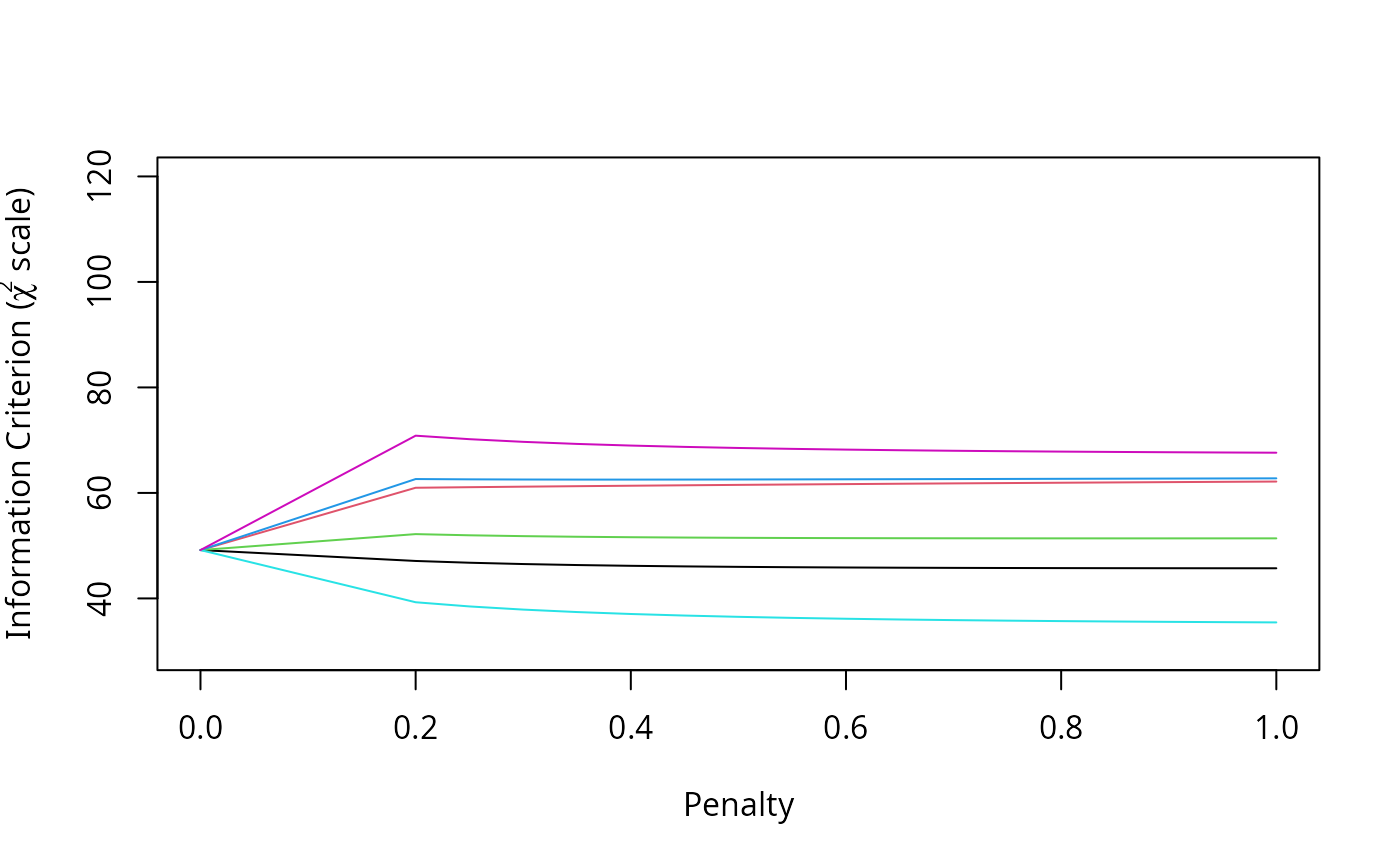
# Bootstrap pentrace 5 times, making a plot of corrected AIC plot with 5 reps
n <- nrow(f$x)
plot(pentrace(f, seq(.2,1,by=.05)), which='aic.c',
col=1, ylim=c(30,120)) #original in black
for(j in 1:5)
plot(pentrace(f, seq(.2,1,by=.05), subset=sample(n,n,TRUE)),
which='aic.c', col=j+1, add=TRUE)
p$diag # may learn something about fractional effective d.f.
#> [1] 1
# for each original parameter
pentrace(f, list(simple=c(0,.2,.4), nonlinear=c(0,.2,.4,.8,1)))
#>
#> Best penalty:
#>
#> simple nonlinear df
#> 0 0 10
#>
#> simple nonlinear df aic bic aic.c
#> 0.0 0.0 10.0000 49.389 0.31126 49.166
#> 0.0 0.2 9.2803 48.315 2.76959 48.122
#> 0.2 0.2 9.0625 47.286 2.81000 47.102
#> 0.0 0.4 8.9605 47.187 3.21069 47.006
#> 0.2 0.4 8.8176 46.673 3.39800 46.498
#> 0.4 0.4 8.7354 46.355 3.48327 46.183
#> 0.0 0.8 8.5771 46.212 4.11762 46.046
#> 0.2 0.8 8.4834 46.092 4.45760 45.930
#> 0.4 0.8 8.4204 46.009 4.68377 45.849
#> 0.0 1.0 8.4391 45.991 4.57354 45.830
#> 0.2 1.0 8.3568 45.949 4.93563 45.791
#> 0.4 1.0 8.2989 45.918 5.18894 45.762
# Bootstrap pentrace 5 times, making a plot of corrected AIC plot with 5 reps
n <- nrow(f$x)
plot(pentrace(f, seq(.2,1,by=.05)), which='aic.c',
col=1, ylim=c(30,120)) #original in black
for(j in 1:5)
plot(pentrace(f, seq(.2,1,by=.05), subset=sample(n,n,TRUE)),
which='aic.c', col=j+1, add=TRUE)
 # Find penalty giving optimum corrected AIC. Initial guess is 1.0
# Not implemented yet
# pentrace(f, 1, method='optimize')
# Find penalty reducing total regression d.f. effectively to 5
# pentrace(f, 1, target.df=5)
# Re-fit with penalty giving best aic.c without differential penalization
f <- update(f, penalty=p$penalty)
effective.df(f)
#>
#> Original and Effective Degrees of Freedom
#>
#> Original Penalized
#> All 10 10
#> Simple Terms 4 4
#> Interaction or Nonlinear 6 6
#> Nonlinear 4 4
#> Interaction 4 4
#> Nonlinear Interaction 2 2
# Find penalty giving optimum corrected AIC. Initial guess is 1.0
# Not implemented yet
# pentrace(f, 1, method='optimize')
# Find penalty reducing total regression d.f. effectively to 5
# pentrace(f, 1, target.df=5)
# Re-fit with penalty giving best aic.c without differential penalization
f <- update(f, penalty=p$penalty)
effective.df(f)
#>
#> Original and Effective Degrees of Freedom
#>
#> Original Penalized
#> All 10 10
#> Simple Terms 4 4
#> Interaction or Nonlinear 6 6
#> Nonlinear 4 4
#> Interaction 4 4
#> Nonlinear Interaction 2 2