Robust Location-Free Scale Estimate More Efficient than MAD
Qn.RdCompute the robust scale estimator \(Q_n\), an efficient alternative to the MAD.
By default, \(Q_n(x_1, \ldots, x_n)\) is the \(k\)-th
order statistic (a quantile) of the choose(n, 2) absolute
differences \(|x_i - x_j|\),
(for \(1 \le i < j \le n\)),
where by default (originally only possible value) \(k = choose(n\%/\% 2 + 1, 2)\)
which is about the first quartile (25% quantile) of these
pairwise differences. See the references for more.
Arguments
- x
numeric vector of observations.
- constant
number by which the result is multiplied; the default achieves consistency for normally distributed data. Note that until Nov. 2010, “thanks” to a typo in the very first papers, a slightly wrong default constant, 2.2219, was used instead of the correct one which is equal to
1 / (sqrt(2) * qnorm(5/8))(as mentioned already on p.1277, after (3.7) in Rousseeuw and Croux (1993)).If you need the old slightly off version for historical reproducibility, you can use
Qn.old().Note that the relative difference is only about 1 in 1000, and that the correction should not affect the finite sample corrections for \(n \le 9\).
- finite.corr
logical indicating if the finite sample bias correction factor should be applied. Defaults to
TRUEunlessconstantis specified. Note the for non-defaultk, the consistencyconstantalready depends onnleading to some finite sample correction, but no simulation-based small-ncorrection factors are available.- na.rm
logical specifying if missing values (
NA) should be removed fromxbefore further computation. If false as by default, and if there areNAs, i.e.,if(anyNA(x)), the result will beNA.- k
integer, typically half of n, specifying the “quantile”, i.e., rather the order statistic that
Qn()should return; for the Qn() proper, this has been hard wired tochoose(n%/%2 +1, 2), i.e., \(\lfloor\frac{n}{2}\rfloor +1\). Choosing a largekis less robust but allows to get non-zero results in case the defaultQn()is zero.- warn.finite.corr
logical indicating if a
warningshould be signalled whenkis non-default, in which case specific small-\(n\) correction is not yet provided.- mu.too
logical indicating if the
median(x)should also be returned fors_Qn().- ...
potentially further arguments for
s_Qn()passed toQn().
Value
Qn() returns a number, the \(Q_n\) robust scale
estimator, scaled to be consistent for \(\sigma^2\) and
i.i.d. Gaussian observations, optionally bias corrected for finite
samples.
s_Qn(x, mu.too=TRUE) returns a length-2 vector with location
(\(\mu\)) and scale; this is typically only useful for
covOGK(*, sigmamu = s_Qn).
Details
As the (default, consistency) constant needed to be corrected, the finite sample correction has been based on a much more extensive simulation, and on a 3rd or 4th degree polynomial model in \(1/n\) for odd or even n, respectively.
References
Rousseeuw, P.J. and Croux, C. (1993) Alternatives to the Median Absolute Deviation, Journal of the American Statistical Association 88, 1273–1283. doi:10.2307/2291267
Christophe Croux and Peter J. Rousseeuw (1992) A class of high-breakdown scale estimators based on subranges , Communications in Statistics - Theory and Methods 21, 1935–1951; doi:10.1080/03610929208830889
Christophe Croux and Peter J. Rousseeuw (1992) Time-Efficient Algorithms for Two Highly Robust Estimators of Scale, Computational Statistics, Vol. 1, ed. Dodge and Whittaker, Physica-Verlag Heidelberg, 411–428; available via Springer Link.
About the typo in the constant:
Christophe Croux (2010)
Private e-mail, Fri Jul 16, w/ Subject
Re: Slight inaccuracy of Qn implementation .......
See also
Examples
set.seed(153)
x <- sort(c(rnorm(80), rt(20, df = 1)))
s_Qn(x, mu.too = TRUE)
#> [1] -0.2154659  1.1766966
Qn(x, finite.corr = FALSE)
#> [1] 1.220186

## A simple pure-R version of Qn() -- slow and memory-rich for large n: O(n^2)
Qn0R <- function(x, k = choose(n %/% 2 + 1, 2)) {
    n <- length(x <- sort(x))
    if(n == 0) return(NA) else if(n == 1) return(0.)
    stopifnot(is.numeric(k), k == as.integer(k), 1 <= k, k <= n*(n-1)/2)
    m <- outer(x,x,"-")# abs not needed as x[] is sorted
    sort(m[lower.tri(m)], partial = k)[k]
}
(Qx1 <- Qn(x, constant=1)) # 0.5498463
#> [1] 0.5498463
## the C-algorithm "rounds" to 'float' single precision ..
stopifnot(all.equal(Qx1, Qn0R(x), tol = 1e-6))


(qn <- Qn(c(1:4, 10, Inf, NA), na.rm=TRUE))
#> [1] 4.075673
stopifnot(is.finite(qn), all.equal(4.075672524, qn, tol=1e-10))

## -- compute for different 'k' :

n <- length(x) # = 100 here
(k0 <- choose(floor(n/2) + 1, 2)) # 51*50/2 == 1275
#> [1] 1275
stopifnot(identical(Qx1, Qn(x, constant=1, k=k0)))
nn2 <- n*(n-1)/2
all.k <- 1:nn2
system.time(Qss <- sapply(all.k, function(k) Qn(x, 1, k=k)))
#>    user  system elapsed
#>   0.098   0.000   0.099
system.time(Qs  <- Qn  (x, 1, k = all.k))
#>    user  system elapsed
#>    0.05    0.00    0.05
system.time(Qs0 <- Qn0R(x,    k = all.k) )
#>    user  system elapsed
#>   0.001   0.000   0.001
stopifnot(exprs = {
   Qs[1]   == min(diff(x))
   Qs[nn2] == diff(range(x))
   all.equal(Qs,  Qss, tol = 1e-15) # even exactly
   all.equal(Qs0, Qs, tol = 1e-7) # see 2.68e-8, as Qn() C-code rounds to (float)
})

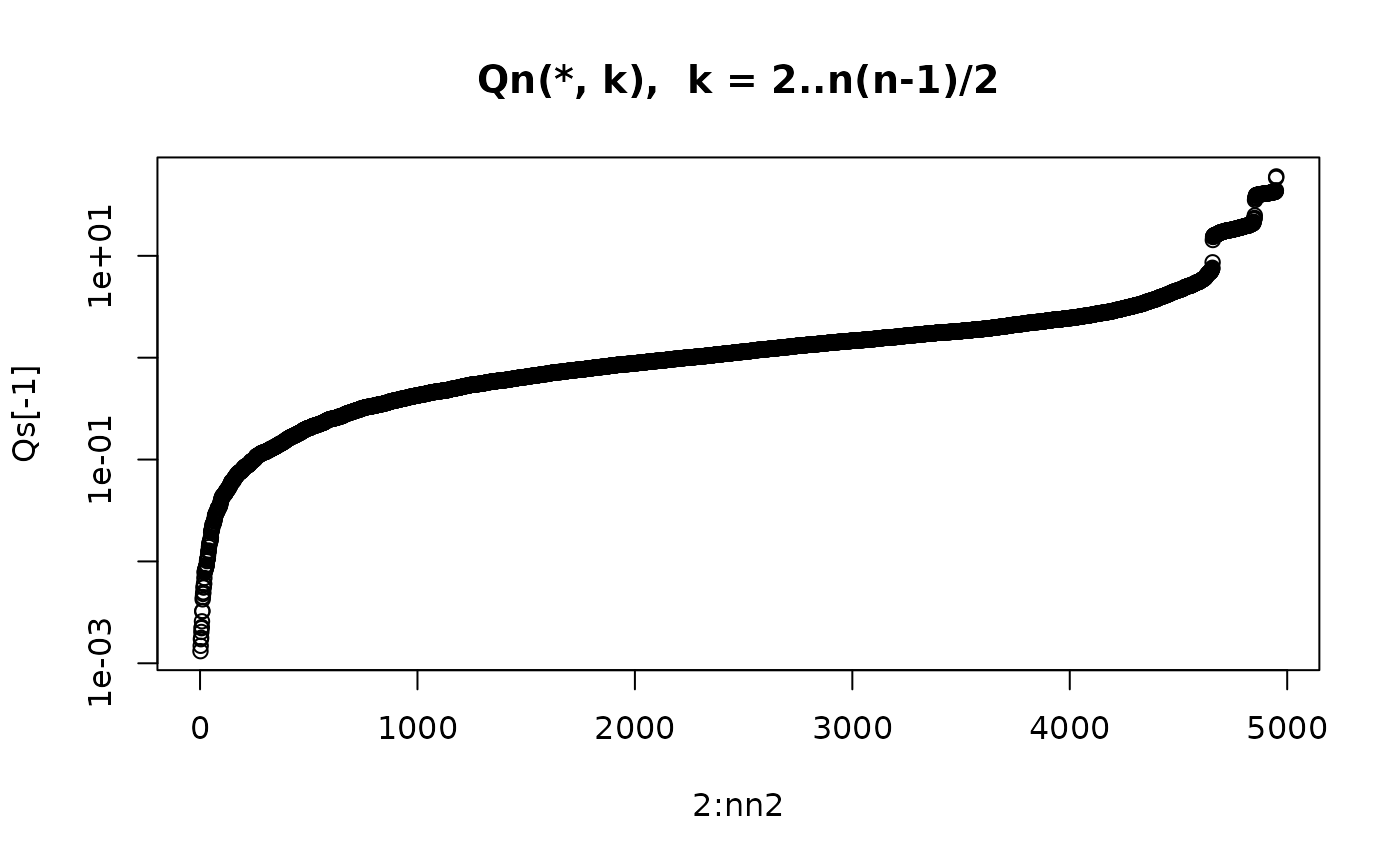
plot(2:nn2, Qs[-1], type="b", log="y", main = "Qn(*, k),  k = 2..n(n-1)/2")