Numerical Derivatives of (x,y) Data via Smoothing Splines
D1D2.RdCompute numerical derivatives of \(f()\) given observations
(x,y), using cubic smoothing splines with GCV, see
smooth.spline. In other words, estimate \(f'()\)
and/or \(f''()\) for the model
$$Y_i = f(x_i) + E_i, \ \ i = 1,\dots n,$$
D1D2(x, y, xout = x, spar.offset = 0.1384, deriv = 1:2, spl.spar = NULL)Arguments
- x,y
numeric vectors of same length, supposedly from a model
y ~ f(x).- xout
abscissa values at which to evaluate the derivatives.
- spar.offset
numeric fudge added to the smoothing parameter, see
spl.parbelow.- deriv
integer in
1:2indicating which derivatives are to be computed.- spl.spar
direct smoothing parameter for
smooth.spline. If it isNULL(as per default), the smoothing parameter used will bespar.offset + sp$spar, wheresp$sparis the GCV estimated smoothing parameter, seesmooth.spline.
Details
It is well known that for derivative estimation, the optimal smoothing
parameter is larger (more smoothing) than for the function itself.
spar.offset is really just a fudge offset added to the
smoothing parameter. Note that in R's implementation of
smooth.spline, spar is really on the
\(\log\lambda\) scale.
When deriv = 1:2 (as per default), both derivatives are
estimated with the same smoothing parameter which is suboptimal
for the single functions individually. Another possibility is to call
D1D2(*, deriv = k) twice with k = 1 and k = 2 and
use a larger smoothing parameter for the second derivative.
Value
a list with several components,
- x
the abscissae values at which the derivative(s) are evaluated.
- D1
if
derivcontains 1, estimated values of \(f'(x_i)\) where \(x_i\) are the values fromxout.- D2
if
derivcontains 2, estimated values of \(f''(x_i)\).- spar
the smoothing parameter used in the (final)
smooth.splinecall.- df
the equivalent degrees of freedom in that
smooth.splinecall.
See also
D2ss which calls smooth.spline twice,
first on y, then on the \(f'(x_i)\) values;
smooth.spline on which it relies completely.
Examples
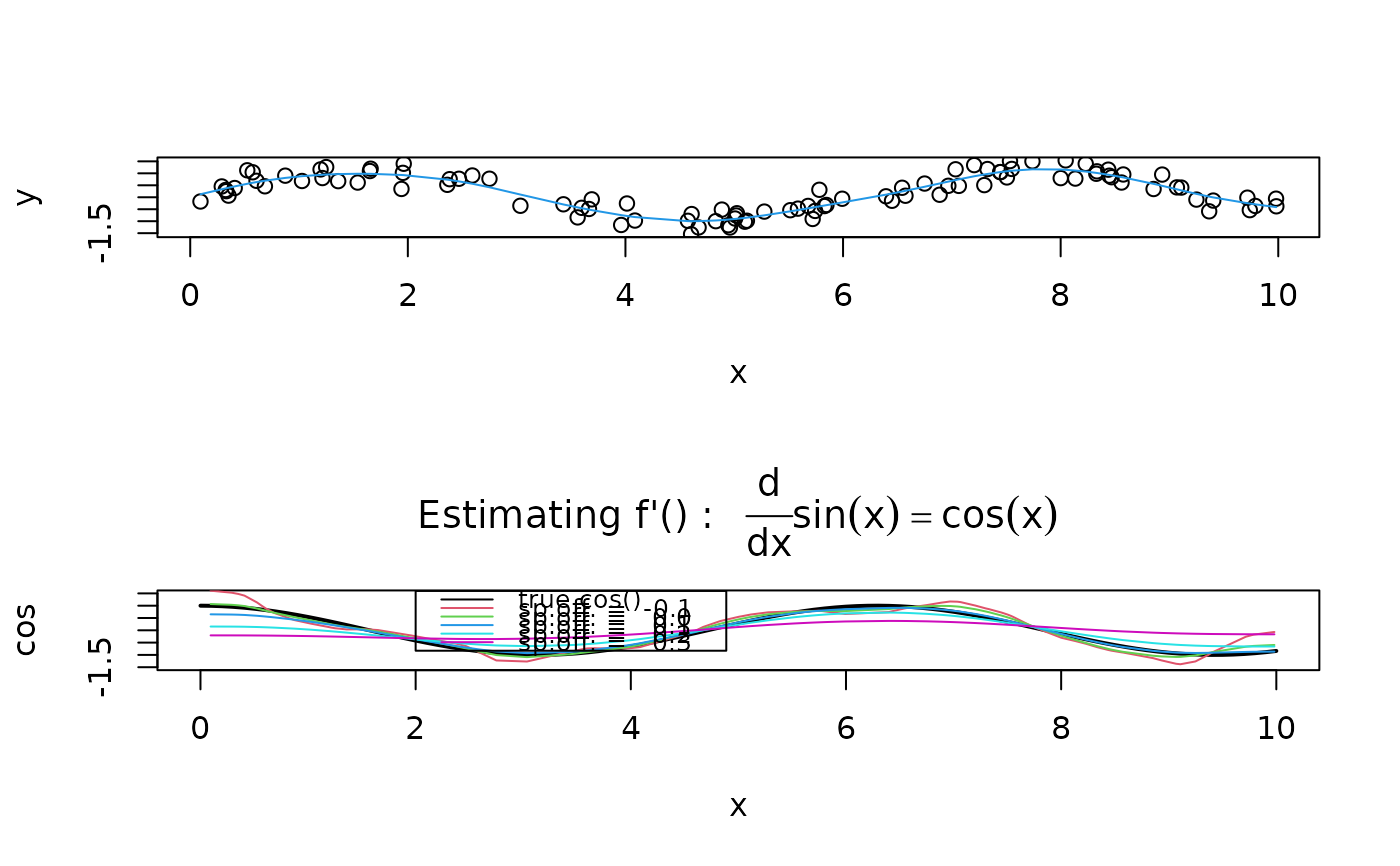
set.seed(8840)
x <- runif(100, 0,10)
y <- sin(x) + rnorm(100)/4
op <- par(mfrow = c(2,1))
plot(x,y)
lines(ss <- smooth.spline(x,y), col = 4)
str(ss[c("df", "spar")])
#> List of 2
#> $ df : num 10.3
#> $ spar: num 0.716
plot(cos, 0, 10, ylim = c(-1.5,1.5), lwd=2,
main = expression("Estimating f'() : "~~ frac(d,dx) * sin(x) == cos(x)))
offs <- c(-0.1, 0, 0.1, 0.2, 0.3)
i <- 1
for(off in offs) {
d12 <- D1D2(x,y, spar.offset = off)
lines(d12$x, d12$D1, col = i <- i+1)
}
legend(2,1.6, c("true cos()",paste("sp.off. = ", format(offs))), lwd=1,
col = 1:(1+length(offs)), cex = 0.8, bg = NA)
 par(op)