Find all Primes Less Than n
primes.RdFind all prime numbers aka ‘primes’ less than \(n\).
Uses an obvious sieve method (and some care), working with
logical and and integers to be quite fast.
primes(n, pSeq = NULL)Arguments
Details
As the function only uses max(n), n can also be a
vector of numbers.
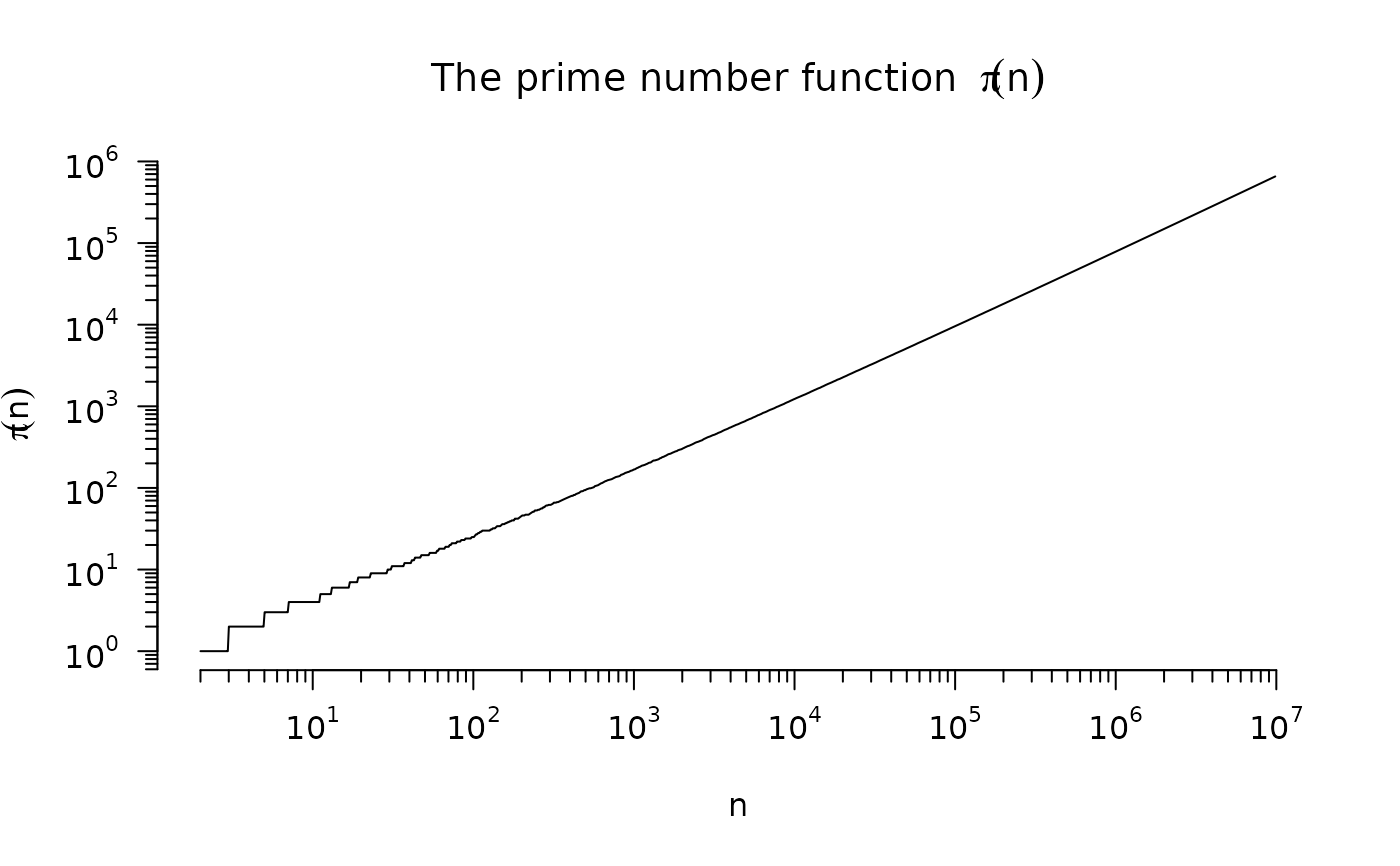
The famous prime number theorem states that \(\pi(n)\), the number of primes below \(n\) is asymptotically \(n / \log(n)\) in the sense that \(\lim_{n \to \infty}{\pi(n) \cdot \log(n) / n \sim 1}\).
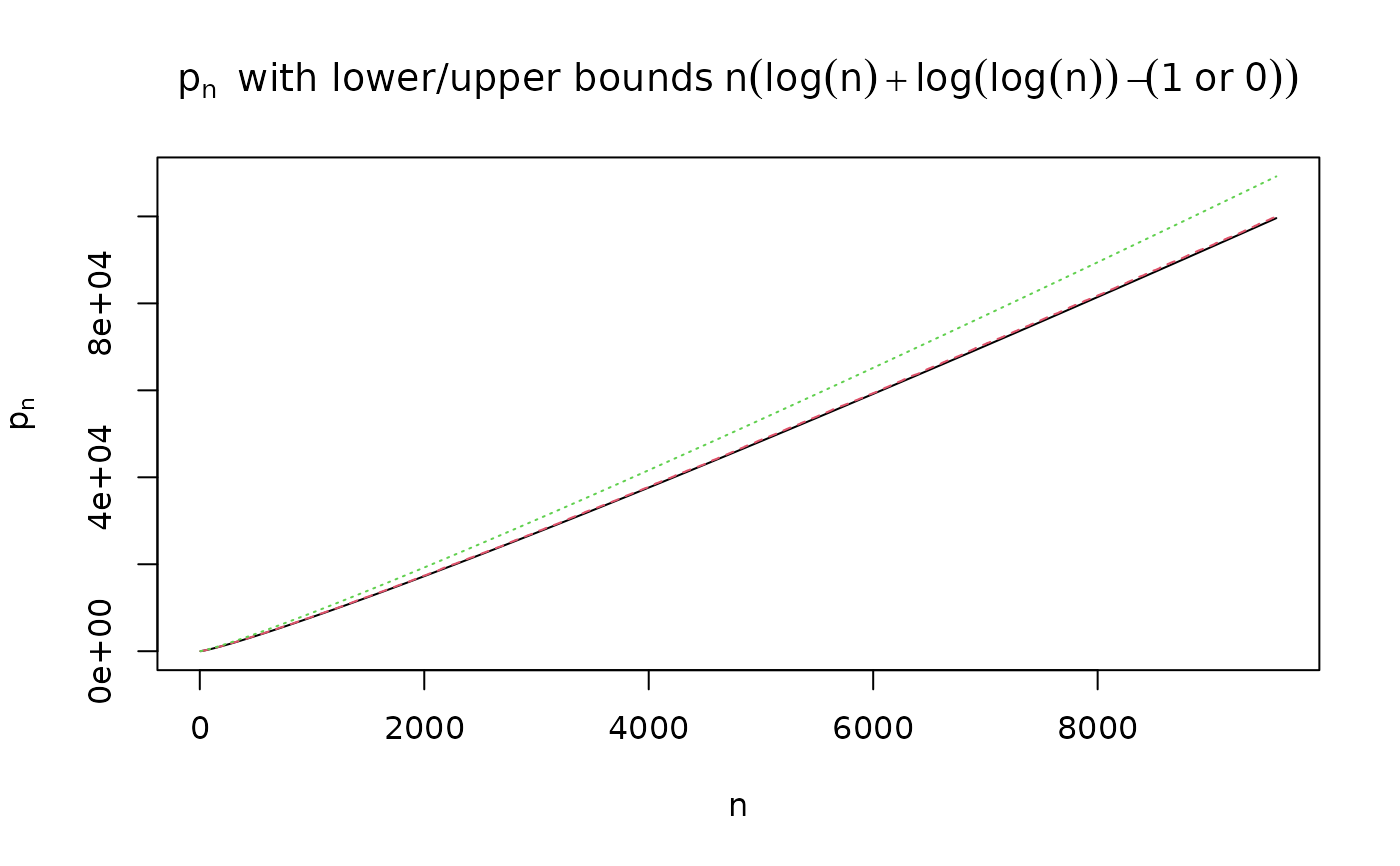
Equivalently, the inverse of \(pi()\), the \(n\)-th prime number \(p_n\) is around \(n \log n\); recent results (Pierre Dusart, 1999), prove that $$\log n + \log\log n - 1 < \frac{p_n}{n} < \log n + \log \log n \quad\mathrm{for } n \ge 6.$$
Value
numeric vector of all prime numbers \(\le n\).
Examples
(p1 <- primes(100))
#> [1] 2 3 5 7 11 13 17 19 23 29 31 37 41 43 47 53 59 61 67 71 73 79 83 89 97
system.time(p1k <- primes(1000)) # still lightning fast
#> user system elapsed
#> 0.002 0.000 0.002
stopifnot(length(p1k) == 168)
# \donttest{
system.time(p.e7 <- primes(1e7)) # still only 0.3 sec (2015 (i7))
#> user system elapsed
#> 0.500 0.012 0.597
stopifnot(length(p.e7) == 664579)
## The famous pi(n) := number of primes <= n:
pi.n <- approxfun(p.e7, seq_along(p.e7), method = "constant")
pi.n(c(10, 100, 1000)) # 4 25 168
#> [1] 4 25 168
plot(pi.n, 2, 1e7, n = 1024, log="xy", axes = FALSE,
xlab = "n", ylab = quote(pi(n)),
main = quote("The prime number function " ~ pi(n)))
eaxis(1); eaxis(2)
 # }
## Exploring p(n) := the n-th prime number ~=~ n * pnn(n), where
## pnn(n) := log n + log log n
pnn <- function(n) { L <- log(n); L + log(L) }
n <- 6:(N <- length(PR <- primes(1e5)))
m.pn <- cbind(l.pn = ceiling(n*(pnn(n)-1)), pn = PR[n], u.pn = floor(n*pnn(n)))
matplot(n, m.pn, type="l", ylab = quote(p[n]), main = quote(p[n] ~~
"with lower/upper bounds" ~ n*(log(n) + log(log(n)) -(1~"or"~0))))
# }
## Exploring p(n) := the n-th prime number ~=~ n * pnn(n), where
## pnn(n) := log n + log log n
pnn <- function(n) { L <- log(n); L + log(L) }
n <- 6:(N <- length(PR <- primes(1e5)))
m.pn <- cbind(l.pn = ceiling(n*(pnn(n)-1)), pn = PR[n], u.pn = floor(n*pnn(n)))
matplot(n, m.pn, type="l", ylab = quote(p[n]), main = quote(p[n] ~~
"with lower/upper bounds" ~ n*(log(n) + log(log(n)) -(1~"or"~0))))
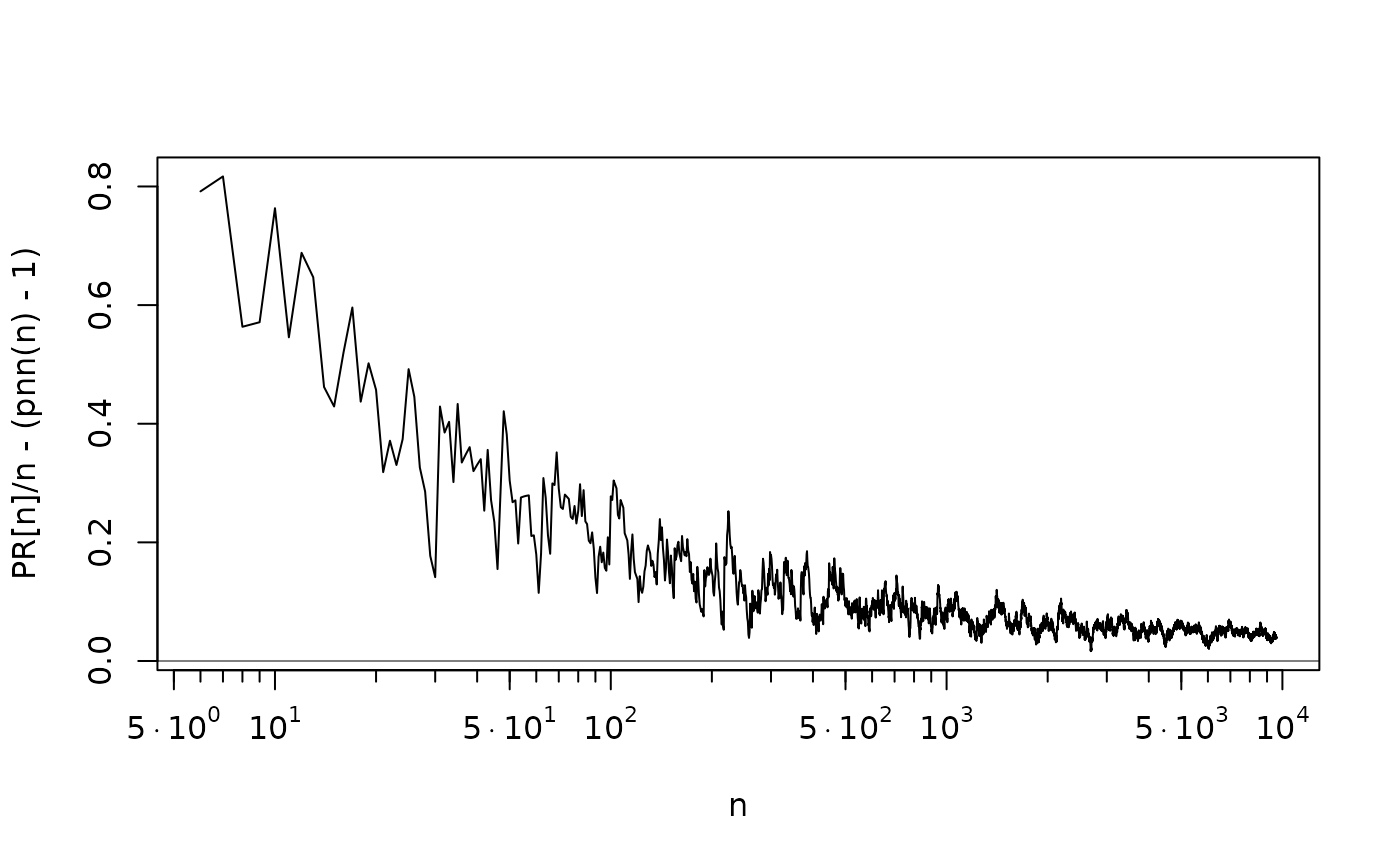
 ## (difference to the lower approximation) / n --> ~ 0.0426 (?) :
plot(n, PR[n]/n - (pnn(n)-1), type = 'l', cex = 1/8, log="x", xaxt="n")
eaxis(1); abline(h=0, col=adjustcolor(1, 0.5))
## (difference to the lower approximation) / n --> ~ 0.0426 (?) :
plot(n, PR[n]/n - (pnn(n)-1), type = 'l', cex = 1/8, log="x", xaxt="n")
eaxis(1); abline(h=0, col=adjustcolor(1, 0.5))