Plot Components + Residuals for Two Factors
compresid2way.RdFor an analysis of variance or regression with (at least) two factors: Plot components + residuals for two factors according to Tukey's “forget-it plot”. Try it!
Arguments
- aov
either an
aovobject with a formula of the formy ~ a + b, whereaandbare factors, or such a formula.- data
data frame containing
aandb.- fac
the two factors used for plotting. Either column numbers or names for argument
data.- label
logical indicating if levels of factors should be shown in the plot.
- numlabel
logical indicating if effects of factors will be shown in the plot.
- xlab,ylab,main
the usual
titlecomponents, here with a non-trivial default constructed fromaovand the component factors used.- col,lty,pch
colors, line types, plotting characters to be used for plotting [1] positive residuals, [2] negative residuals, [3] grid, [4] labels. If
pchis sufficiently long, it will be used as the list of individual symbols for plotting the y values.
Details
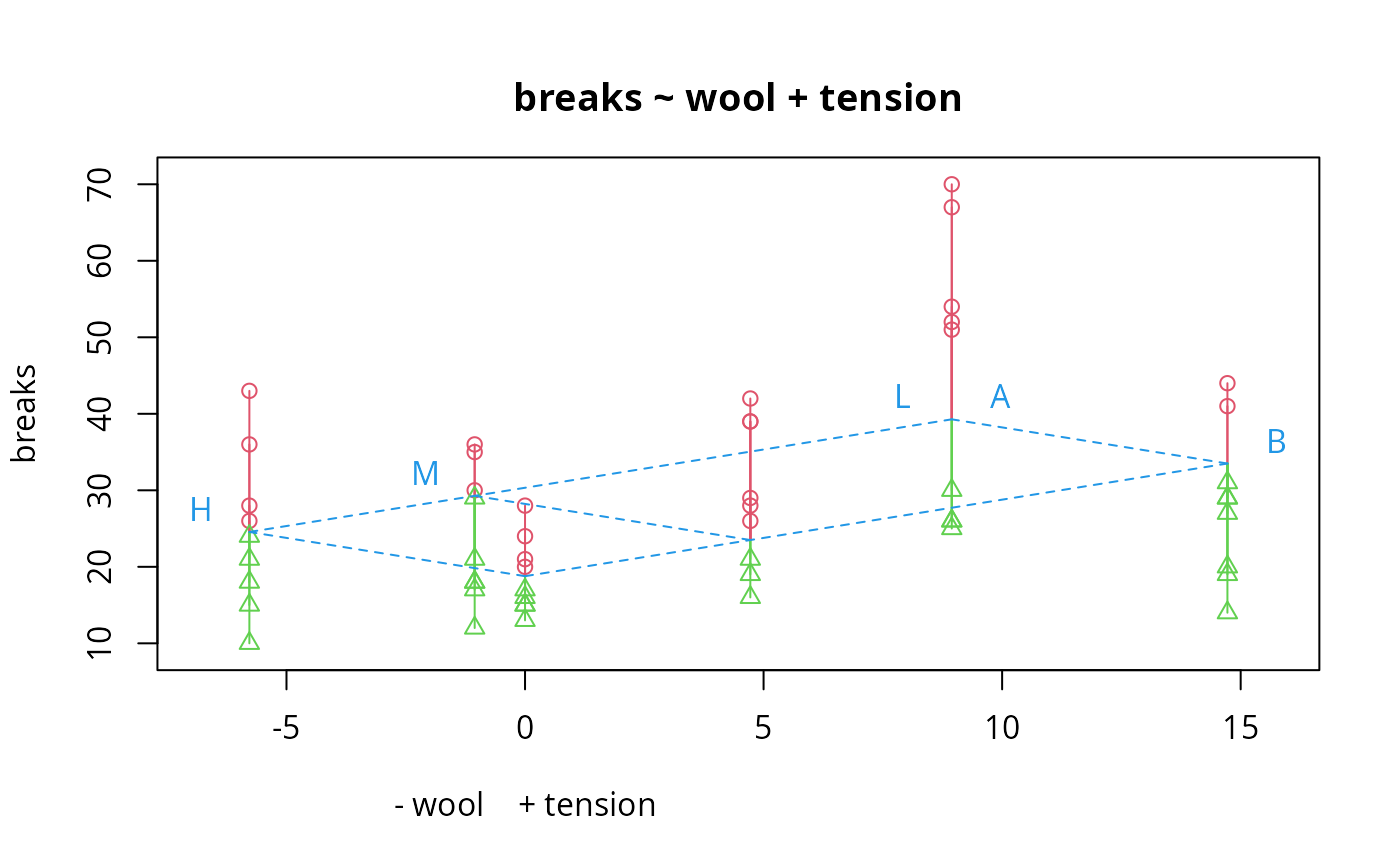
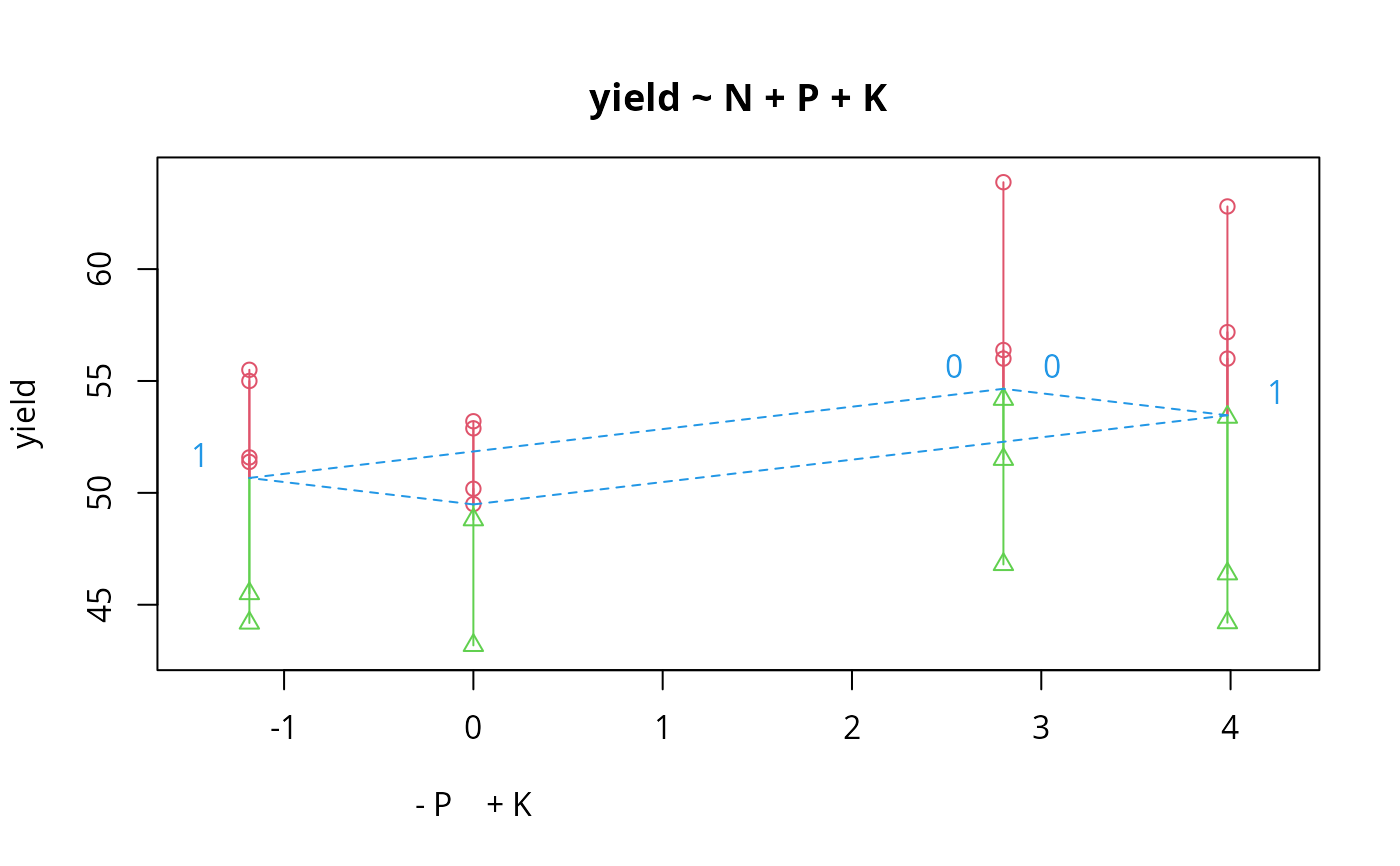
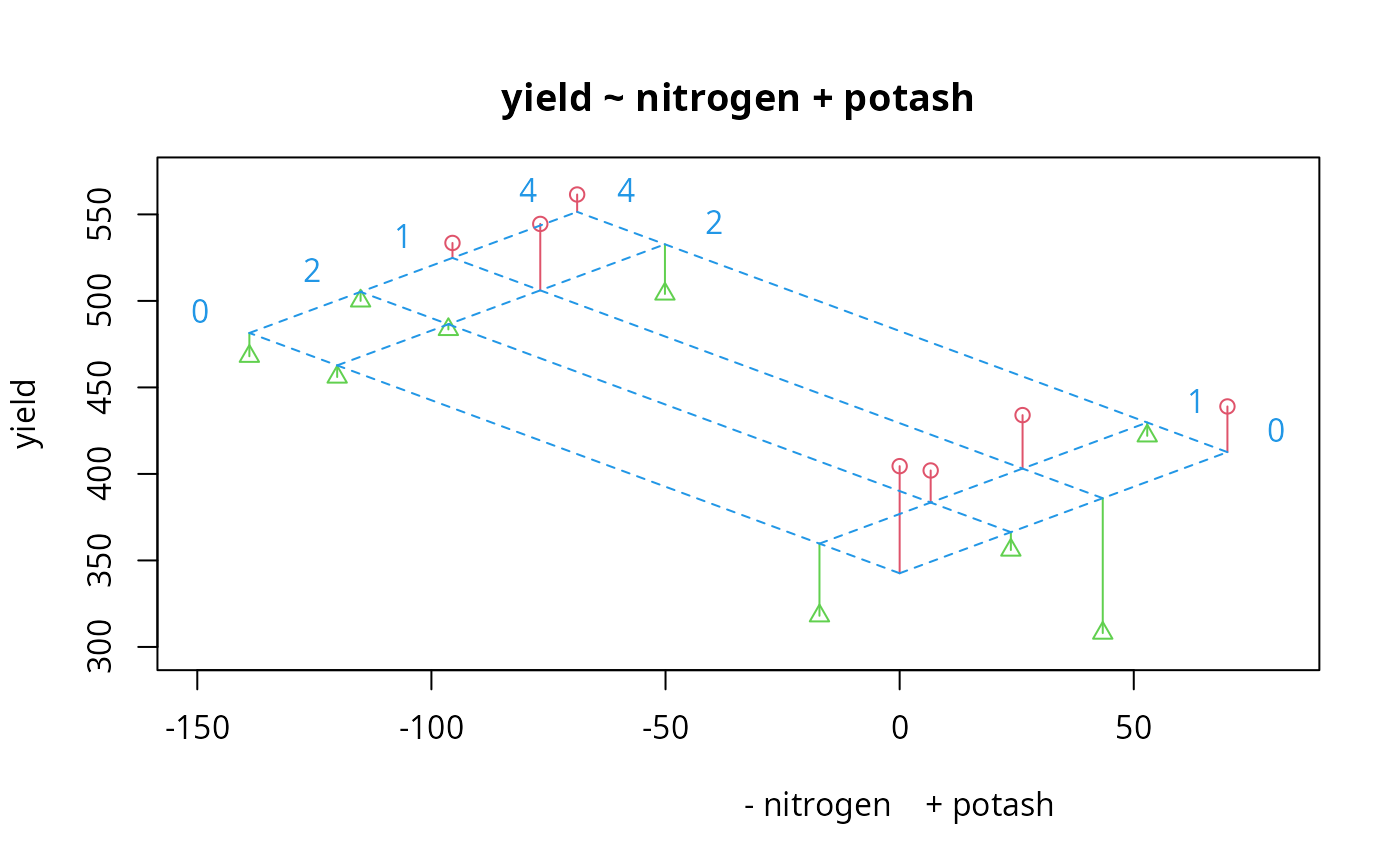
For a two-way analysis of variance, the plot shows the additive components of the fits for the two factors by the intersections of a grid, along with the residuals. The observed values of the target variable are identical to the vertical coordinate.
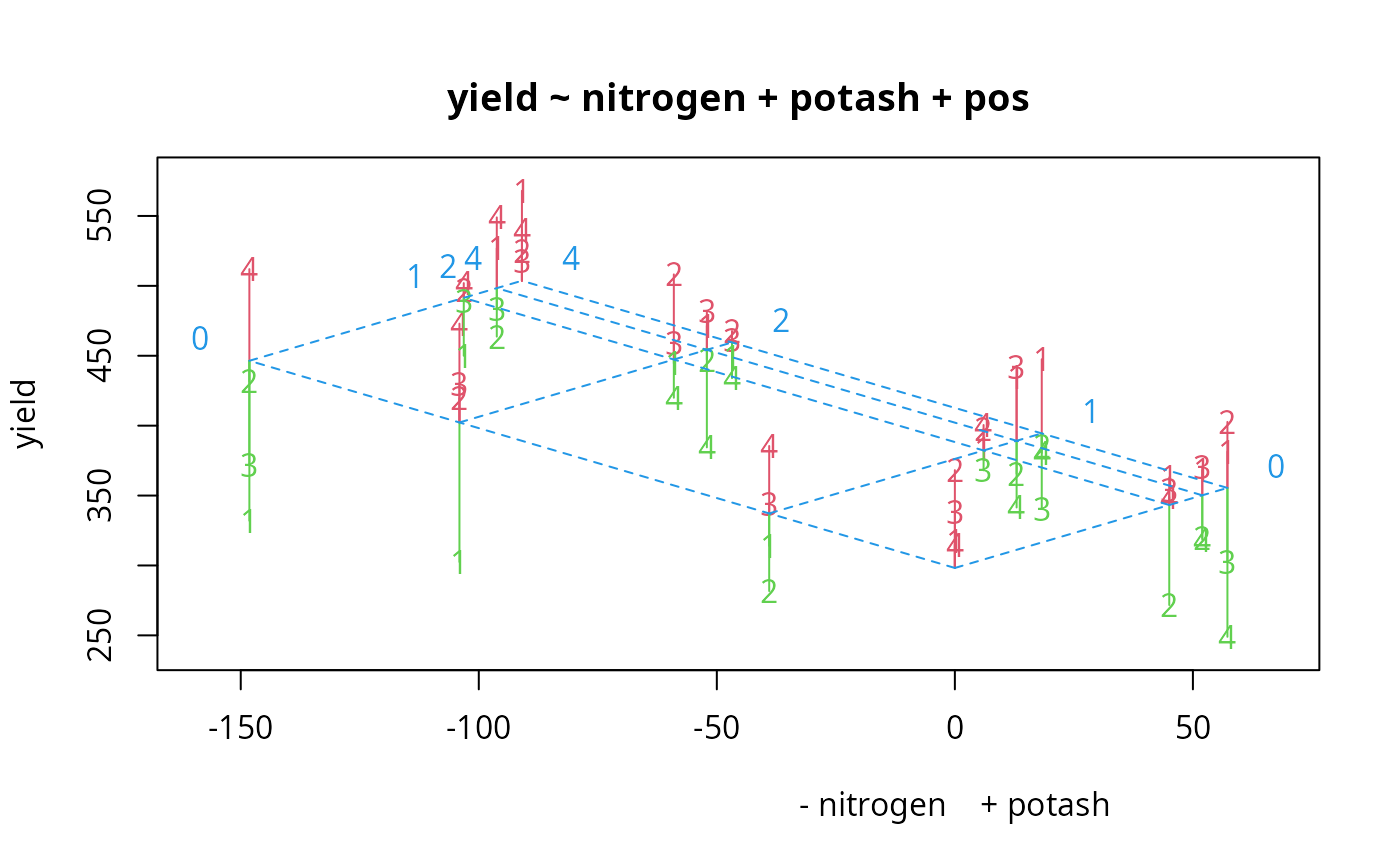
The application of the function has been extended to cover more complicated models. The components of the fit for two factors are shown as just described, and the residuals are added. The result is a “component plus residual” plot for two factors in one display.
Value
Invisibly, a list with components
- compy
data.frame containing the component effects of the two factors, and combined effects plus residual
- coef
coefficients: Intercept and effects of the factors
References
F. Mosteller and J. W. Tukey (1977) Data Analysis and Regression: A Second Course in Statistics. Addison-Wesley, Reading, Mass., p. 176.
John W. Tukey (1977) Exploratory Data Analysis. Addison-Wesley, Reading, Mass., p. 381.
Author
Werner Stahel stahel@stat.math.ethz.ch
Examples
## From Venables and Ripley (2002) p.165.
N <- c(0,1,0,1,1,1,0,0,0,1,1,0,1,1,0,0,1,0,1,0,1,1,0,0)
P <- c(1,1,0,0,0,1,0,1,1,1,0,0,0,1,0,1,1,0,0,1,0,1,1,0)
K <- c(1,0,0,1,0,1,1,0,0,1,0,1,0,1,1,0,0,0,1,1,1,0,1,0)
yield <- c(49.5,62.8,46.8,57.0,59.8,58.5,55.5,56.0,62.8,55.8,69.5,55.0,
62.0,48.8,45.5,44.2,52.0,51.5,49.8,48.8,57.2,59.0,53.2,56.0)
npk <- data.frame(block=gl(6,4), N=factor(N), P=factor(P),
K=factor(K), yield=yield)
npk.cr <- compresid2way(yield ~ N+P+K, data=npk, fac=c("P","K"))
 ## Fisher's 1926 data on potatoe yield
data(potatoes)
pot.aov <- aov(yield ~ nitrogen+potash+pos, data=potatoes)
compresid2way(pot.aov, pch=as.character(potatoes$pos))
## Fisher's 1926 data on potatoe yield
data(potatoes)
pot.aov <- aov(yield ~ nitrogen+potash+pos, data=potatoes)
compresid2way(pot.aov, pch=as.character(potatoes$pos))
 compresid2way(yield~nitrogen+potash, data=subset(potatoes, pos == 2))
 ## 2 x 3 design :
data(warpbreaks)
summary(fm1 <- aov(breaks ~ wool + tension, data = warpbreaks))
#> Df Sum Sq Mean Sq F value Pr(>F)
#> wool 1 451 450.7 3.339 0.07361 .
#> tension 2 2034 1017.1 7.537 0.00138 **
#> Residuals 50 6748 135.0
#> ---
#> Signif. codes: 0 ‘***’ 0.001 ‘**’ 0.01 ‘*’ 0.05 ‘.’ 0.1 ‘ ’ 1
compresid2way(fm1)
## 2 x 3 design :
data(warpbreaks)
summary(fm1 <- aov(breaks ~ wool + tension, data = warpbreaks))
#> Df Sum Sq Mean Sq F value Pr(>F)
#> wool 1 451 450.7 3.339 0.07361 .
#> tension 2 2034 1017.1 7.537 0.00138 **
#> Residuals 50 6748 135.0
#> ---
#> Signif. codes: 0 ‘***’ 0.001 ‘**’ 0.01 ‘*’ 0.05 ‘.’ 0.1 ‘ ’ 1
compresid2way(fm1)