Hat Matrix of a Smoother
hatMat.RdCompute the hat matrix or smoother matrix, of ‘any’ (linear) smoother, smoothing splines, by default.
Usage
hatMat(x, trace= FALSE,
       pred.sm = function(x, y, ...)
                 predict(smooth.spline(x, y, ...), x = x)$y,
       ...)
Arguments
- x
numeric vector or matrix.
- trace
logical indicating if the whole hat matrix, or only its trace, i.e. the sum of the diagonal values should be computed.
- pred.sm
a function of at least two arguments
(x,y)which returns fitted values, i.e. \(\hat{y}\), of length compatible tox(andy).- ...
optionally further arguments to the smoother function
pred.sm.
Value
The hat matrix \(H\) (if trace = FALSE as per default) or
a number, \(tr(H)\), the trace of \(H\), i.e.,
\(\sum_i H_{ii}\).
Note that dim(H) == c(n, n) where n <- length(x) also in
the case where some x values are duplicated (aka ties).
Author
Martin Maechler maechler@stat.math.ethz.ch
See also
smooth.spline, etc.
Note the demo, demo("hatmat-ex").
Examples
require(stats) # for smooth.spline() or loess()
x1 <- c(1:4, 7:12)
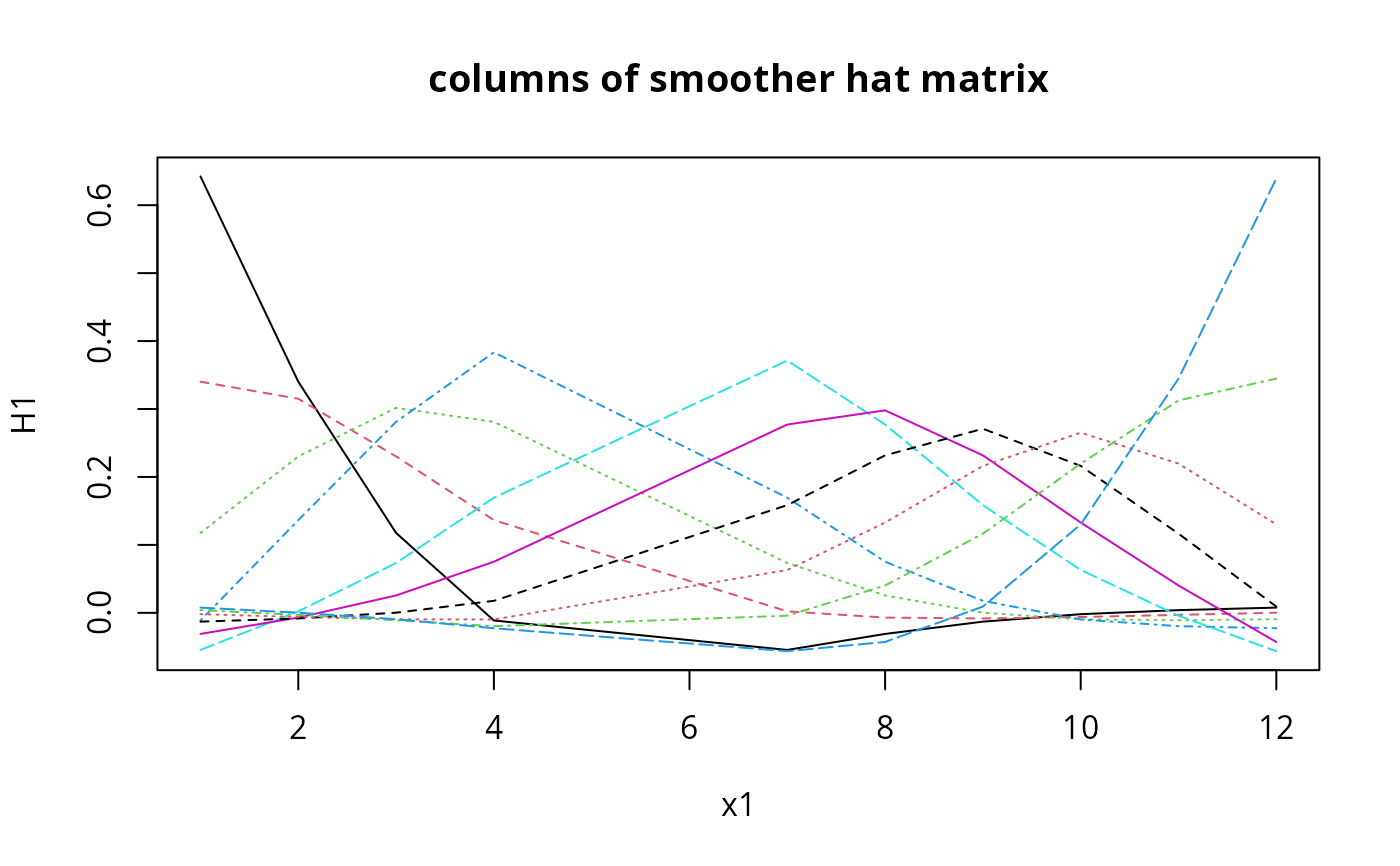
H1 <- hatMat(x1, spar = 0.5) # default : smooth.spline()
matplot(x1, H1, type = "l", main = "columns of smoother hat matrix")
 ## Example 'pred.sm' arguments for hatMat() :
pspl <- function(x,y,...) predict(smooth.spline(x,y, ...), x = x)$y
pksm <- function(x,y,...) ksmooth(sort(x),y, "normal", x.points=x, ...)$y
## Rather than ksmooth():
if(require("lokern"))
pksm2 <- function(x,y,...) glkerns(x,y, x.out=x, ...)$est
#> Loading required package: lokern
## Explaining 'trace = TRUE'
all.equal(sum(diag((hatMat(c(1:4, 7:12), df = 4)))),
hatMat(c(1:4, 7:12), df = 4, trace = TRUE), tol = 1e-12)
#> [1] TRUE
## ksmooth() :
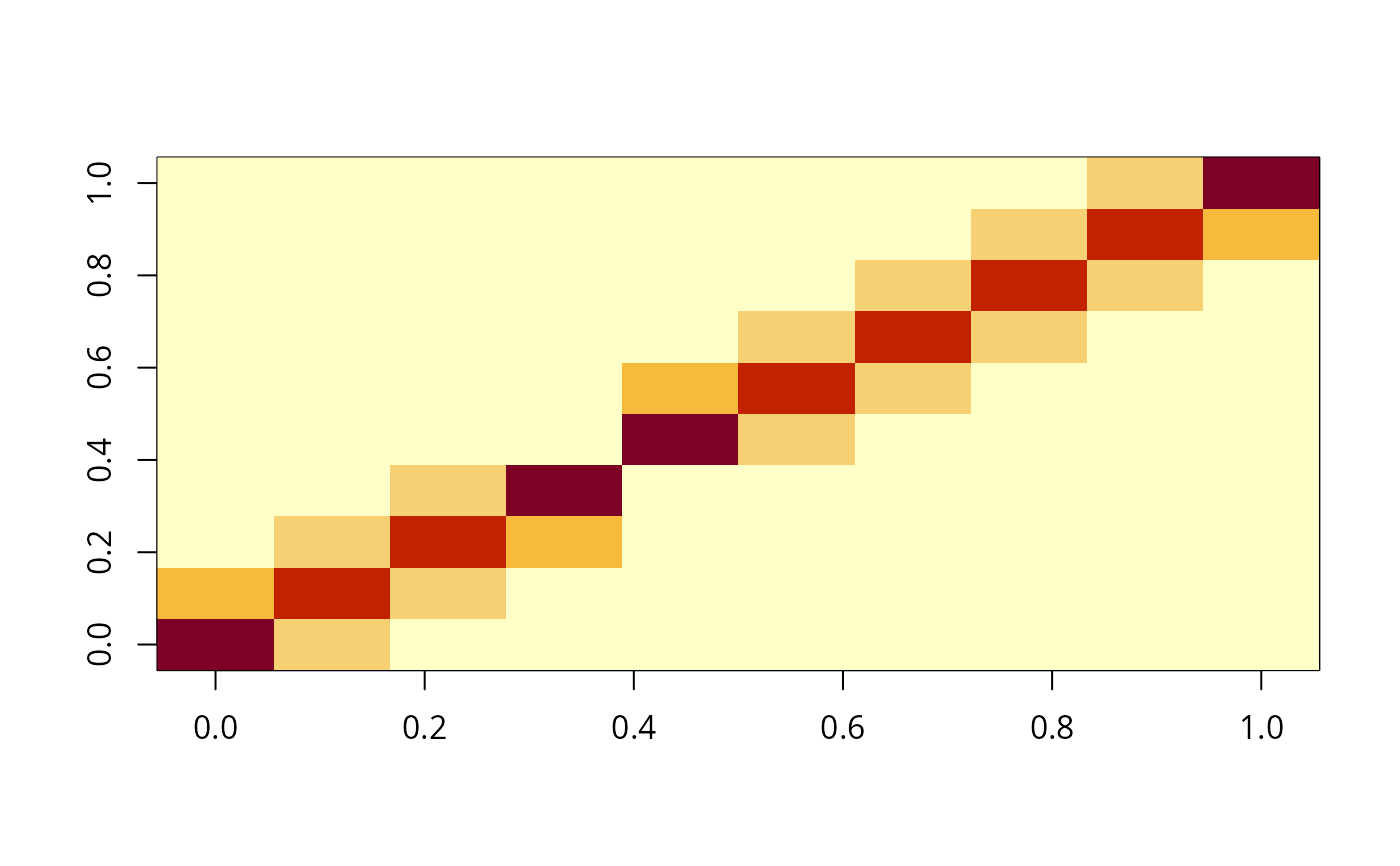
Hk <- hatMat(x1, pr = pksm, bandwidth = 2)
cat(sprintf("df = %.2f\n", sum(diag(Hk))))
#> df = 6.06
image(Hk)
## Example 'pred.sm' arguments for hatMat() :
pspl <- function(x,y,...) predict(smooth.spline(x,y, ...), x = x)$y
pksm <- function(x,y,...) ksmooth(sort(x),y, "normal", x.points=x, ...)$y
## Rather than ksmooth():
if(require("lokern"))
pksm2 <- function(x,y,...) glkerns(x,y, x.out=x, ...)$est
#> Loading required package: lokern
## Explaining 'trace = TRUE'
all.equal(sum(diag((hatMat(c(1:4, 7:12), df = 4)))),
hatMat(c(1:4, 7:12), df = 4, trace = TRUE), tol = 1e-12)
#> [1] TRUE
## ksmooth() :
Hk <- hatMat(x1, pr = pksm, bandwidth = 2)
cat(sprintf("df = %.2f\n", sum(diag(Hk))))
#> df = 6.06
image(Hk)
 Matrix::printSpMatrix(as(round(Hk, 2), "sparseMatrix"))
#>
#> [1,] 0.70 0.28 0.02 . . . . . . .
#> [2,] 0.22 0.55 0.22 0.01 . . . . . .
#> [3,] 0.01 0.22 0.55 0.22 . . . . . .
#> [4,] . 0.02 0.28 0.70 . . . . . .
#> [5,] . . . . 0.70 0.28 0.02 . . .
#> [6,] . . . . 0.22 0.55 0.22 0.01 . .
#> [7,] . . . . 0.01 0.22 0.54 0.22 0.01 .
#> [8,] . . . . . 0.01 0.22 0.54 0.22 0.01
#> [9,] . . . . . . 0.01 0.22 0.55 0.22
#> [10,] . . . . . . . 0.02 0.28 0.70
##---> see demo("hatmat-ex") for more (and larger) examples
Matrix::printSpMatrix(as(round(Hk, 2), "sparseMatrix"))
#>
#> [1,] 0.70 0.28 0.02 . . . . . . .
#> [2,] 0.22 0.55 0.22 0.01 . . . . . .
#> [3,] 0.01 0.22 0.55 0.22 . . . . . .
#> [4,] . 0.02 0.28 0.70 . . . . . .
#> [5,] . . . . 0.70 0.28 0.02 . . .
#> [6,] . . . . 0.22 0.55 0.22 0.01 . .
#> [7,] . . . . 0.01 0.22 0.54 0.22 0.01 .
#> [8,] . . . . . 0.01 0.22 0.54 0.22 0.01
#> [9,] . . . . . . 0.01 0.22 0.55 0.22
#> [10,] . . . . . . . 0.02 0.28 0.70
##---> see demo("hatmat-ex") for more (and larger) examples