Plot Data and Smoother / Fitted Values
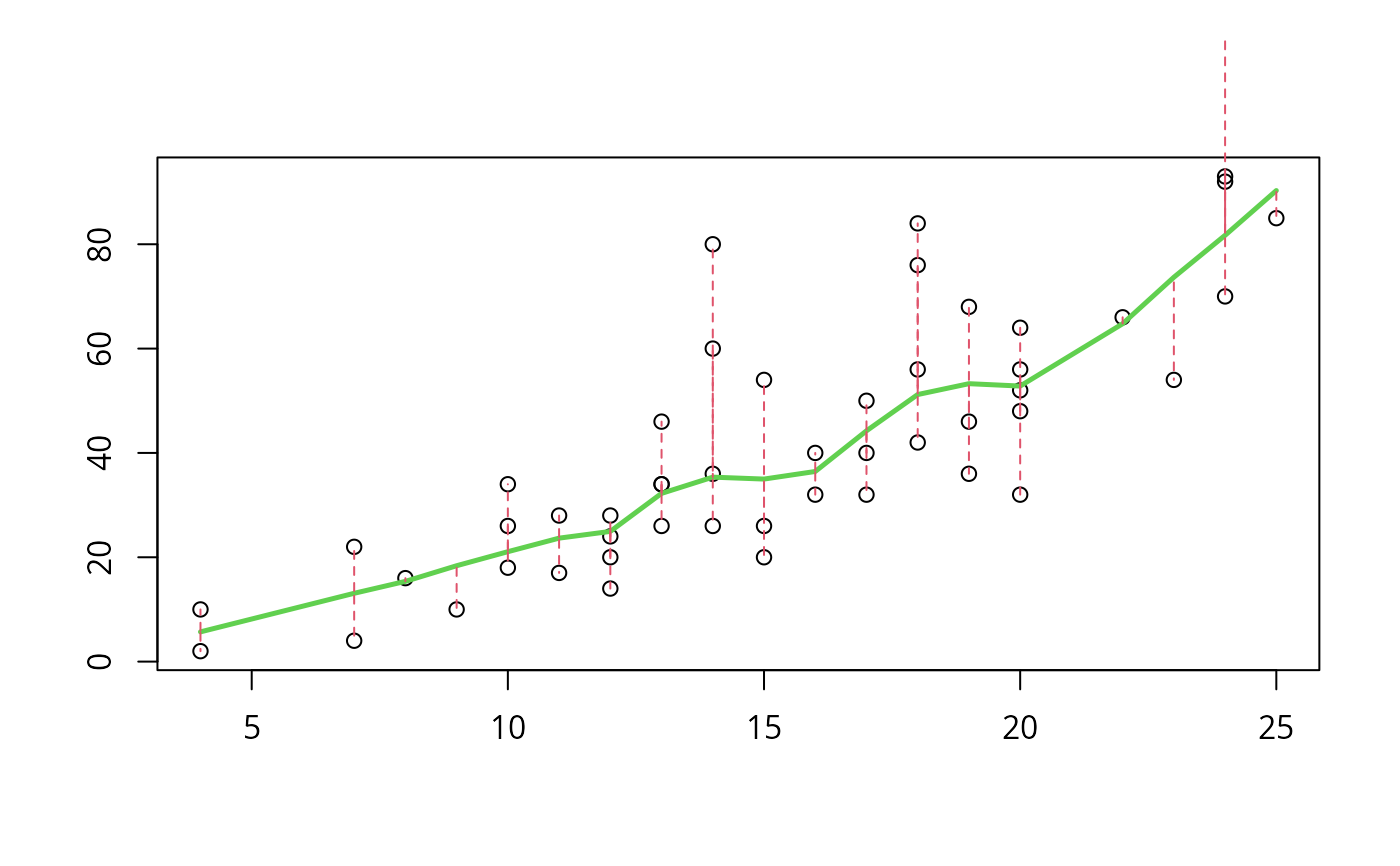
plotDS.RdFor one-dimensional nonparametric regression, plot the data and fitted values, typically a smooth function, and optionally use segments to visualize the residuals.
Arguments
- x, yd, ys
numeric vectors all of the same length, representing \((x_i, y_i)\) and fitted (smooth) values \(\hat{y}_i\).
xwill be sorted increasingly if necessary, andydandysaccordingly.Alternatively,
yscan be an x-y list (as resulting fromxy.coords) containing fitted values on a finer grid than the observationsx. In that case, the observational valuesx[]must be part of the larger set;seqXtend()may be applied to construct such a set of abscissa values.- xlab, ylab
x- and y- axis labels, as in
plot.default.- ylim
limits of y-axis to be used; defaults to a robust range of the values.
- xpd
see
par(xpd=.); by default do allow to draw outside the plot region.- do.seg
logical indicating if residual segments should be drawn, at
x[i], fromyd[i]toys[i](approximately, seeseg.p).- seg.p
segment percentage of segments to be drawn, from
ydtoseg.p*ys + (1-seg.p)*yd.- segP
list with named components
lty, lwd, colspecifying line type, width and color for the residual segments, used only whendo.segis true.- linP
list with named components
lty, lwd, colspecifying line type, width and color for “smooth curve lines”.- ...
further arguments passed to
plot.
Note
Non-existing components in the lists segP or linP
will result in the par defaults to be used.
plotDS() used to be called pl.ds up to November 2007.
See also
seqXtend() to construct more smooth ys
“objects”.
Examples
data(cars)
x <- cars$speed
yd <- cars$dist
ys <- lowess(x, yd, f = .3)$y
plotDS(x, yd, ys)
 ## More interesting : Version of example(Theoph)
data(Theoph)
Th4 <- subset(Theoph, Subject == 4)
## just for "checking" purposes -- permute the observations:
Th4 <- Th4[sample(nrow(Th4)), ]
fm1 <- nls(conc ~ SSfol(Dose, Time, lKe, lKa, lCl), data = Th4)
#> Warning: NaNs produced
#> Error in numericDeriv(form[[3L]], names(ind), env, central = nDcentral): Missing value or an infinity produced when evaluating the model
## Simple
plotDS(Th4$Time, Th4$conc, fitted(fm1),
sub = "Theophylline data - Subject 4 only",
segP = list(lty=1,col=2), las = 1)
#> Error: object 'fm1' not found
## Nicer: Draw the smoother not only at x = x[i] (observations):
xsm <- unique(sort(c(Th4$Time, seq(0, 25, length = 201))))
ysm <- c(predict(fm1, newdata = list(Time = xsm)))
#> Error: object 'fm1' not found
plotDS(Th4$Time, Th4$conc, ys = list(x=xsm, y=ysm),
sub = "Theophylline data - Subject 4 only",
segP = list(lwd=2), las = 1)
#> Error: object 'ysm' not found
## More interesting : Version of example(Theoph)
data(Theoph)
Th4 <- subset(Theoph, Subject == 4)
## just for "checking" purposes -- permute the observations:
Th4 <- Th4[sample(nrow(Th4)), ]
fm1 <- nls(conc ~ SSfol(Dose, Time, lKe, lKa, lCl), data = Th4)
#> Warning: NaNs produced
#> Error in numericDeriv(form[[3L]], names(ind), env, central = nDcentral): Missing value or an infinity produced when evaluating the model
## Simple
plotDS(Th4$Time, Th4$conc, fitted(fm1),
sub = "Theophylline data - Subject 4 only",
segP = list(lty=1,col=2), las = 1)
#> Error: object 'fm1' not found
## Nicer: Draw the smoother not only at x = x[i] (observations):
xsm <- unique(sort(c(Th4$Time, seq(0, 25, length = 201))))
ysm <- c(predict(fm1, newdata = list(Time = xsm)))
#> Error: object 'fm1' not found
plotDS(Th4$Time, Th4$conc, ys = list(x=xsm, y=ysm),
sub = "Theophylline data - Subject 4 only",
segP = list(lwd=2), las = 1)
#> Error: object 'ysm' not found