
Split a survival data set at specified times
survSplit.RdGiven a survival data set and a set of specified cut times, split each record into multiple subrecords at each cut time.
Usage
survSplit(formula, data, subset, na.action=na.pass,
            id, cut, zero=0, episode, start="tstart",
          end="tstop", event="event", added, timefix=TRUE)
Arguments
- formula
a model formula
- data
a data frame
- subset, na.action
rows of the data to be retained
- id
name of an id variable, normally found in the data frame. Necessary for timeline data.
- cut
the vector of timepoints to cut at
- zero
For simple
Surv(time, status)data, the starting point for the first interval.- episode
character string with the name of new episode variable (optional)
- start
character string with the name of a start time variable (will be created if needed)
- end
character string with the name of event time variable
- event
character string with the name of censoring indicator
- added
character string with the name of the new "this observation was added" variable (optional)
- timefix
process times through the
aeqSurvfunction to eliminate potential roundoff issues.
Details
Each interval in the original data is cut at the given points; if an original row were (15, 60] with a cut vector of (10,30, 40) the resulting data set would have intervals of (15,30], (30,40] and (40, 60].
Each row in the final data set will lie completely within one of the
cut intervals. Which interval for each row of the output is shown by the
episode variable, where 1= less than the first cutpoint, 2=
between the first and the second, etc.
For the example above the values would be 2, 3, and 4.
Whether a given row was added is shown by the added variable.
The routine is called with a formula as the first argument.
The right hand side of the formula can be used to delimit variables
that should be retained; normally one will use ~ . as a
shorthand to retain them all.
The most common call would have Surv(name1, name2, name3) or
Surv2(name1, name2) as
the left hand side, where name1, name2, name3 are simple variable
names; in that case the output will have the same variable names.
For a Surv(name1, name2) call a new variable with the name
given by start option will be added to the data.
However, the routine is not sophisticated; it only does this
substitution for simple names. A call of Surv(time, stat==2)
for instance will not retain "stat" as the name of the event variable,
it will instead use the name found in the event argument.
If the response variable is the variable names of a Surv or Surv2
object then the updated response will have the same name.
Rows of data with a missing time or status are copied across
unchanged, unless the na.action argument is changed from its default
value of na.pass. But in the latter case any row
that is missing for any variable will be removed, which is rarely
what is desired.
An older, now deprecated usage is a call without a formula,
e.g., survSplit(veteran, time="time", event="status", cut=c(90,180))
Examples
fit1 <- coxph(Surv(time, status) ~ karno + age + trt, veteran)
plot(cox.zph(fit1)[1])
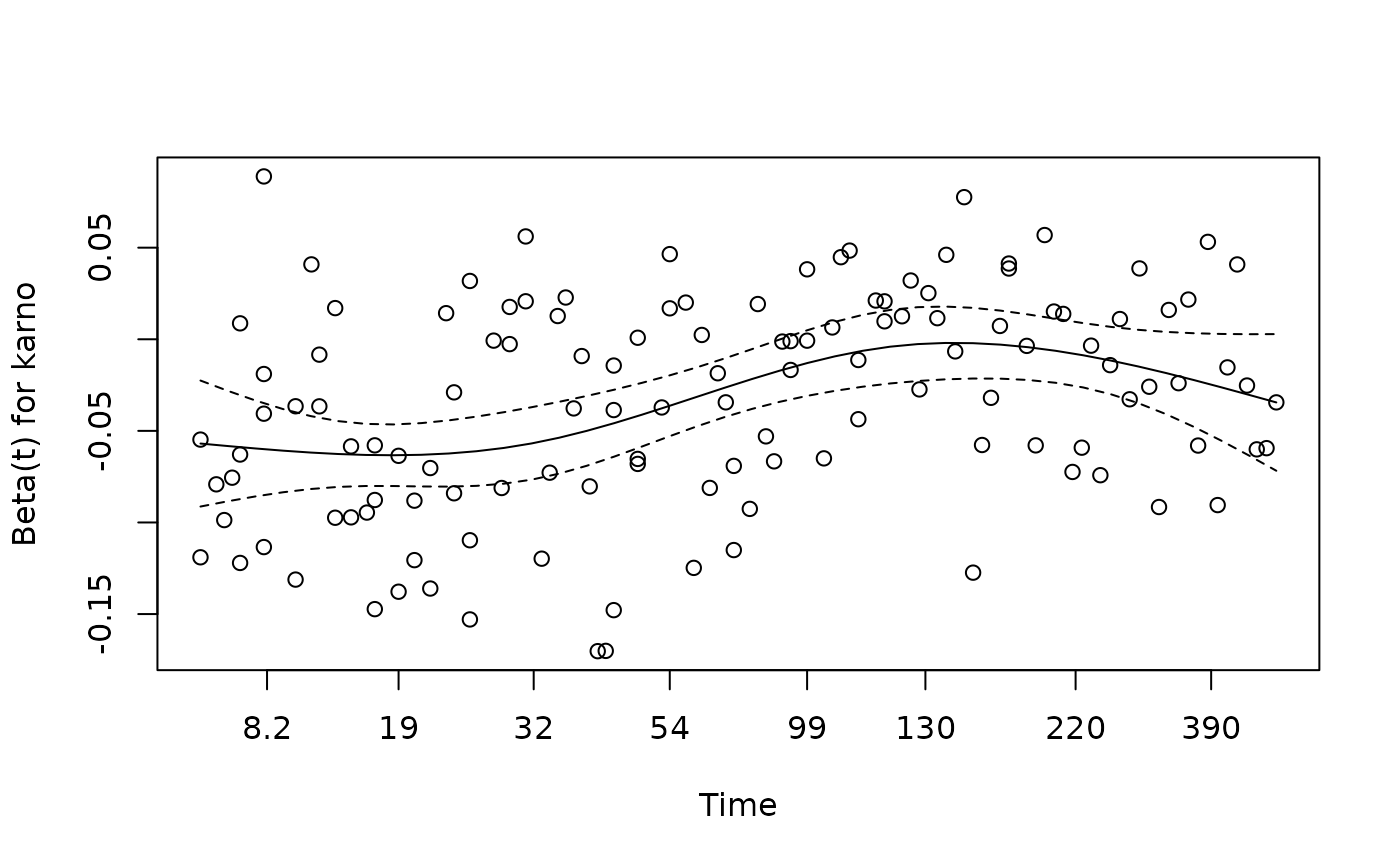 # a cox.zph plot of the data suggests that the effect of Karnofsky score
# begins to diminish by 60 days and has faded away by 120 days.
# Fit a model with separate coefficients for the three intervals.
#
vet2 <- survSplit(Surv(time, status) ~., veteran,
cut=c(60, 120), episode ="timegroup")
fit2 <- coxph(Surv(tstart, time, status) ~ karno* strata(timegroup) +
age + trt, data= vet2)
c(overall= coef(fit1)[1],
t0_60 = coef(fit2)[1],
t60_120= sum(coef(fit2)[c(1,4)]),
t120 = sum(coef(fit2)[c(1,5)]))
#> overall.karno t0_60.karno t60_120 t120
#> -0.034443897 -0.049176157 -0.011031558 -0.007629841
# Sometimes we want to split on one scale and analyse on another
# Add a "current age" variable to the mgus2 data set.
temp1 <- mgus2
temp1$endage <- mgus2$age + mgus2$futime/12 # futime is in months
temp1$startage <- temp1$age
temp2 <- survSplit(Surv(age, endage, death) ~ ., temp1, cut=25:100,
start= "age1", end= "age2")
# restore the time since enrollment scale
temp2$time1 <- (temp2$age1 - temp2$startage)*12
temp2$time2 <- (temp2$age2 - temp2$startage)*12
# In this data set, initial age and current age have similar utility
mfit1 <- coxph(Surv(futime, death) ~ age + sex, data=mgus2)
mfit2 <- coxph(Surv(time1, time2, death) ~ age1 + sex, data=temp2)
# a cox.zph plot of the data suggests that the effect of Karnofsky score
# begins to diminish by 60 days and has faded away by 120 days.
# Fit a model with separate coefficients for the three intervals.
#
vet2 <- survSplit(Surv(time, status) ~., veteran,
cut=c(60, 120), episode ="timegroup")
fit2 <- coxph(Surv(tstart, time, status) ~ karno* strata(timegroup) +
age + trt, data= vet2)
c(overall= coef(fit1)[1],
t0_60 = coef(fit2)[1],
t60_120= sum(coef(fit2)[c(1,4)]),
t120 = sum(coef(fit2)[c(1,5)]))
#> overall.karno t0_60.karno t60_120 t120
#> -0.034443897 -0.049176157 -0.011031558 -0.007629841
# Sometimes we want to split on one scale and analyse on another
# Add a "current age" variable to the mgus2 data set.
temp1 <- mgus2
temp1$endage <- mgus2$age + mgus2$futime/12 # futime is in months
temp1$startage <- temp1$age
temp2 <- survSplit(Surv(age, endage, death) ~ ., temp1, cut=25:100,
start= "age1", end= "age2")
# restore the time since enrollment scale
temp2$time1 <- (temp2$age1 - temp2$startage)*12
temp2$time2 <- (temp2$age2 - temp2$startage)*12
# In this data set, initial age and current age have similar utility
mfit1 <- coxph(Surv(futime, death) ~ age + sex, data=mgus2)
mfit2 <- coxph(Surv(time1, time2, death) ~ age1 + sex, data=temp2)