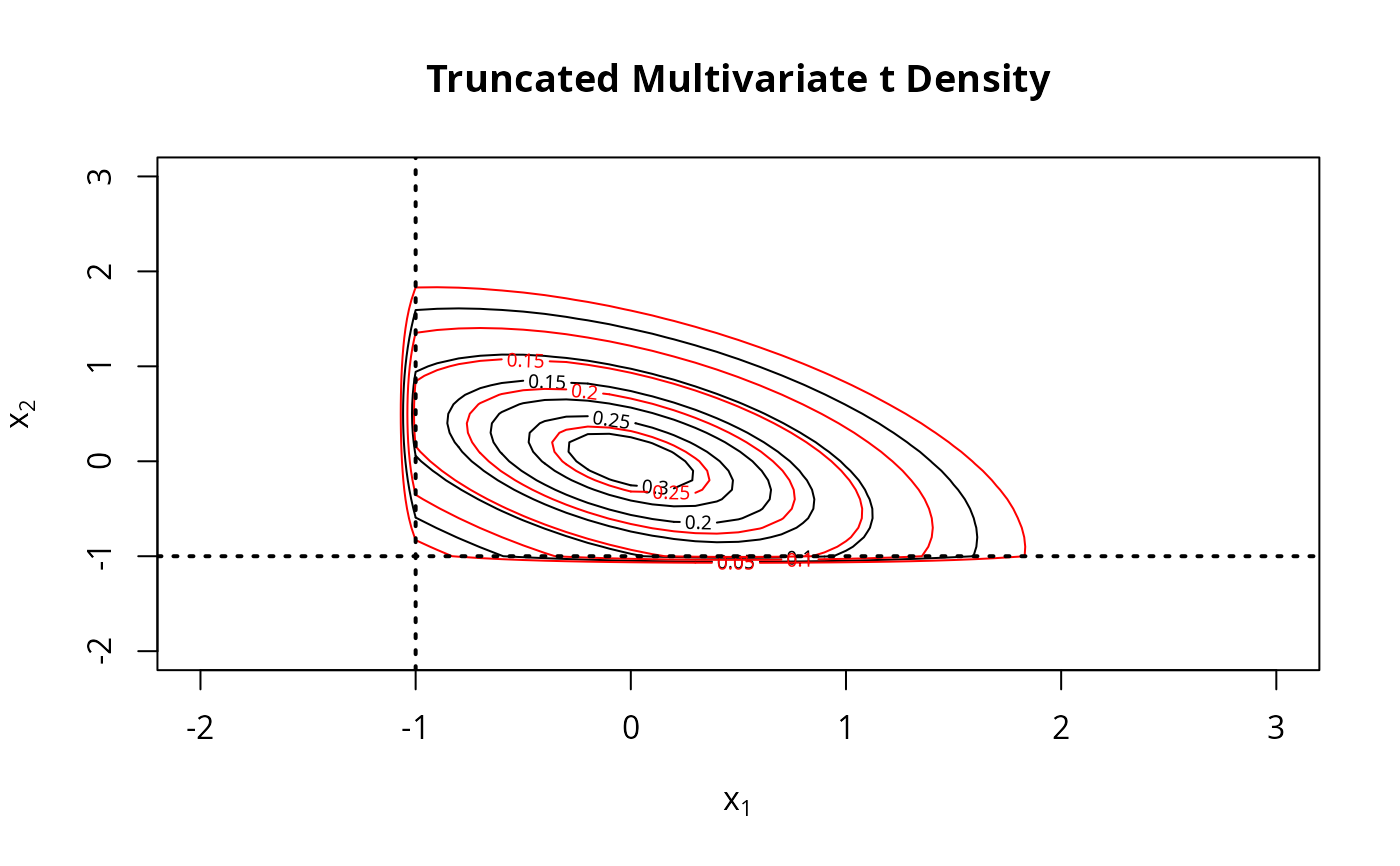
Truncated Multivariate Student t Density
dtmvt.RdThis function provides the joint density function for the truncated multivariate Student t
distribution with mean vector equal to mean, covariance matrix
sigma, degrees of freedom parameter df and
lower and upper truncation points lower and upper.
Arguments
- x
Vector or matrix of quantiles. If
xis a matrix, each row is taken to be a quantile.- mean
Mean vector, default is
rep(0, nrow(sigma)).- sigma
Covariance matrix, default is
diag(length(mean)).- df
degrees of freedom parameter
- lower
Vector of lower truncation points, default is
rep(-Inf, length = length(mean)).- upper
Vector of upper truncation points, default is
rep( Inf, length = length(mean)).- log
Logical; if
TRUE, densities d are given as log(d).
Details
The Truncated Multivariate Student t Distribution is a conditional Multivariate Student t distribution subject to (linear) constraints \(a \le \bold{x} \le b\).
The density of the \(p\)-variate Multivariate Student t distribution with \(\nu\) degrees of freedom is $$ f(\bold{x}) = \frac{\Gamma((\nu + p)/2)}{(\pi\nu)^{p/2} \Gamma(\nu/2) \|\Sigma\|^{1/2}} [ 1 + \frac{1}{\nu} (x - \mu)^T \Sigma^{-1} (x - \mu) ]^{- (\nu + p) / 2} $$ The density of the truncated distribution \(f_{a,b}(x)\) with constraints \((a \le x \le b)\) is accordingly $$ f_{a,b}(x) = \frac{f(\bold{x})} {P(a \le x \le b)} $$
Value
a numeric vector with density values
See also
References
Geweke, J. F. (1991) Efficient simulation from the multivariate normal and Student-t distributions subject to linear constraints and the evaluation of constraint probabilities. https://www.researchgate.net/publication/2335219_Efficient_Simulation_from_the_Multivariate_Normal_and_Student-t_Distributions_Subject_to_Linear_Constraints_and_the_Evaluation_of_Constraint_Probabilities
Samuel Kotz, Saralees Nadarajah (2004). Multivariate t Distributions and Their Applications. Cambridge University Press
Examples
# Example

x1 <- seq(-2, 3, by=0.1)
x2 <- seq(-2, 3, by=0.1)

mean <- c(0,0)
sigma <- matrix(c(1, -0.5, -0.5, 1), 2, 2)
lower <- c(-1,-1)


density <- function(x)
{
  z=dtmvt(x, mean=mean, sigma=sigma, lower=lower)
  z
}

fgrid <- function(x, y, f)
{
  z <- matrix(nrow=length(x), ncol=length(y))
  for(m in 1:length(x)){
    for(n in 1:length(y)){
      z[m,n] <- f(c(x[m], y[n]))
    }
  }
  z
}

# compute multivariate-t density d for grid
d <- fgrid(x1, x2, function(x) dtmvt(x, mean=mean, sigma=sigma, lower=lower))

# compute multivariate normal density d for grid
d2 <- fgrid(x1, x2, function(x) dtmvnorm(x, mean=mean, sigma=sigma, lower=lower))

# plot density as contourplot
contour(x1, x2, d, nlevels=5, main="Truncated Multivariate t Density",
    xlab=expression(x[1]), ylab=expression(x[2]))

contour(x1, x2, d2, nlevels=5, add=TRUE, col="red")
abline(v=-1, lty=3, lwd=2)
abline(h=-1, lty=3, lwd=2)