Add Text or Points to Ordination Plots
orditorp.RdThe function adds text or points to
ordination plots. Text will be used if this can be done without
overwriting other text labels, and points will be used otherwise. The
function can help in reducing clutter in ordination graphics, but
manual editing may still be necessary.
Arguments
- x
A result object from ordination or an
ordiplotresult. If the function is used inordiplotpipe, this should be missing and first argument bedisplay.- display
Items to be displayed in the plot. Only one alternative is allowed. Typically this is
"sites"or"species".- labels
Optional text used for labels. Row names of scores will be used if this is missing. If
selectis used, labels are given only selected items in the order they occur in the scores.- choices
Axes shown.
- priority
Text will be used for items with higher priority if labels overlap. This should be vector of the same length as the number of items plotted or number of scores.
- select
Items to be displayed. This can either be a logical vector which is
TRUEfor displayed items or a vector of indices, orlabelsand if these are missing, row names of scores. If a logical vector is used, it must have the same length as the scores plotted.- cex, pcex
Text and point sizes, see
plot.default..- col, pcol
Text and point colours, see
plot.default.- pch
Plotting character, see
points.- air
Amount of empty space between text labels. Values <1 allow overlapping text.
- ...
Other arguments to
scores(and its various methods),textandpoints.
Details
Function orditorp will add either text or points to an existing
plot. The items with high priority will be added first
and text will be used if this can be done without
overwriting previous labels,and points will be used
otherwise. If priority is missing, labels will be added from the
outskirts to the centre. Function orditorp can be used
with most ordination results, or plotting results from
ordiplot or ordination plot functions
(plot.cca, plot.decorana,
plot.metaMDS). Function can also be used in a pipe
(|>) where the first command is a vegan ordination
plot command or ordiplot.
Arguments can be passed to the relevant scores method
for the ordination object (x) being drawn. See the relevant
scores help page for arguments that can be used.
Value
The function returns invisibly the The function returns invisibly a
logical vector where TRUE means that item was labelled with
text and FALSE means that it was marked with a point. If
function is used in an ordiplot pipe, it will return the
input ordiplot object, but amend the plotted scores with this
vector as attribute "orditorp". The returned vector can be used
as the select argument in ordination text and
points functions.
Examples
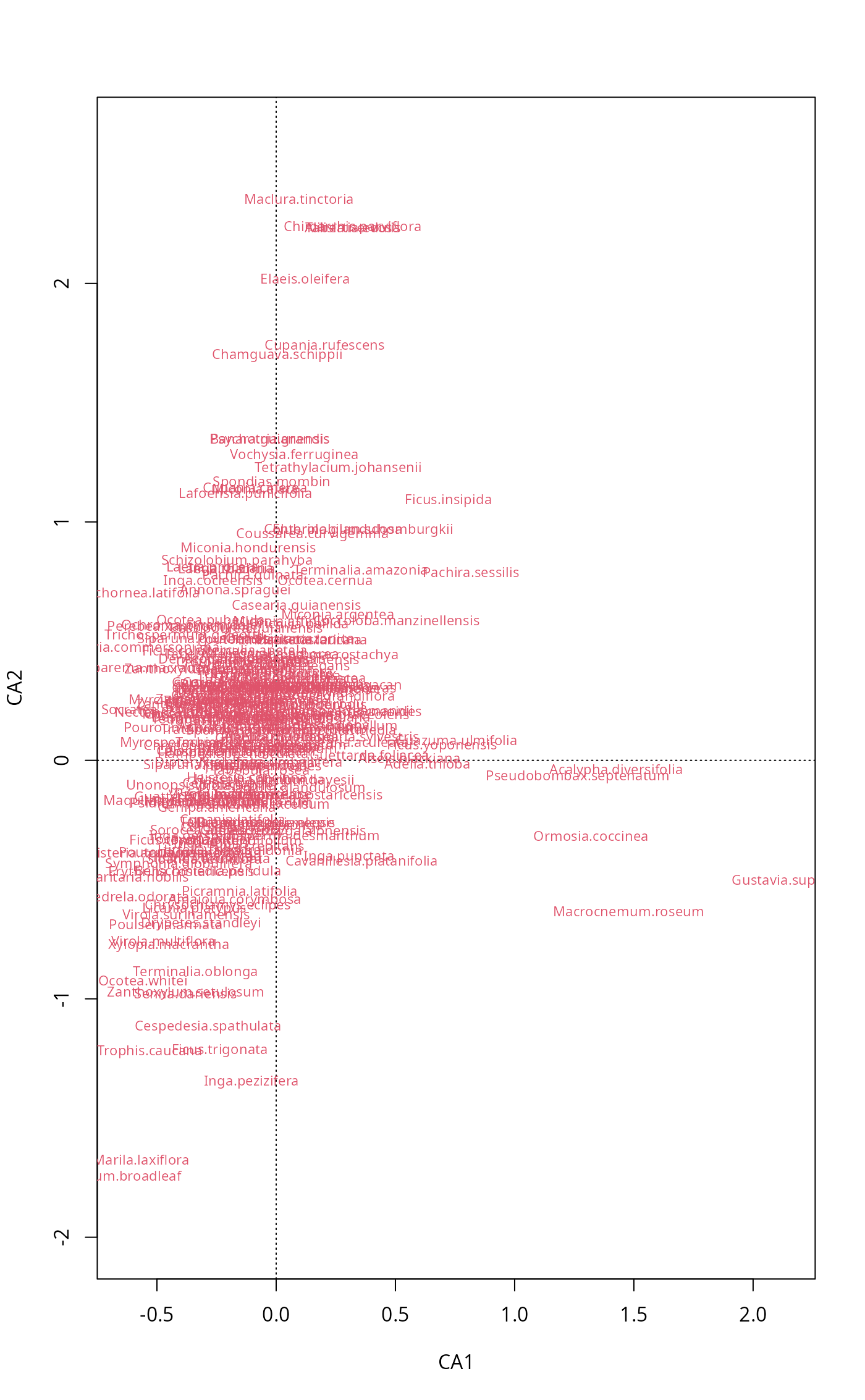
## A cluttered ordination plot :
data(BCI)
mod <- cca(BCI)
plot(mod, dis="sp", type="t")
 # Now with orditorp and abbreviated species names
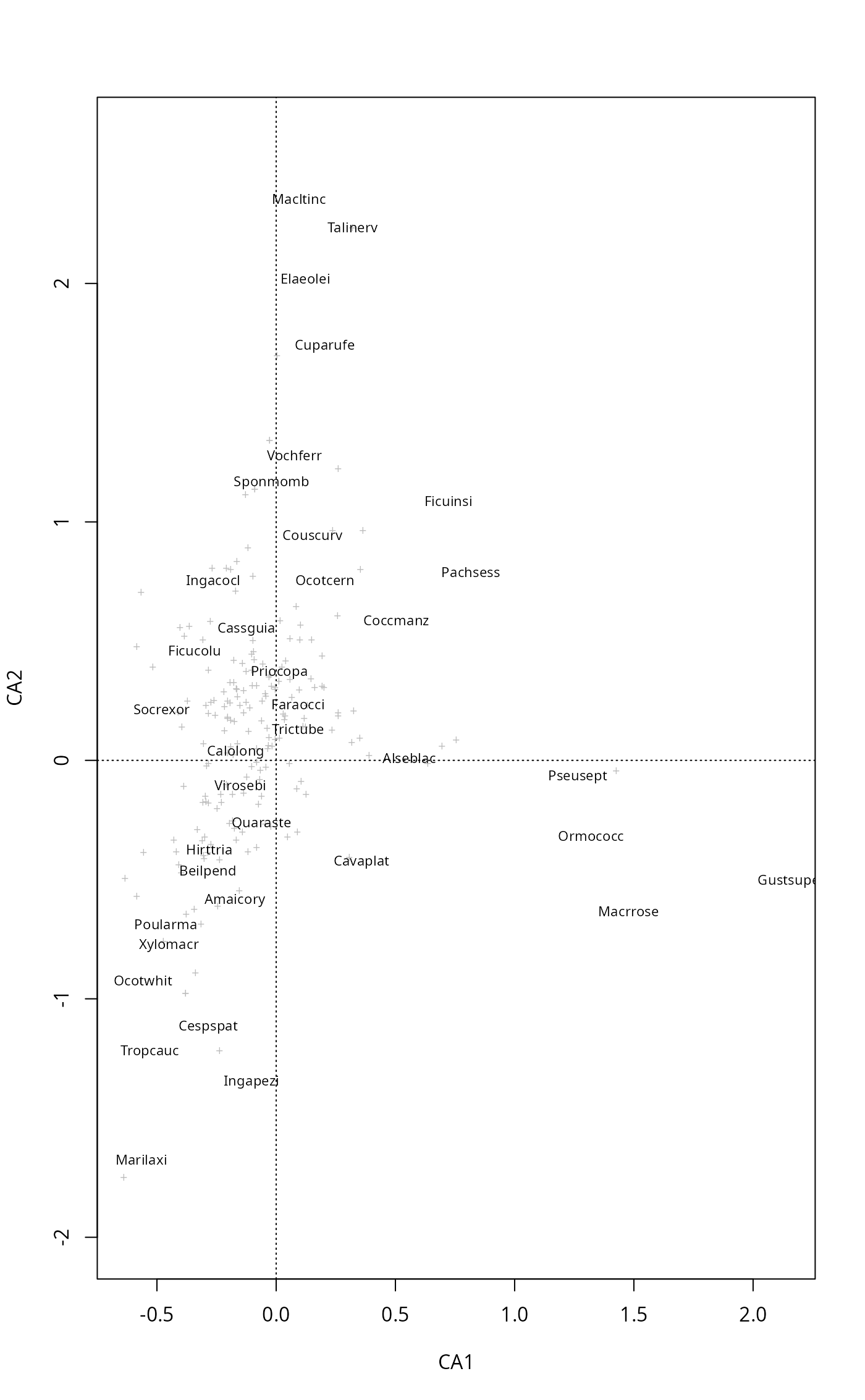
cnam <- make.cepnames(names(BCI))
plot(mod, dis="sp", type="n")
stems <- colSums(BCI)
orditorp(mod, "sp", labels = cnam, priority=stems, pch="+", pcol="grey")
# Now with orditorp and abbreviated species names
cnam <- make.cepnames(names(BCI))
plot(mod, dis="sp", type="n")
stems <- colSums(BCI)
orditorp(mod, "sp", labels = cnam, priority=stems, pch="+", pcol="grey")
 ## show select in action
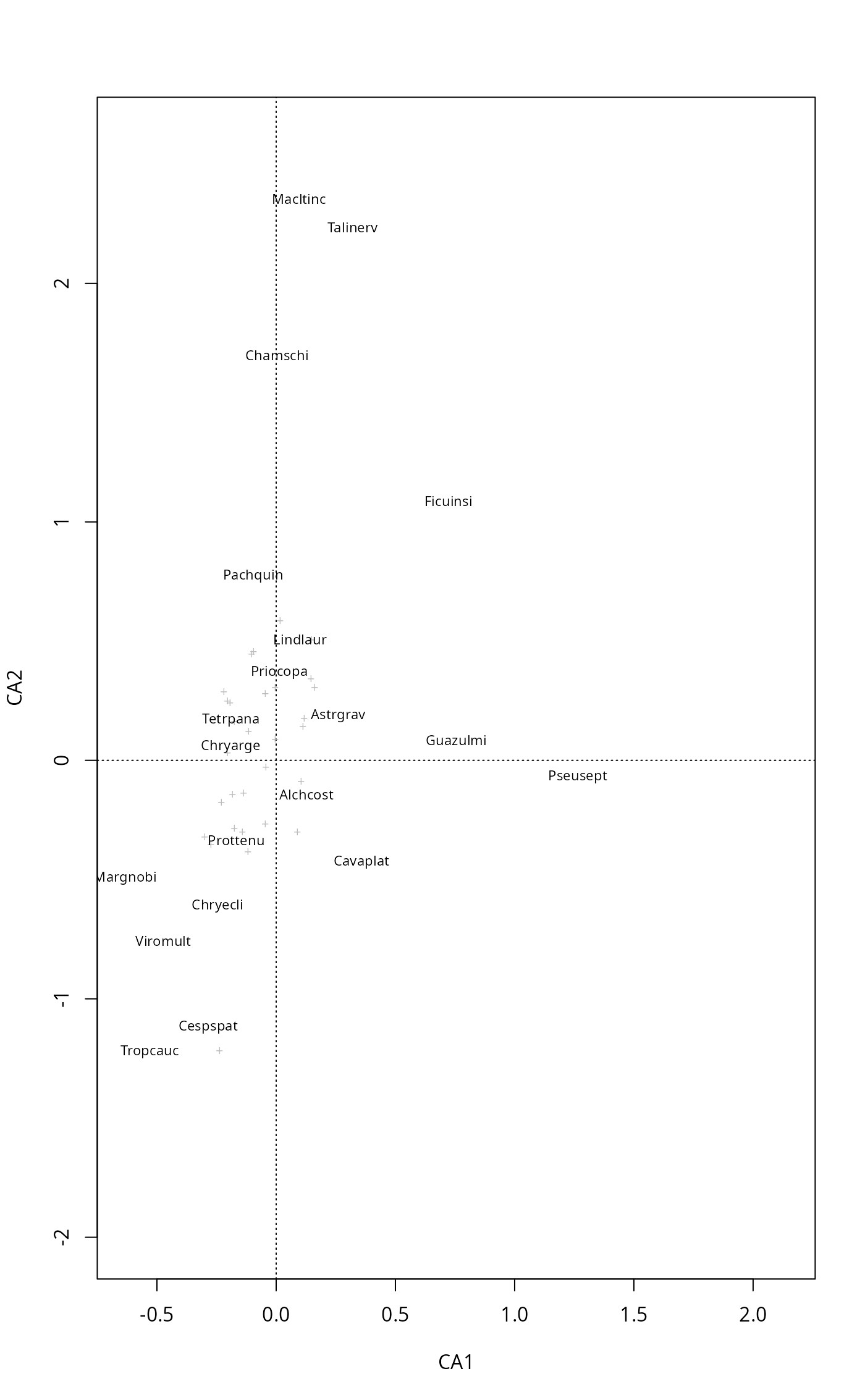
set.seed(1)
take <- sample(ncol(BCI), 50)
plot(mod, dis="sp", type="n")
stems <- colSums(BCI)
## only selected items are labelled, and the labels must be in the some
## order as in the scores
orditorp(mod, "sp", labels = cnam[sort(take)], priority=stems, select = take,
pch="+", pcol="grey")
## show select in action
set.seed(1)
take <- sample(ncol(BCI), 50)
plot(mod, dis="sp", type="n")
stems <- colSums(BCI)
## only selected items are labelled, and the labels must be in the some
## order as in the scores
orditorp(mod, "sp", labels = cnam[sort(take)], priority=stems, select = take,
pch="+", pcol="grey")
 #> Warning: object '.Random.seed' not found