Derivatives of the Incomplete Gamma Integral
pgamma.deriv.RdThe first two derivatives of the incomplete gamma integral.
pgamma.deriv(q, shape, tmax = 100)Details
Write \(x = q\) and shape = \(a\).
The first and second derivatives with respect to \(q\) and \(a\)
are returned. This function is similar in spirit to
pgamma;
define
$$P(a,x) = \frac{1}{\Gamma(a)} \int_0^x t^{a-1} e^{-t} dt$$
so that
\(P(a, x)\) is pgamma(x, a).
Currently a 6-column matrix is returned (in the future this
may change and an argument may be supplied so that only what
is required by the user is computed.)
The computations use a series expansion for \(a \leq x \leq 1\) or or \(x < a\), else otherwise a continued fraction expansion. Machine overflow can occur for large values of \(x\) when \(x\) is much greater than \(a\).
Value
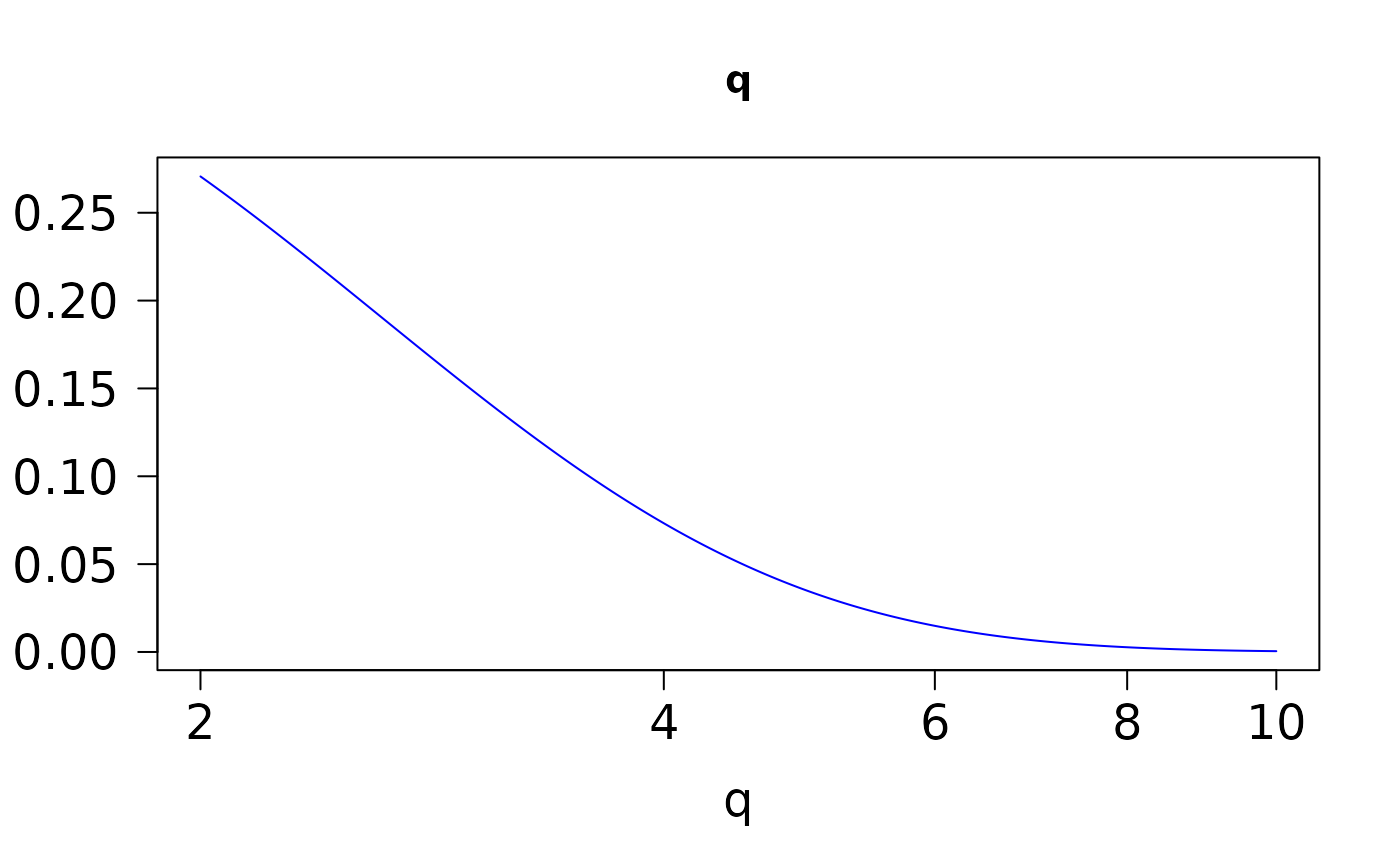
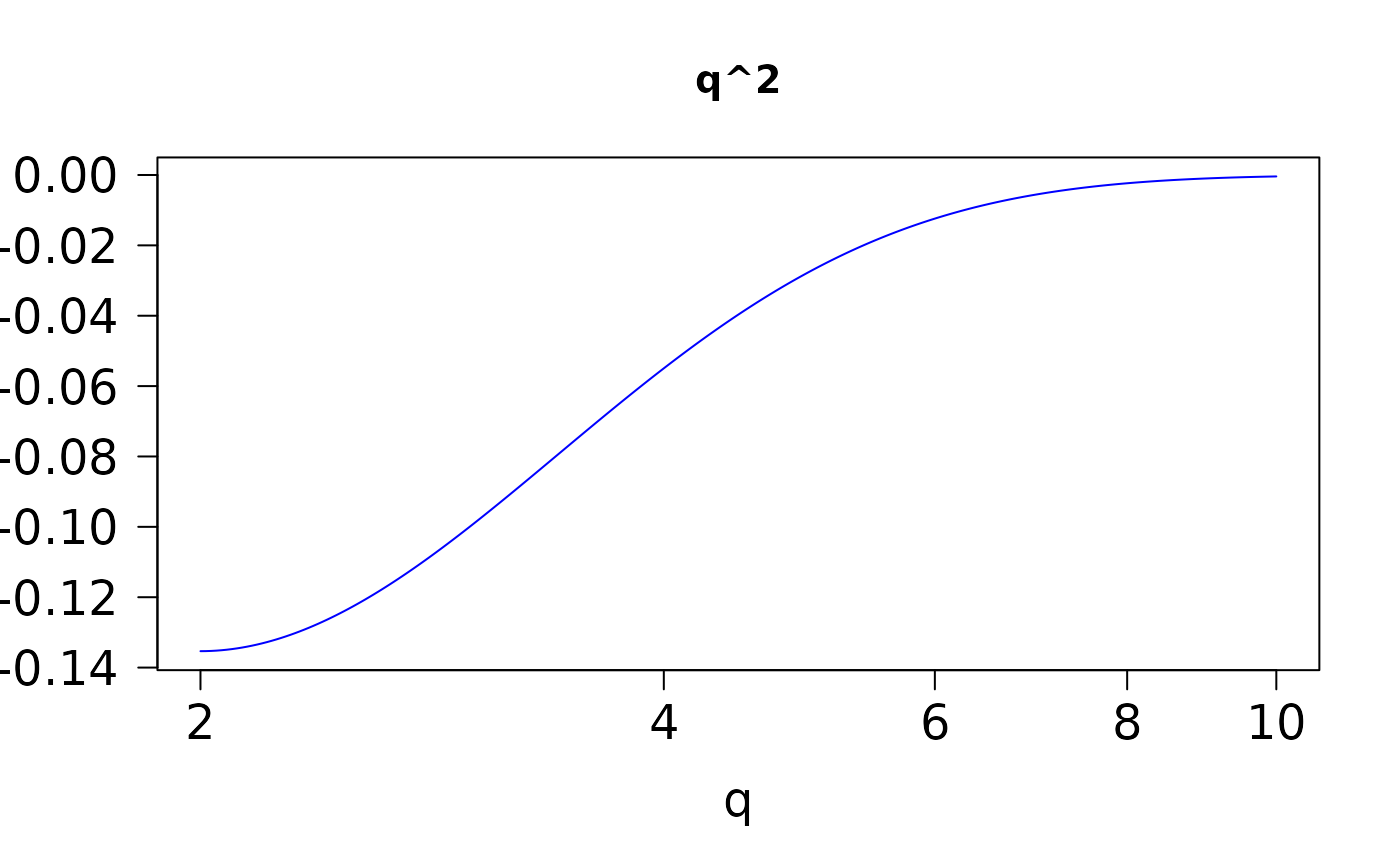
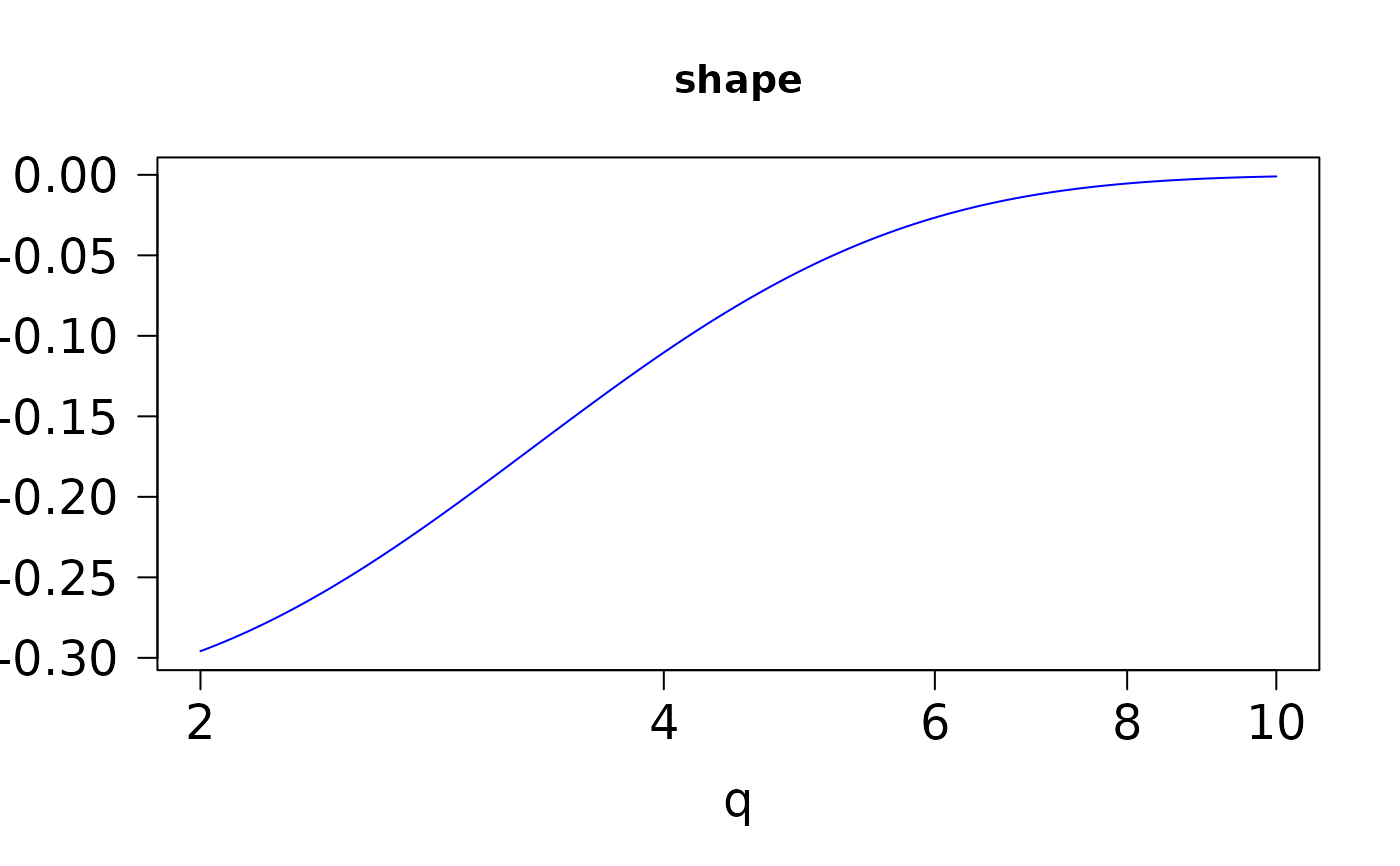
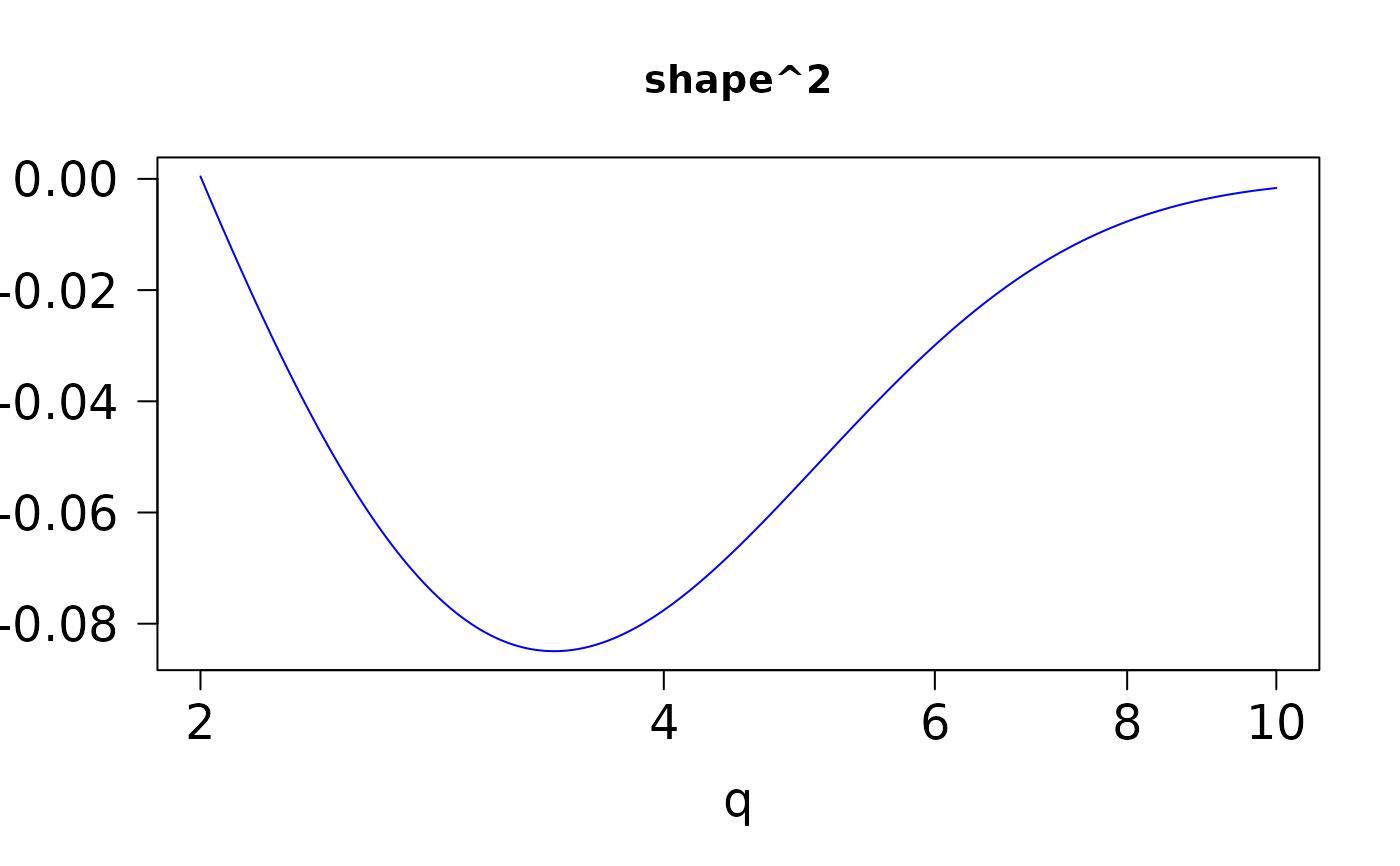
The first 5 columns, running from left to right, are the derivatives
with respect to:
\(x\),
\(x^2\),
\(a\),
\(a^2\),
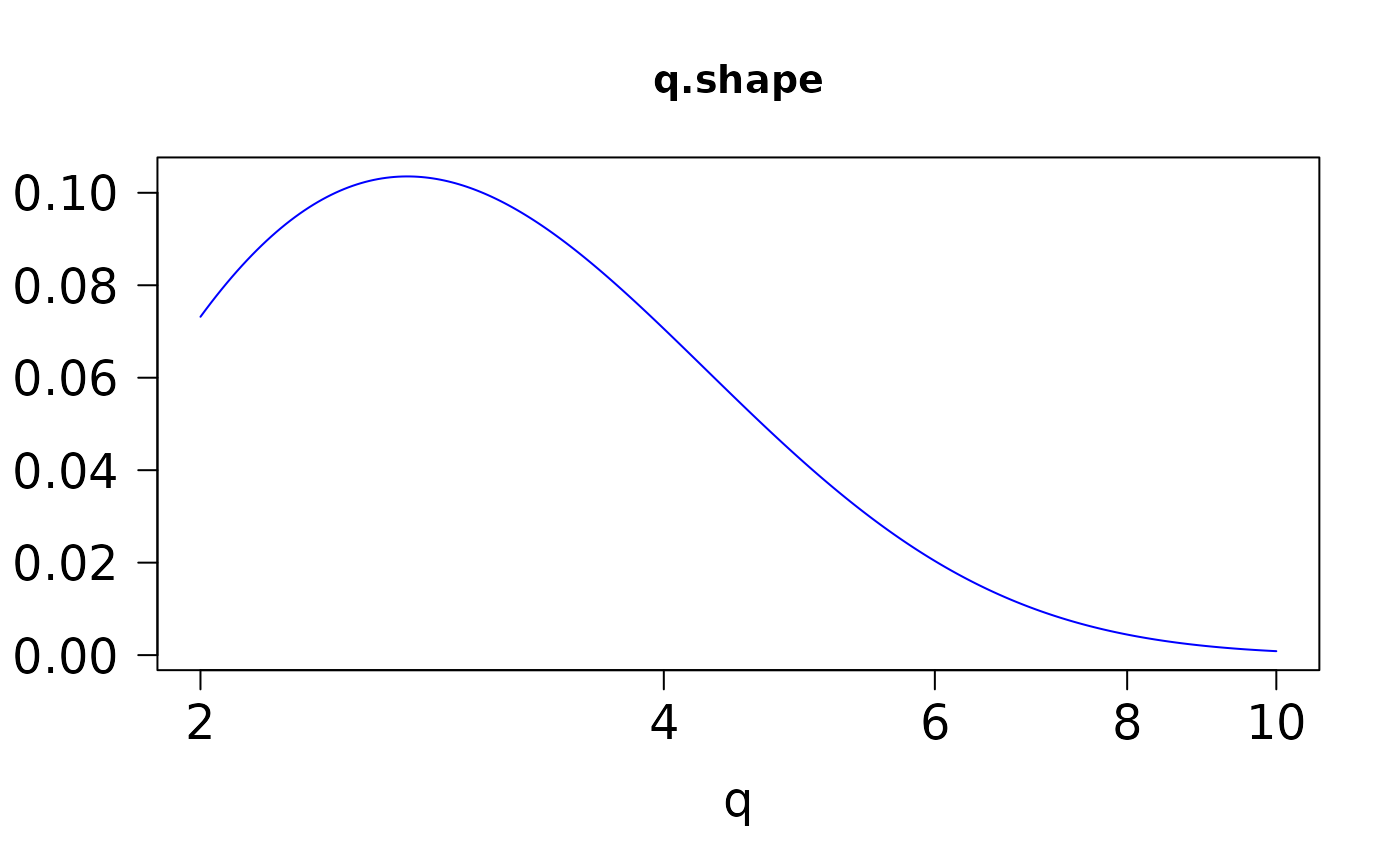
\(xa\).
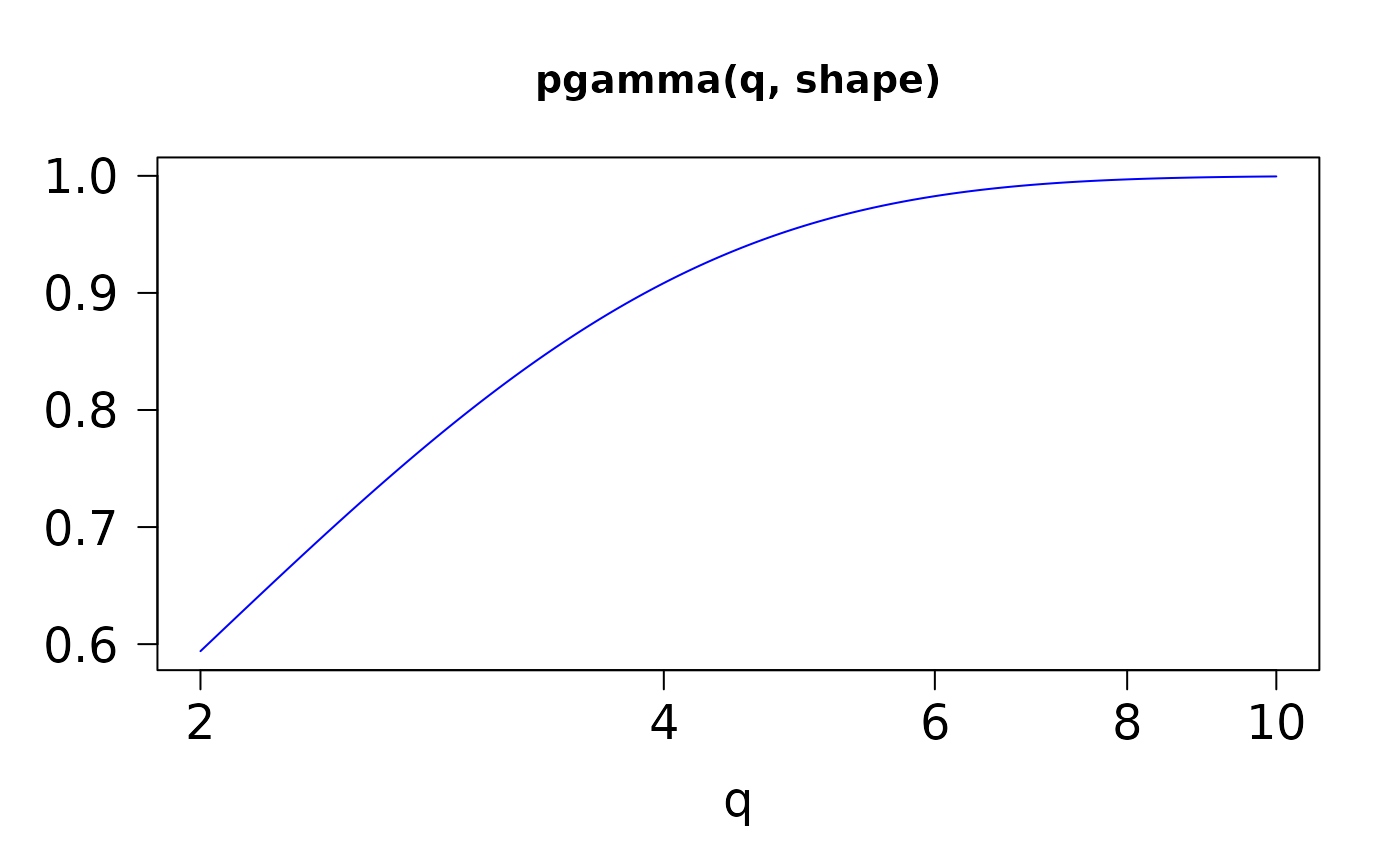
The 6th column is \(P(a, x)\) (but it is not as accurate
as calling pgamma directly).
References
Moore, R. J. (1982). Algorithm AS 187: Derivatives of the Incomplete Gamma Integral. Journal of the Royal Statistical Society, Series C (Applied Statistics), 31(3), 330–335.
Note
If convergence does not occur then try increasing the value of
tmax.
Yet to do: add more arguments to give greater flexibility in the accuracy desired and to compute only quantities that are required by the user.
See also
Examples
x <- seq(2, 10, length = 501)
head(ans <- pgamma.deriv(x, 2))
#>              q        q^2      shape       shape^2    q.shape pgamma(q, shape)
#> [1,] 0.2706706 -0.1353353 -0.2958549  0.0004420282 0.07317926        0.5939942
#> [2,] 0.2685053 -0.1353181 -0.2946052 -0.0018133884 0.07473335        0.5983076
#> [3,] 0.2663406 -0.1352675 -0.2933336 -0.0040379197 0.07623631        0.6025863
#> [4,] 0.2641769 -0.1351843 -0.2920409 -0.0062311686 0.07768898        0.6068305
#> [5,] 0.2620148 -0.1350697 -0.2907277 -0.0083927774 0.07909219        0.6110400
#> [6,] 0.2598548 -0.1349246 -0.2893947 -0.0105224259 0.08044679        0.6152149
if (FALSE)  par(mfrow = c(2, 3))
for (jay in 1:6)
  plot(x, ans[, jay], type = "l", col = "blue", cex.lab = 1.5,
       cex.axis = 1.5, las = 1, log = "x",
       main = colnames(ans)[jay], xlab = "q", ylab = "")  # \dontrun{}