Alpha-transparency scales are not tremendously useful, but can be a
convenient way to visually down-weight less important observations.
scale_alpha() is an alias for scale_alpha_continuous() since
that is the most common use of alpha, and it saves a bit of typing.
scale_alpha(name = waiver(), ..., range = NULL, aesthetics = "alpha")

scale_alpha_continuous(
  name = waiver(),
  ...,
  range = NULL,
  aesthetics = "alpha"
)

scale_alpha_binned(name = waiver(), ..., range = NULL, aesthetics = "alpha")

scale_alpha_discrete(...)

scale_alpha_ordinal(name = waiver(), ..., range = NULL, aesthetics = "alpha")
Arguments
- name
The name of the scale. Used as the axis or legend title. If
waiver(), the default, the name of the scale is taken from the first mapping used for that aesthetic. IfNULL, the legend title will be omitted.- ...
Other arguments passed on to
continuous_scale(),binned_scale(), ordiscrete_scale()as appropriate, to control name, limits, breaks, labels and so forth.- range
Output range of alpha values. Must lie between 0 and 1.
- aesthetics
The names of the aesthetics that this scale works with.
See also
The documentation on colour aesthetics.
Other alpha scales: scale_alpha_manual(), scale_alpha_identity().
The alpha scales section of the online ggplot2 book.
Other colour scales:
scale_colour_brewer(),
scale_colour_continuous(),
scale_colour_gradient(),
scale_colour_grey(),
scale_colour_hue(),
scale_colour_identity(),
scale_colour_manual(),
scale_colour_steps(),
scale_colour_viridis_d()
Examples
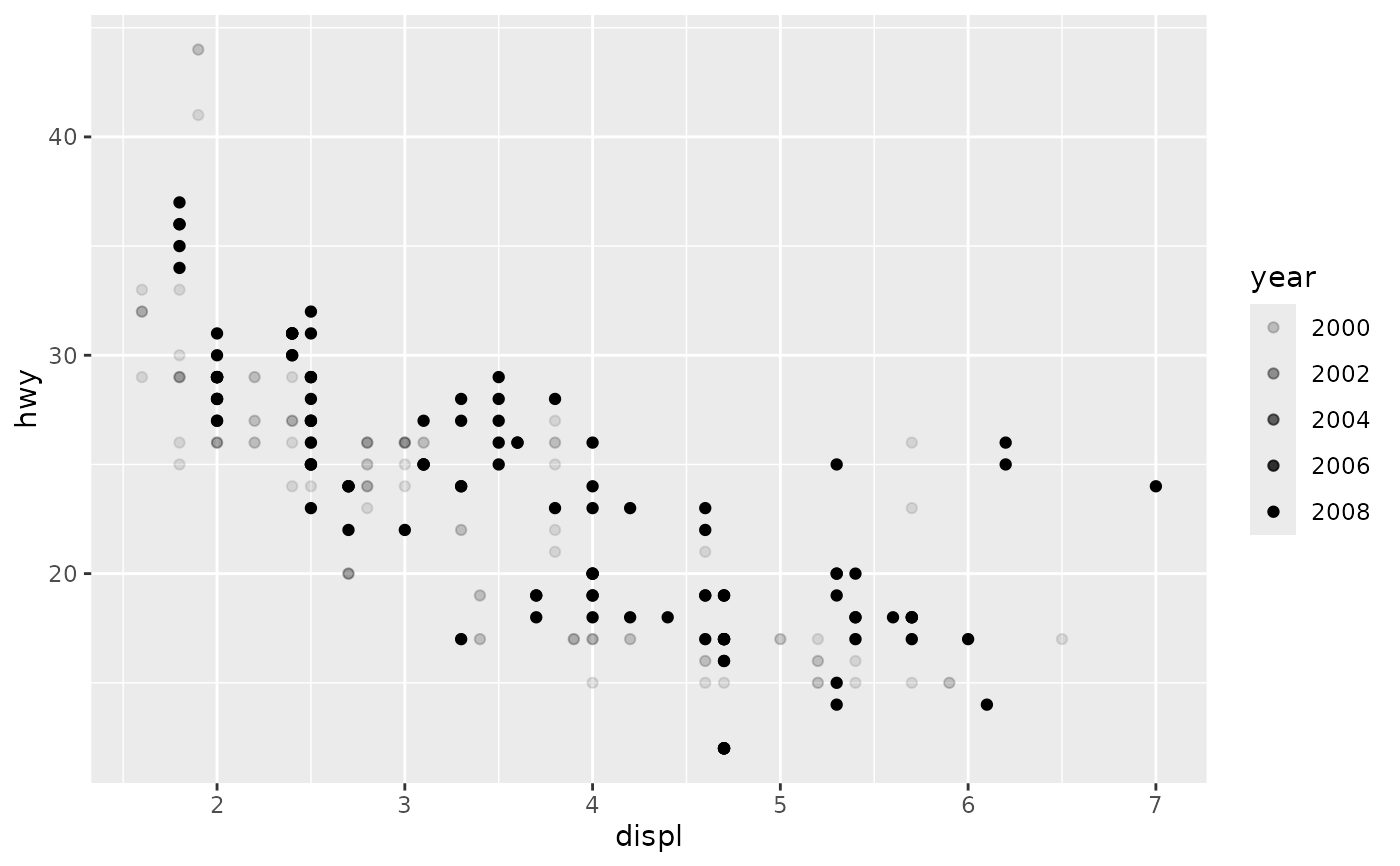
p <- ggplot(mpg, aes(displ, hwy)) +
geom_point(aes(alpha = year))
# The default range of 0.1-1.0 leaves all data visible
p
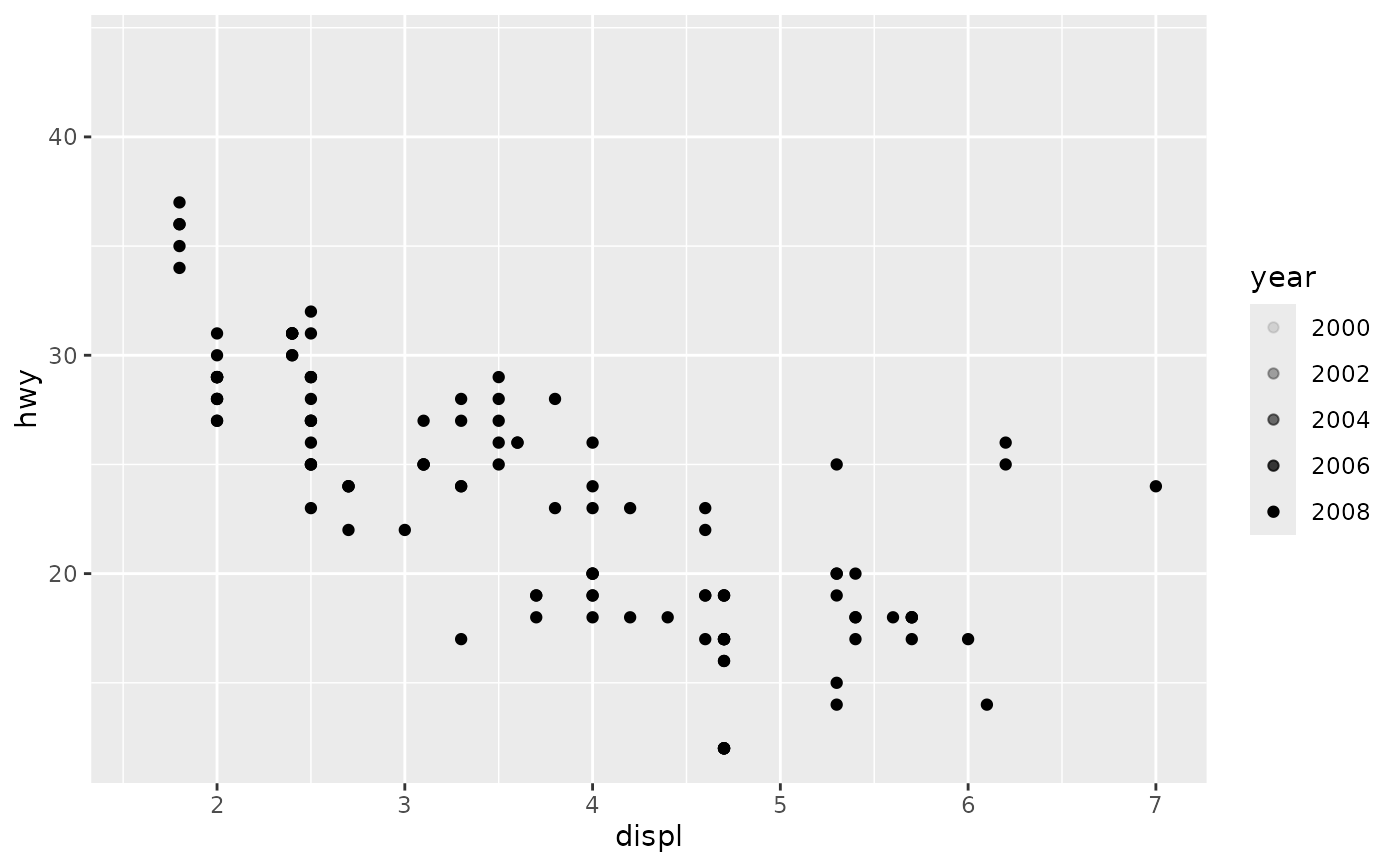
 # Include 0 in the range to make data invisible
p + scale_alpha(range = c(0, 1))
# Include 0 in the range to make data invisible
p + scale_alpha(range = c(0, 1))
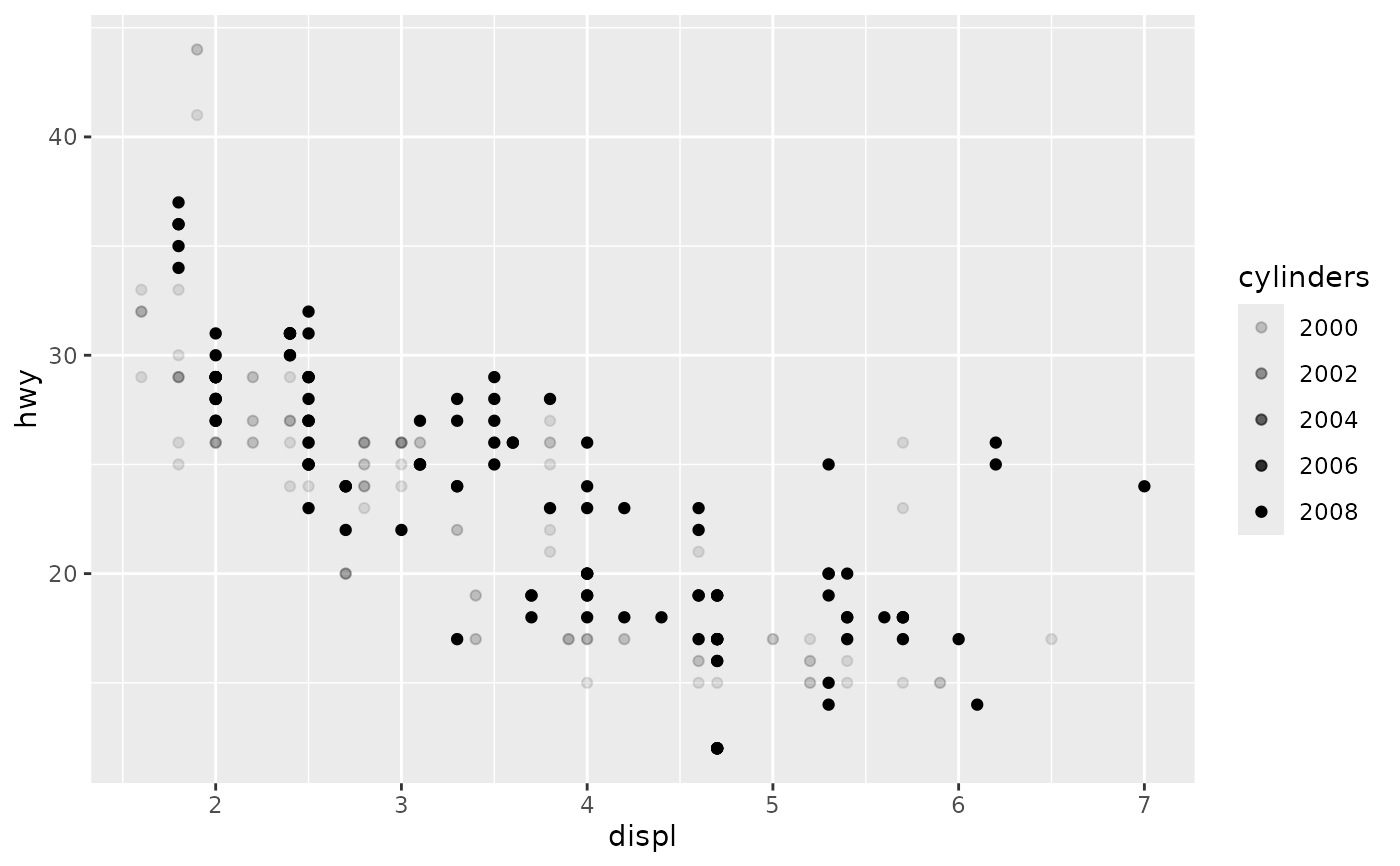
 # Changing the title
p + scale_alpha("cylinders")
# Changing the title
p + scale_alpha("cylinders")