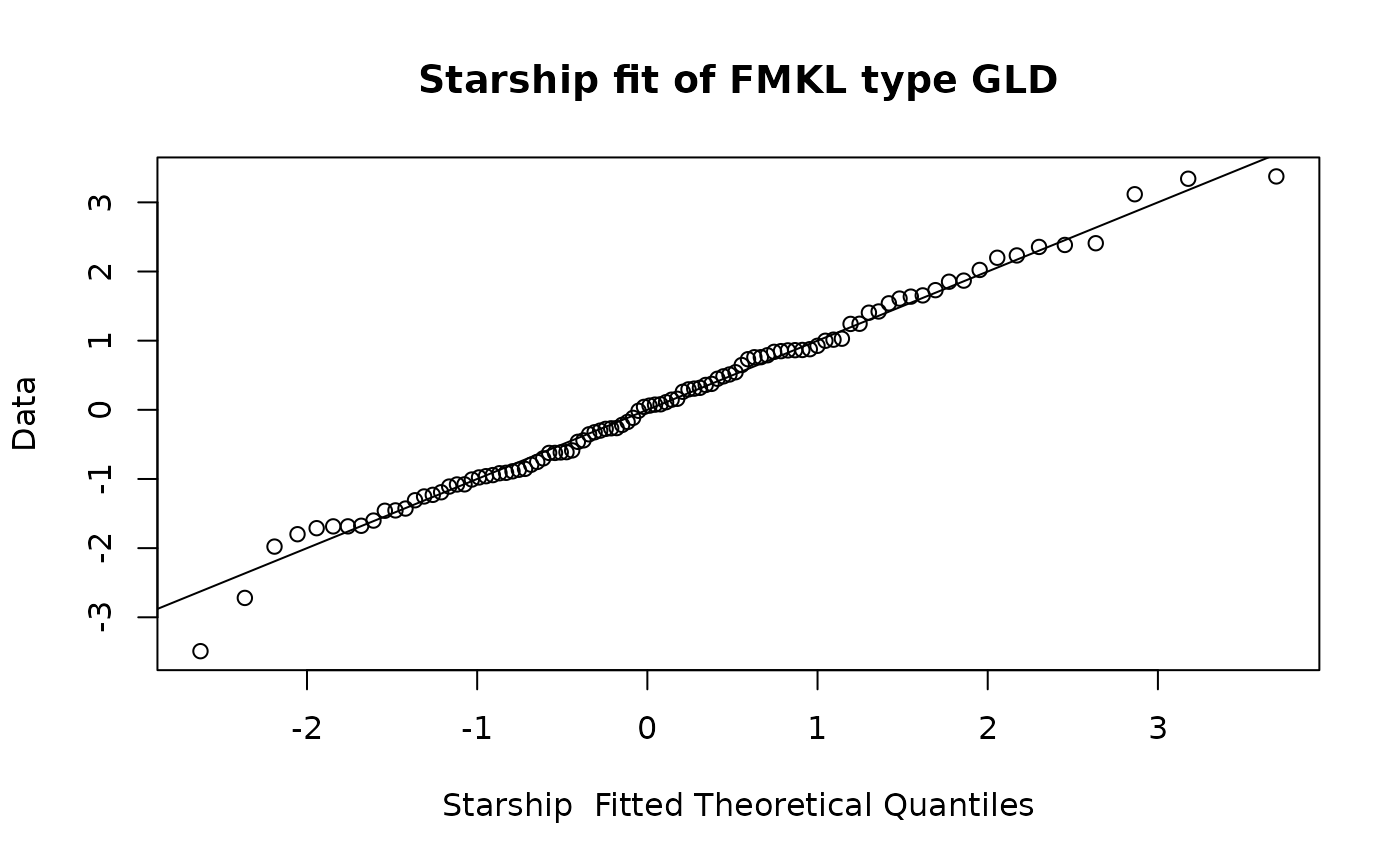
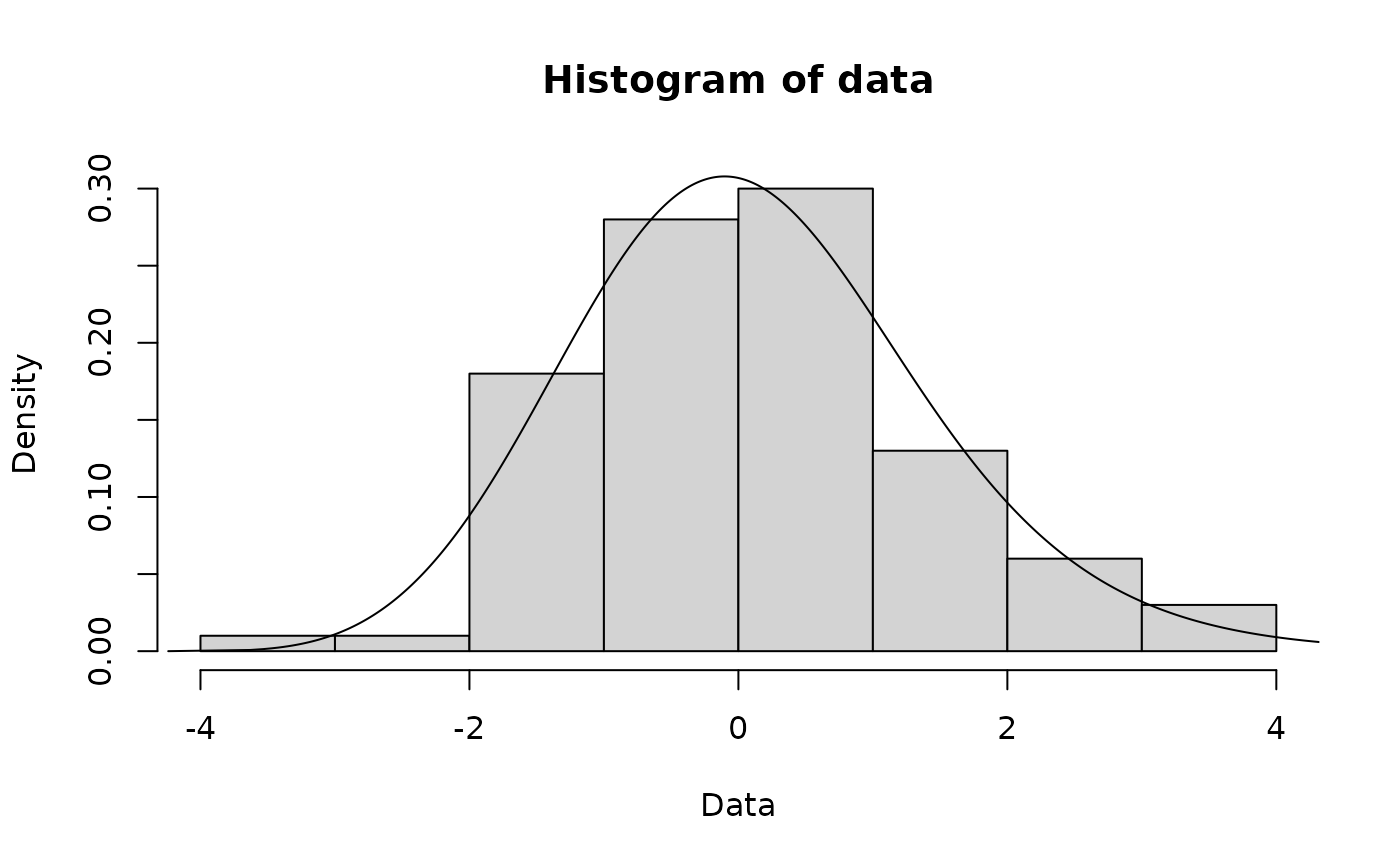
Plots to compare a fitted generalised lambda distribution to data
plot.starship.RdPlots to compare a fitted Generalised Lambda Distribution to data. This works with fitted gld objects from starship or fit.fkml.
# S3 method for class 'starship'
plot(x, data, ask = NULL, one.page = FALSE,
    breaks = "Sturges", plot.title = "default",granularity=10000,...)
Arguments
- x
An object of class
starship. These are produced by the fitting functionsfit.fkmlandstarship.- data
Data to which the gld was fitted. Leave this as NULL if the return.data argument was TRUE in the call that created (
starshiporfit.fkml)- ask
Ask for user input before next plot. The default of NULL changes to TRUE if one.page is FALSE and
plotis called interactively, otherwise it changes to FALSE this is then passed topar(ask). Does not permanently change this setting. The argument is ignored ifone.pageis TRUE- one.page
If TRUE, put the two plots on one page using
par(mfrow=c(2,1)). Does not permanently change this setting.- breaks
Control the number of histogram bins — passed to
hist.- plot.title
Main title for histogram and QQ — passed to
hist(main=)andqqgl(main=). If you set this to"default", it will include the fitting method and gld type, for example “Starship fit of FMKL type GLD”.- granularity
The number of points to calculate the quantile function for the QQ plot. Values less than 30 or more than 10000000 are changed to the default
- ...
Details
This function produces a Q-Q plot of the data against the fitted generalised lambda distribution and a histogram of the data overlaid with the fitted probability density function.
References
Freimer, M., Mudholkar, G. S., Kollia, G. & Lin, C. T. (1988), A study of the generalized tukey lambda family, Communications in Statistics - Theory and Methods 17, 3547–3567.
Ramberg, J. S. & Schmeiser, B. W. (1974), An approximate method for generating asymmetric random variables, Communications of the ACM 17, 78–82.
King, R.A.R. & MacGillivray, H. L. (1999), A starship method for fitting the generalised \(\lambda\) distributions, Australian and New Zealand Journal of Statistics 41, 353–374