The gridpattern package supports heraldic color hatching
via grid.pattern_hatch(). Hatching encodes color
information using patterns of lines and dots, allowing images to be
reproduced in black and white while retaining color identity.
Four systems are supported via the subtype argument:
-
"combinatorial"(default): extends the seven standard Petra Sancta tinctures with systematically derived mixed-color combinations following three rules:- white combined with a color is represented by dashed lines
- yellow combined with a color is represented by dotdash lines
- color combined with a color is represented by crossing solid lines
"fox-davies": contains the sixteen hatchings from Fox-Davies’ A Complete Guide to Heraldry covering the seven standard Petra Sancta tinctures plus nine extensions from German heraldry."goodman": contains all the hatchings from David Goodman’s Heraldic Tincture reference (v2.0, 2024)."unicode": the system used in the official Unicode character chart pdfs to render “colored” (emoji) glyphs in black-and-white.
Use names_hatch() to query supported tincture names for
a given subtype. The “hatch” pattern will also coerce some of the more
common color names to the right tincture e.g. “gold” and “yellow” will
be both coerced to “or” and vice versa.
library("grid")
library("gridpattern")
names_hatch()
#>  [1] "black"      "blue"       "brown"      "green"      "grey"
#>  [6] "lavender"   "light blue" "lime green" "magenta"    "mint green"
#> [11] "olive"      "orange"     "pink"       "purple"     "red"
#> [16] "rose"       "slate"      "teal"       "umbre"      "violet"
#> [21] "white"      "yellow"
names_hatch("fox-davies")
#>  [1] "argent"       "azure"        "bleu celeste" "brunatre"     "carnation"
#>  [6] "cendree"      "eisenfarbe"   "gules"        "or"           "orange"
#> [11] "proper"       "purpure"      "sable"        "sanguine"     "tenne"
#> [16] "vert"
names_hatch("goodman")
#>  [1] "argent"       "azure"        "bleu celeste" "bronze"       "brunatre"
#>  [6] "carnation"    "cendree"      "copper"       "gules"        "lead"
#> [11] "murrey"       "or"           "orange"       "purpure"      "rose"
#> [16] "sable"        "sanguine"     "steel"        "tenne"        "vert"
names_hatch("unicode")
#>  [1] "black"      "blue"       "brown"      "green"      "grey"
#>  [6] "light blue" "orange"     "pink"       "purple"     "red"
#> [11] "white"      "yellow"
Combinatorial color hatching
The default "combinatorial" subtype starts from the set
of five Munsell
primary colors of red, yellow, green, blue, and purple plus black
and white and the standard Petra Sancta color hatching system and then
systematically derives additional color hatchings via three rules:
- white + color → dashed lines
- yellow + color → dotdash lines
- color + color → crossing solid lines
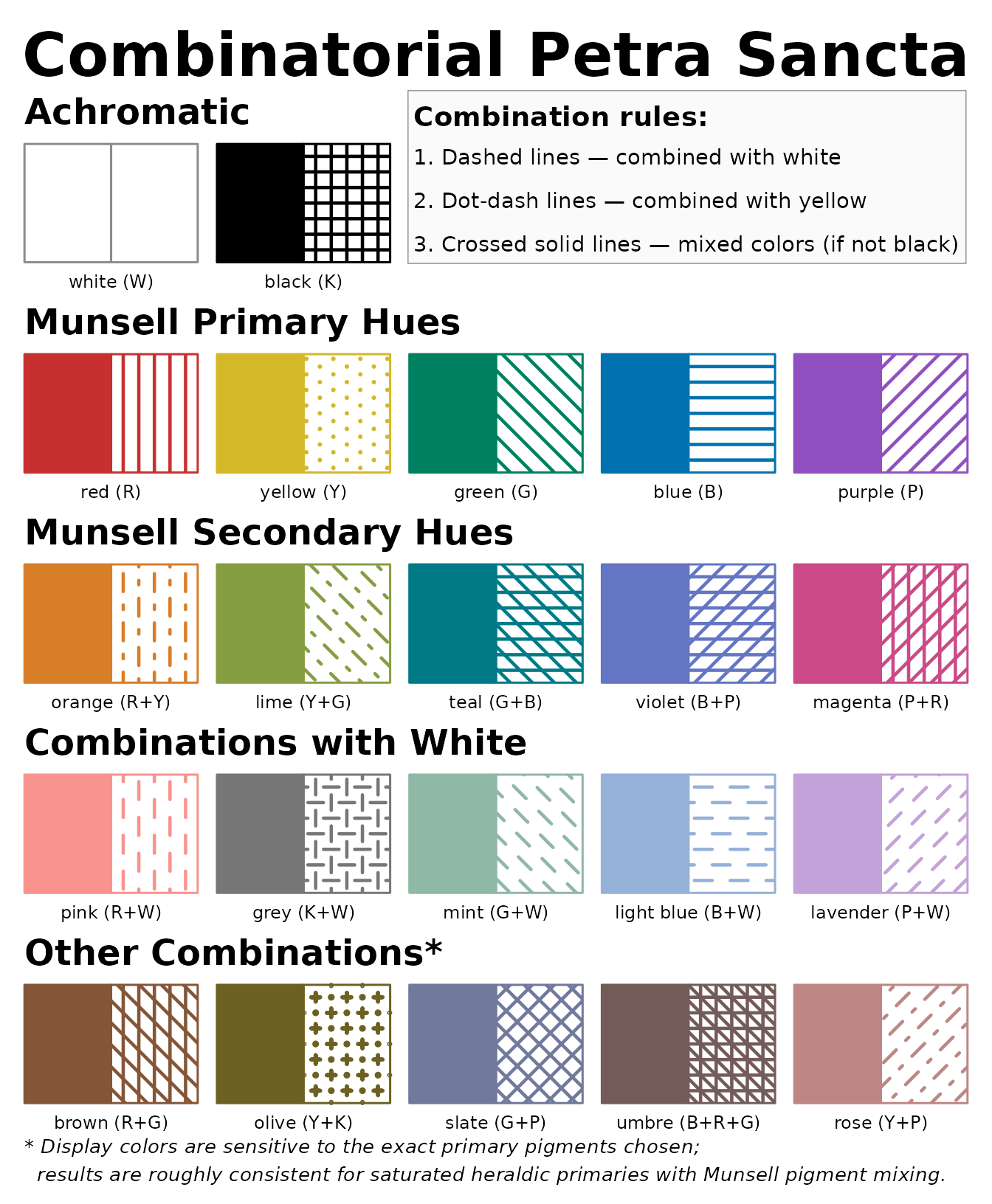
Note: The mixed display colors shown above can be sensitive to the exact hex values chosen for the primaries. The results are fairly consistent when the primaries are the saturated, high-chroma colors typical of heraldry combined with Munsell pigment mixing but softer or more neutral primaries can shift some secondaries noticeably (for example, mixing yellow and blue can yield anything from olive-grey to muted purple depending on the blue’s hue angle).
Heraldic tincture hatching
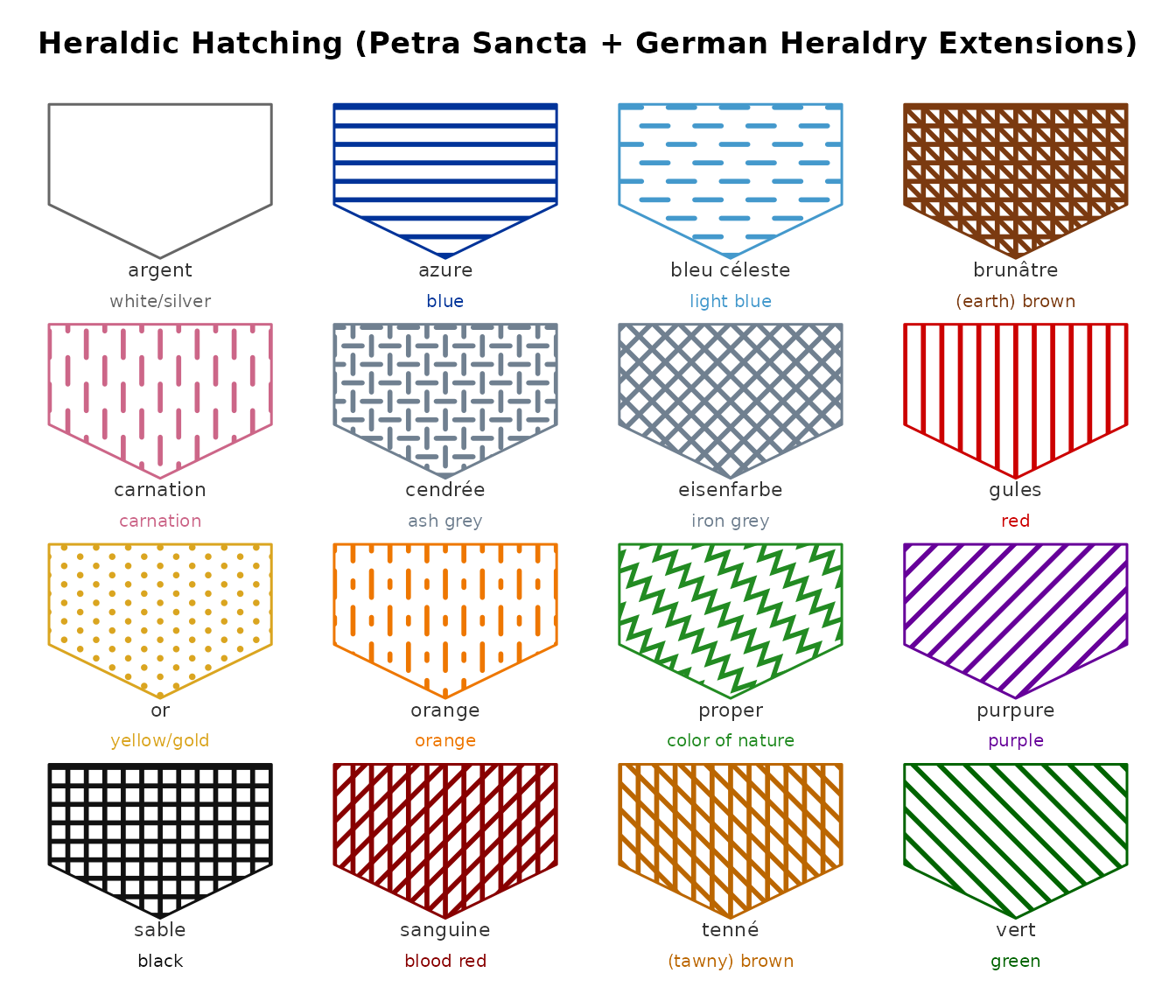
Fox-Davies
The "fox-davies" hatching subtype includes the seven
standard tinctures plus nine extensions from German heraldry whose
hatchings were included in Fox-Davies’ A
Complete Guide to Heraldry.
Goodman
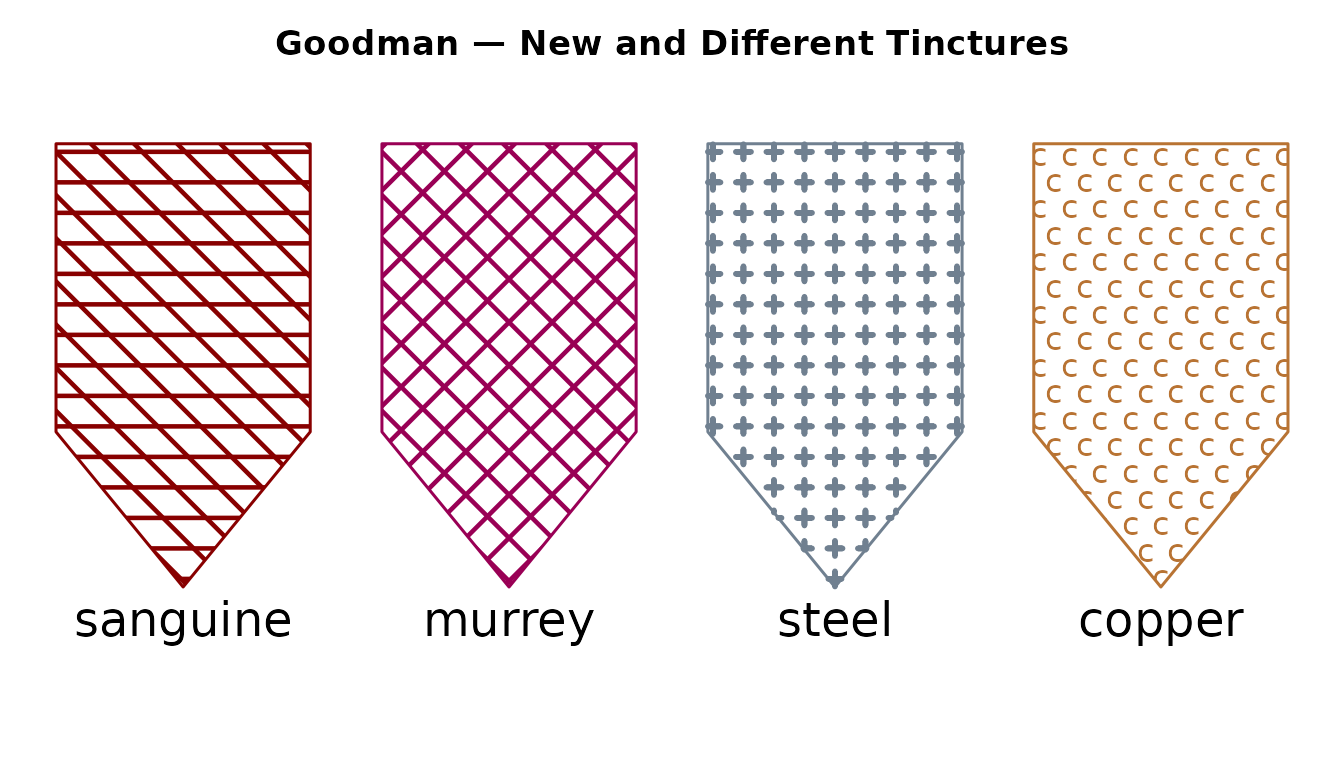
The "goodman" hatching subtype includes all the
hatchings in David Goodman’s Heraldic
Tincture reference (v2.0, 2024). This shares most hatchings with
Fox-Davies but differs in few ways:
- Goodman’s sanguine hatching instead uses horizontal
plus diagonal
\crossing lines. - Goodman also has a distinct murrey hatching which uses crossing diagonal lines (Fox-Davies’ instead uses this hatching for the eisenfarbe (iron grey) hatching).
- New rose with the same hatching as carnation (which Goodman also lists).
- New steel metal rendered as plus signs in a square grid.
- New copper, bronze, and lead metals which are each rendered as the letter “c” in a hex grid.
- Goodman omits the proper hatching that Fox-Davies included.
Unicode color hatching
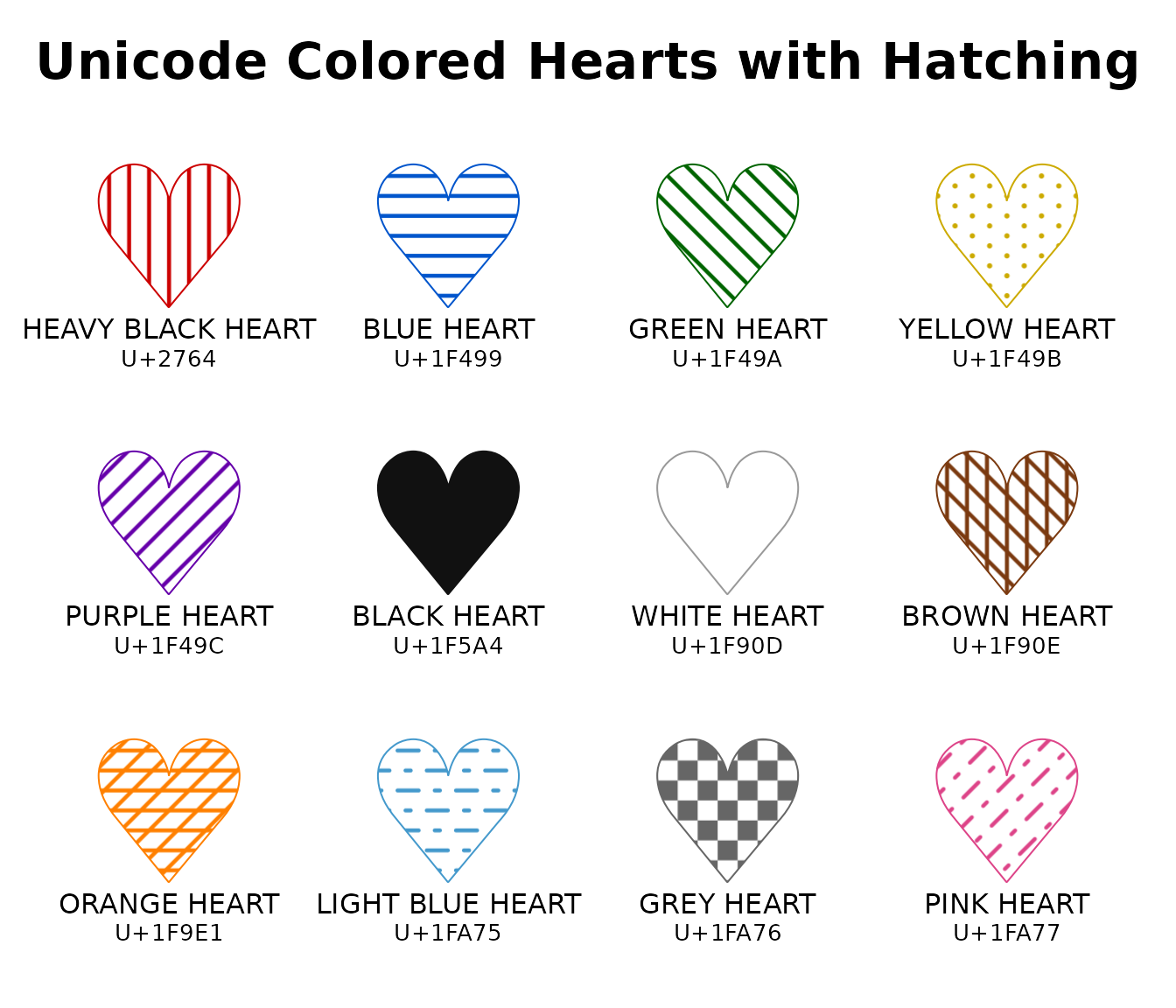
The "unicode" hatching subtype provides each of the
hatching used in the official Unicode character chart pdfs to assign a
distinct pattern to each color to render “colored” (emoji) glyphs in
black-and-white. Notably Unicode has twelve different colored
heart emoji (red, blue, green, yellow, purple, black, white, brown,
orange, light blue, grey, pink) that each needed a separate
hatching.
Okabe-Ito hatching
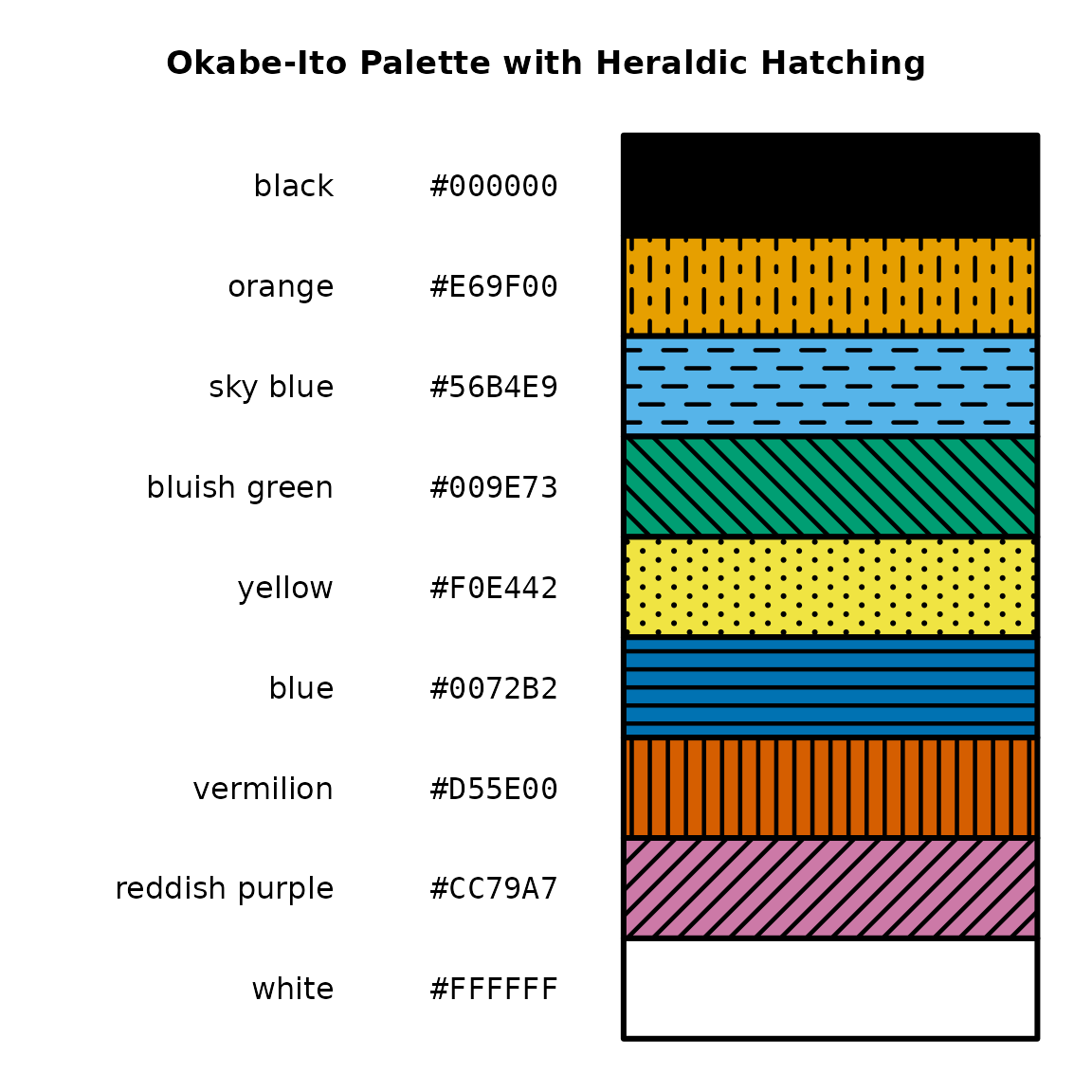
One of the techniques to meet Web Content Accessibility Guidelines (WCAG) is to use color and pattern to ensure things are accessible to the color-blind.
The Okabe-Ito palette is a widely used colorblind-friendly palette. Here is an example of adding a simple hatching scheme to go with this palette to provide visual redundancy:
- “yellow”, “blue”, and “white” are given their standard Petra Sancta hatchings
- “reddish purple” is given a “purple” Petra Sancta hatching
- “bluish green” is given a “green” Petra Sancta hatching
- “vermillion” (red orange) is given a “red” Petra Sancta hatching
- we use a simple black fill for “black” instead of a “sable” crosshatch
- “orange” and “sky blue” are given the hatchings from German heraldry (see Fox-Davies’ section above)
oi_names <- c(
    "black", "orange", "sky blue", "bluish green",
    "yellow", "blue", "vermilion", "reddish purple", "white"
)
oi_hex <- c(
    "#000000", "#E69F00", "#56B4E9", "#009E73",
    "#F0E442", "#0072B2", "#D55E00", "#CC79A7", "#FFFFFF"
)
oi_hatch <- c(
    NA, "orange", "bleu celeste", "vert",
    "or", "azure", "gules", "purpure", NA
)
sx <- c(0, 0, 1, 1)
sy <- c(1, 0, 0, 1)
n <- length(oi_names)

grid.newpage()
grid.rect(gp = gpar(fill = "white", col = NA))
pushViewport(viewport(width = 0.90, height = 0.94))
grid.text(
    "Okabe-Ito Palette with Heraldic Hatching",
    y = unit(1, "npc") - unit(0.25, "cm"),
    just = "top",
    gp = gpar(fontsize = 13, fontface = "bold")
)
pushViewport(viewport(
    y = 0.46, height = 0.88,
    layout = grid.layout(
        n, 3,
        widths = unit(c(3, 2.5, 4), "null"),
        heights = unit(rep(1, n), "null")
    )
))

for (i in seq_len(n)) {
    grid.text(oi_names[i], x = 0.90, just = "right",
              gp = gpar(fontsize = 12, col = "black"),
              vp = viewport(layout.pos.row = i, layout.pos.col = 1))

    grid.text(oi_hex[i],
              gp = gpar(fontsize = 12, fontfamily = "mono", col = "black"),
              vp = viewport(layout.pos.row = i, layout.pos.col = 2))

    pushViewport(viewport(layout.pos.row = i, layout.pos.col = 3))
    grid.rect(gp = gpar(fill = oi_hex[i], col = "black", lwd = 3.0))
    if (!is.na(oi_hatch[i])) {
        grid.pattern_hatch(sx, sy, type = oi_hatch[i],
                           colour = "black", spacing = 0.18, linewidth = 0.8)
    }
    popViewport()
}

popViewport()
popViewport()