Plot Method for "lmrob" Objects
plot.lmrob.RdDiagnostic plots for elements of class lmrob
# S3 method for class 'lmrob'
plot(x, which = 1:5,
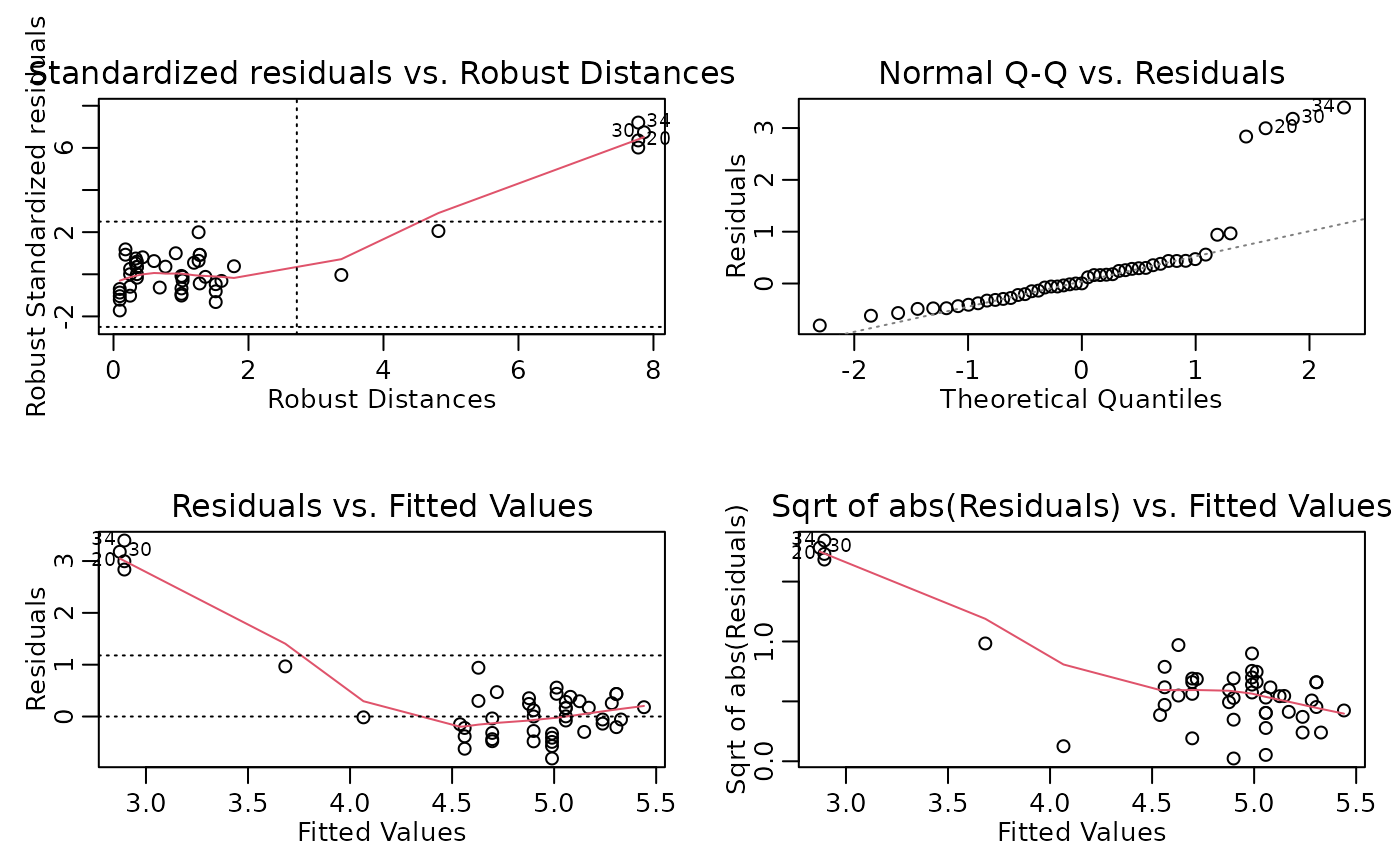
     caption = c("Standardized residuals vs. Robust Distances",
   "Normal Q-Q vs. Residuals", "Response vs. Fitted Values",
   "Residuals vs. Fitted Values" , "Sqrt of abs(Residuals) vs. Fitted Values"),
   panel = if(add.smooth) panel.smooth else points,
   sub.caption = deparse(x$call), main = "",
   compute.MD = TRUE,
   ask = prod(par("mfcol")) < length(which) && dev.interactive(),
   id.n = 3, labels.id = names(residuals(x)), cex.id = 0.75,
   label.pos = c(4,2), qqline = TRUE, add.smooth = getOption("add.smooth"),
   ..., p=0.025)
Arguments
- x
an object as created by
lmrob- which
integer number between 1 and 5 to specify which plot is desired
- caption
Caption for the different plots
- panel
panel function. The useful alternative to
points,panel.smoothcan be chosen byadd.smooth = TRUE.- main
main title
- sub.caption
sub titles
- compute.MD
logical indicating if the robust Mahalanobis distances should be recomputed, using
covMcd()when needed, i.e., ifwhichcontains1.- ask
waits for user input before displaying each plot
- id.n
number of points to be labelled in each plot, starting with the most extreme.
- labels.id
vector of labels, from which the labels for extreme points will be chosen.
NULLuses observation numbers.- cex.id
magnification of point labels.
- label.pos
positioning of labels, for the left half and right half of the graph respectively.
References
Robust diagnostic plots as in Rousseeuw and van Zomeren (1990), see
‘References’ in ltsPlot.
Details
if compute.MD = TRUE and the robust Mahalanobis distances need
to be computed, they are stored (“cached”) with the object
x when this function has been called from top-level.
Examples
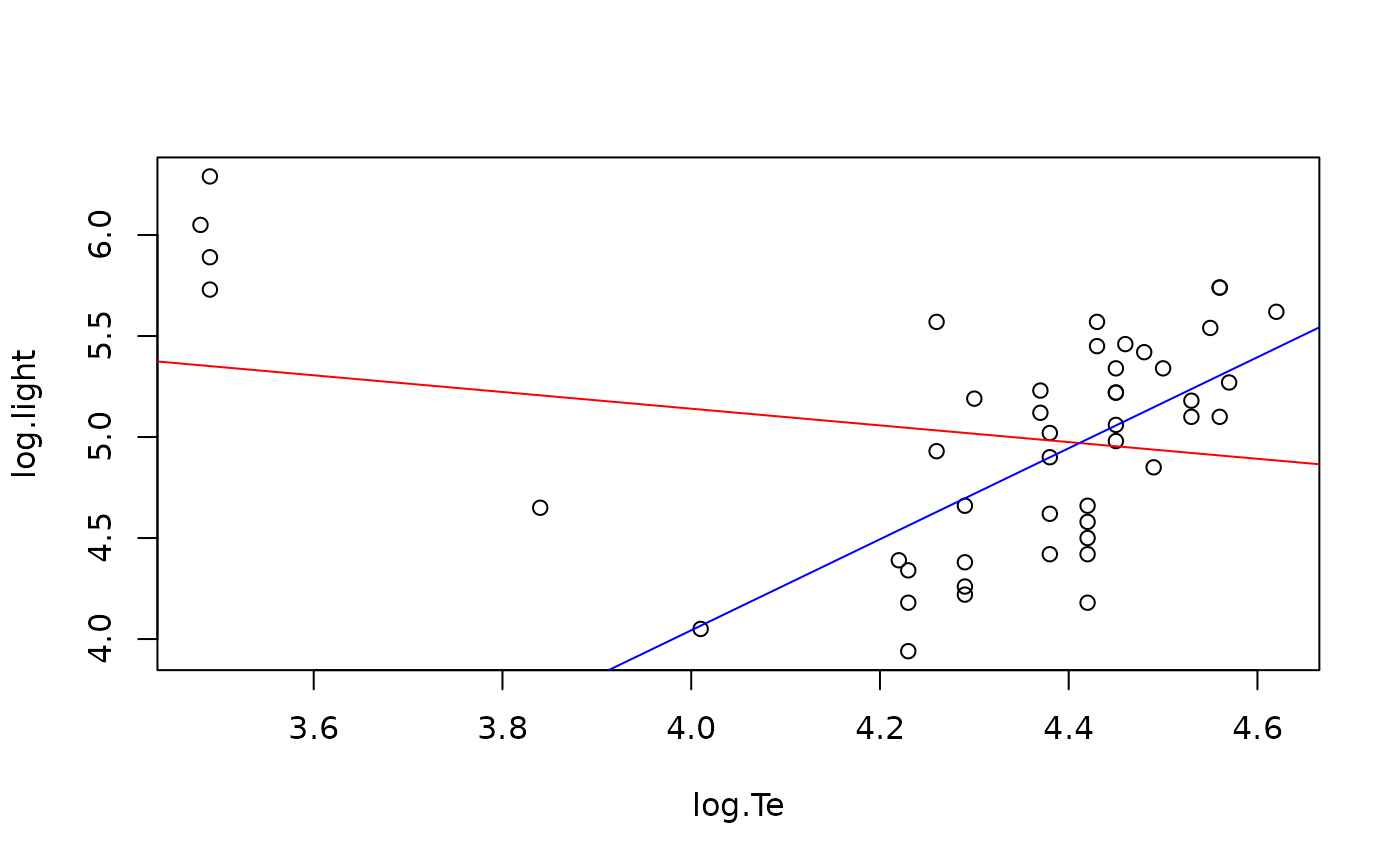
data(starsCYG)
## Plot simple data and fitted lines
plot(starsCYG)
lmST <- lm(log.light ~ log.Te, data = starsCYG)
RlmST <- lmrob(log.light ~ log.Te, data = starsCYG)
RlmST
#>
#> Call:
#> lmrob(formula = log.light ~ log.Te, data = starsCYG)
#> \--> method = "MM"
#> Coefficients:
#> (Intercept) log.Te
#> -4.969 2.253
#>
abline(lmST, col = "red")
abline(RlmST, col = "blue")
 op <- par(mfrow = c(2,2), mgp = c(1.5, 0.6, 0), mar= .1+c(3,3,3,1))
plot(RlmST, which = c(1:2, 4:5))
#> recomputing robust Mahalanobis distances
op <- par(mfrow = c(2,2), mgp = c(1.5, 0.6, 0), mar= .1+c(3,3,3,1))
plot(RlmST, which = c(1:2, 4:5))
#> recomputing robust Mahalanobis distances
 par(op)