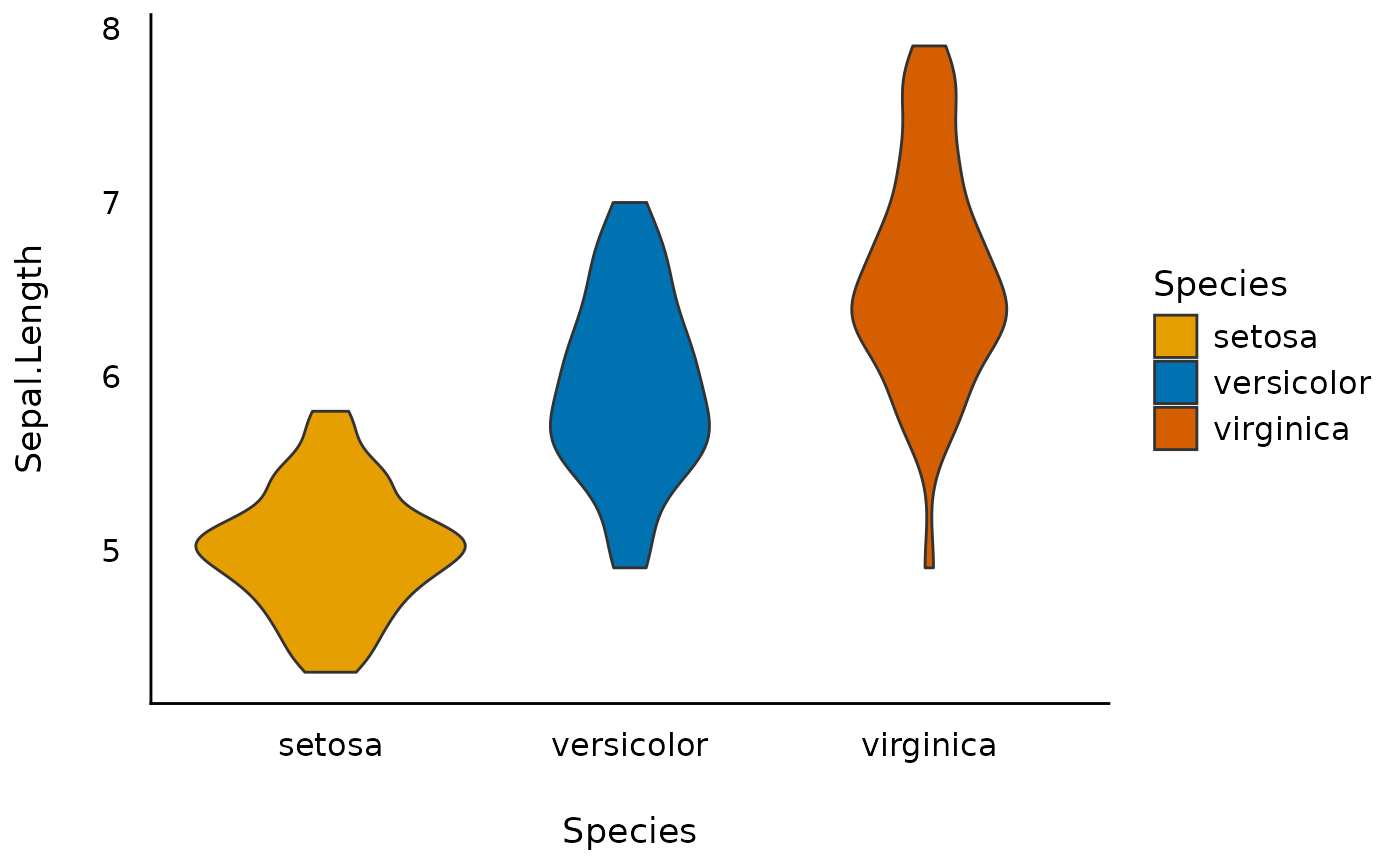
The Okabe-Ito color palette was proposed by Okabe and Ito (2008) as a qualitative color palette that is accessible to people with a variety of forms of color vision deficiency. In addition to being accessible, it includes 9 vivid colors that are readily nameable and include colors that correspond to major primary and secondary colors (e.g., red, yellow, blue).
scale_color_okabeito(
  palette = "full",
  reverse = FALSE,
  order = 1:9,
  aesthetics = "color",
  ...
)

scale_fill_okabeito(
  palette = "full",
  reverse = FALSE,
  order = 1:9,
  aesthetics = "fill",
  ...
)

scale_colour_okabeito(
  palette = "full",
  reverse = FALSE,
  order = 1:9,
  aesthetics = "color",
  ...
)

scale_colour_oi(
  palette = "full",
  reverse = FALSE,
  order = 1:9,
  aesthetics = "color",
  ...
)

scale_color_oi(
  palette = "full",
  reverse = FALSE,
  order = 1:9,
  aesthetics = "color",
  ...
)

scale_fill_oi(
  palette = "full",
  reverse = FALSE,
  order = 1:9,
  aesthetics = "fill",
  ...
)
Arguments
- palette
Character name of palette. Depending on the color scale, can be one of
"full","ice","rainbow","complement","contrast","light"(for dark themes),"black_first",full_original, orblack_first_original. The latter three options are especially for the Okabe-Ito color palette. The default isNULLand either"contrast"or"gradient"is used (depending on whetherdiscreteisTRUEorFALSE), which are the two scale useful for discrete or gradient color scales, respectively.- reverse
Boolean indicating whether the palette should be reversed.
- order
A vector of numbers from 1 to 9 indicating the order of colors to use (default:
1:9)- aesthetics
A vector of names of the aesthetics that this scale should be applied to (e.g.,
c('color', 'fill')).- ...
Additional arguments to pass to
colorRampPalette().
Details
The Okabe-Ito palette is included in the base R
grDevices::palette.colors(). These functions make this palette easier to
use with ggplot2.
The original Okabe-Ito palette's "yellow" color is "#F0E442". This color is
very bright and often does not show up well on white backgrounds (see
here)
for a discussion of this issue). Accordingly, by default, this function uses
a darker more "amber" color for "yellow" ("#F5C710"). This color is the
"yellow" color used in base R >4.0's default color palette.
The palettes "full" and "black_first" use this darker yellow color. For
the original yellow color suggested by Okabe and Ito ("#F0E442"), use
palettes "full_original" or "black_first_original".
The Okabe-Ito palette is only available as a discrete palette. For color-accessible continuous variables, consider the viridis palettes.
References
Okabe, M., & Ito, K. (2008). Color universal design (CUD): How to make figures and presentations that are friendly to colorblind people. https://jfly.uni-koeln.de/color/#pallet (Original work published 2002)
Examples
library(ggplot2)
library(see)
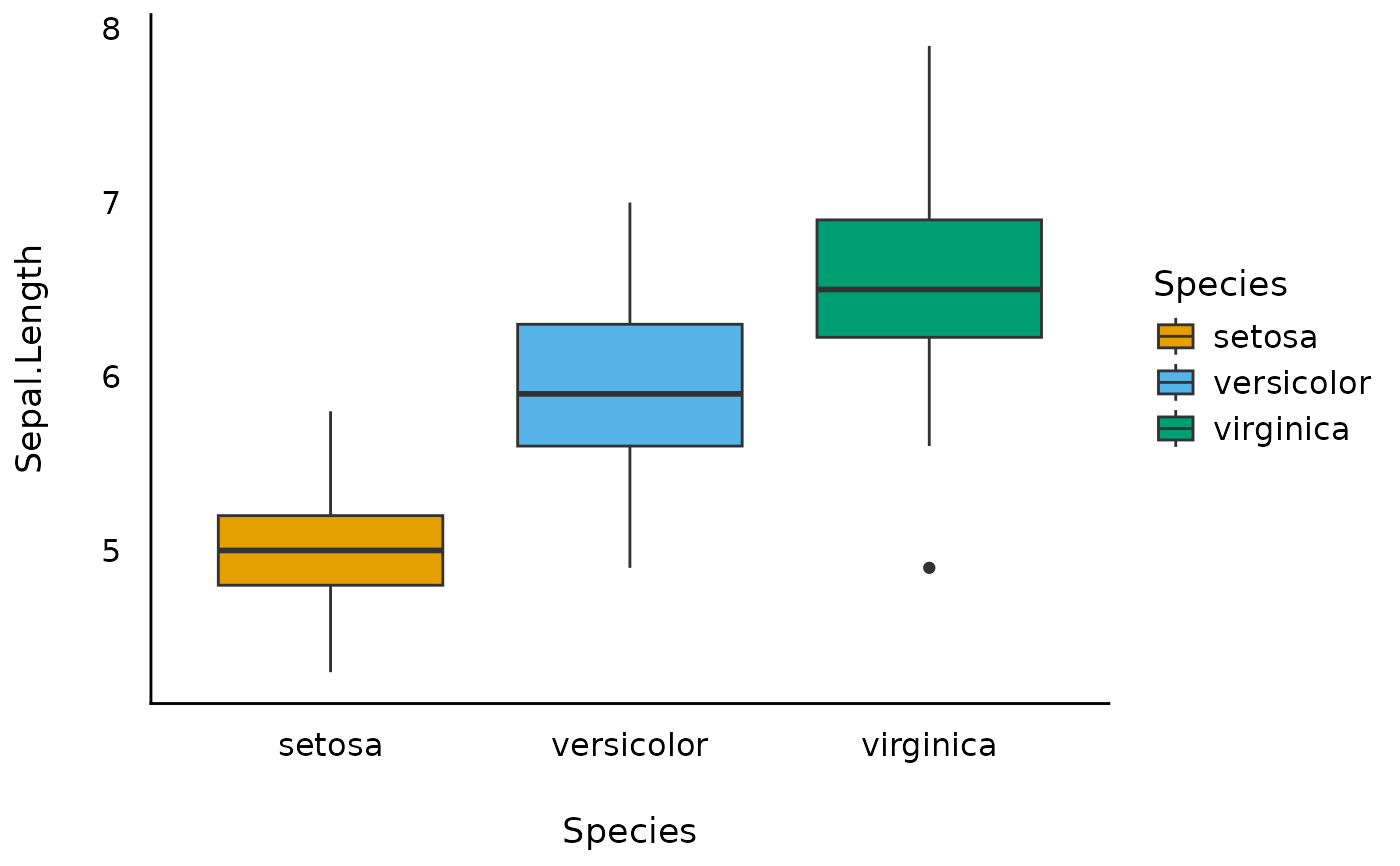
ggplot(iris, aes(x = Species, y = Sepal.Length, fill = Species)) +
geom_boxplot() +
theme_modern() +
scale_fill_okabeito()
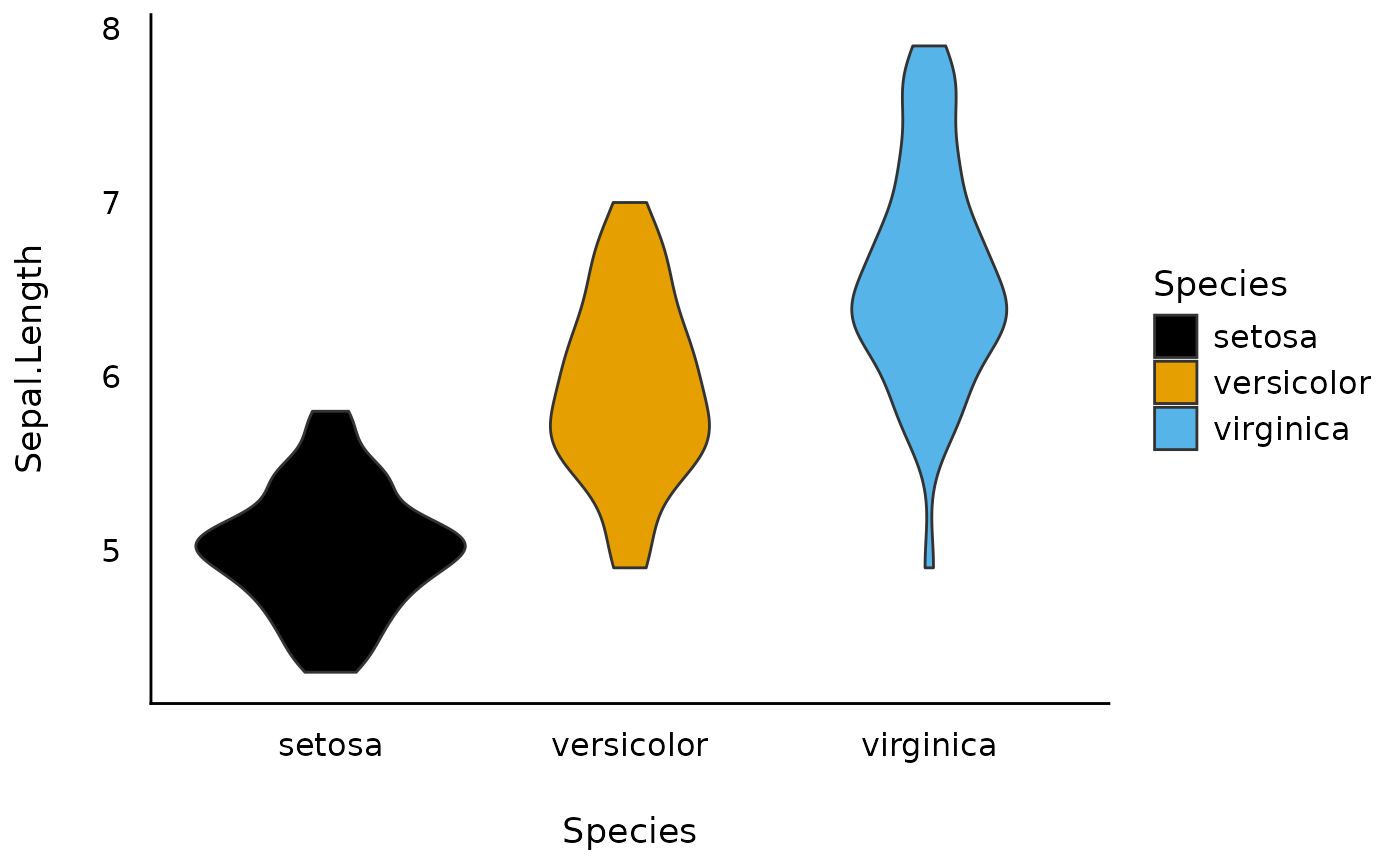
 ggplot(iris, aes(x = Species, y = Sepal.Length, fill = Species)) +
geom_violin() +
theme_modern() +
scale_fill_oi(palette = "black_first")
ggplot(iris, aes(x = Species, y = Sepal.Length, fill = Species)) +
geom_violin() +
theme_modern() +
scale_fill_oi(palette = "black_first")
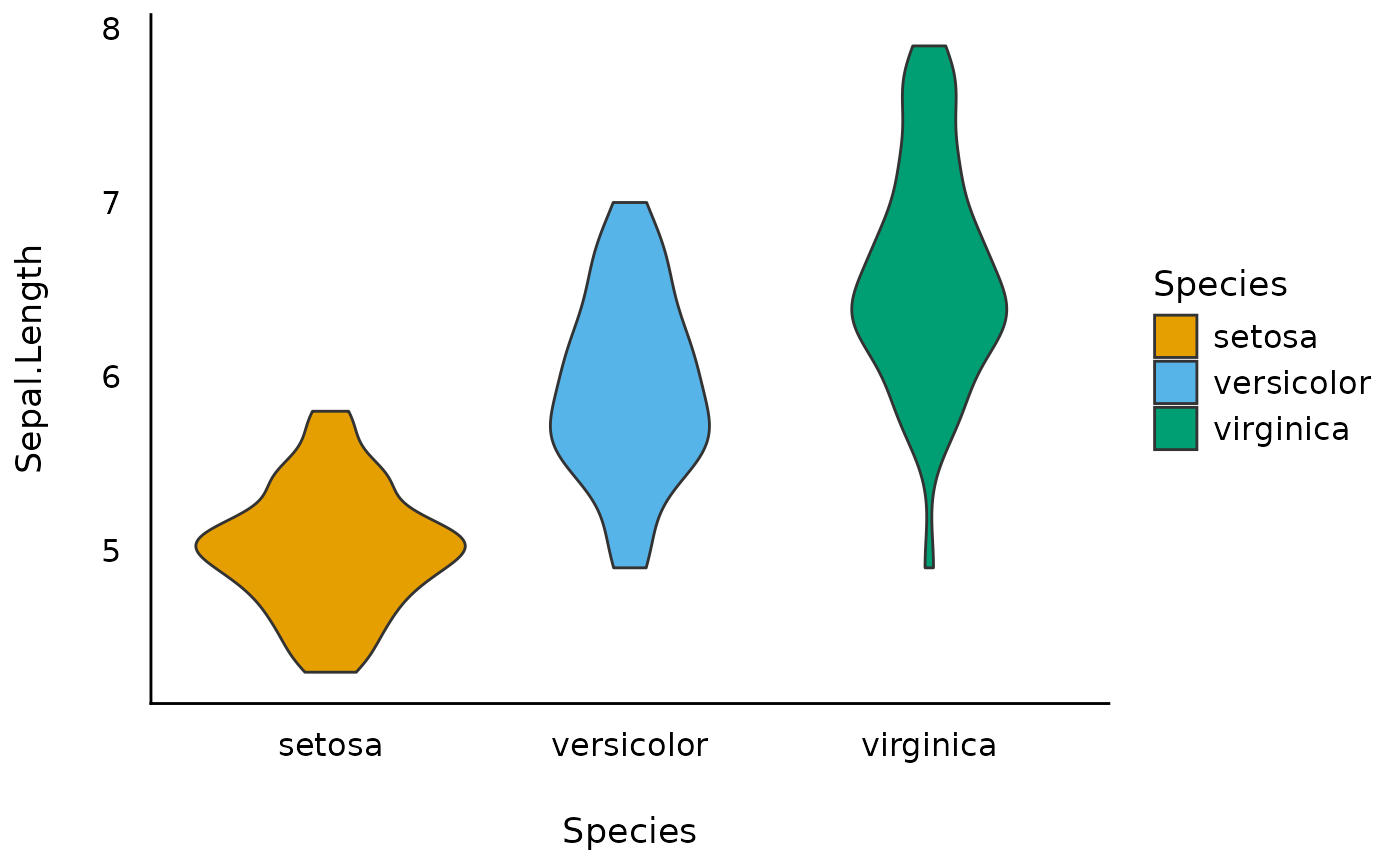
 # for the original brighter yellow color suggested by Okabe and Ito
ggplot(iris, aes(x = Species, y = Sepal.Length, fill = Species)) +
geom_violin() +
theme_modern() +
scale_fill_oi(palette = "full")
# for the original brighter yellow color suggested by Okabe and Ito
ggplot(iris, aes(x = Species, y = Sepal.Length, fill = Species)) +
geom_violin() +
theme_modern() +
scale_fill_oi(palette = "full")
 ggplot(iris, aes(x = Species, y = Sepal.Length, fill = Species)) +
geom_violin() +
theme_modern() +
scale_fill_oi(order = c(1, 5, 6, 2, 4, 3, 7))
ggplot(iris, aes(x = Species, y = Sepal.Length, fill = Species)) +
geom_violin() +
theme_modern() +
scale_fill_oi(order = c(1, 5, 6, 2, 4, 3, 7))