Censored Gumbel Distribution
cens.gumbel.RdMaximum likelihood estimation of the 2-parameter Gumbel distribution when there are censored observations. A matrix response is not allowed.
cens.gumbel(llocation = "identitylink", lscale = "loglink",
            iscale = NULL, mean = TRUE, percentiles = NULL,
            zero = "scale")
Arguments
- llocation, lscale
Character. Parameter link functions for the location and (positive) \(scale\) parameters. See
Linksfor more choices.- iscale
Numeric and positive. Initial value for \(scale\). Recycled to the appropriate length. In general, a larger value is better than a smaller value. The default is to choose the value internally.
- mean
Logical. Return the mean? If
TRUEthen the mean is returned, otherwise percentiles given by thepercentilesargument.- percentiles
Numeric with values between 0 and 100. If
mean=FALSEthen the fitted values are percentiles which must be specified by this argument.- zero
An integer-valued vector specifying which linear/additive predictors are modelled as intercepts only. The value (possibly values) must be from the set {1,2} corresponding respectively to \(location\) and \(scale\). If
zero=NULLthen all linear/additive predictors are modelled as a linear combination of the explanatory variables. The default is to fit the shape parameter as an intercept only. SeeCommonVGAMffArgumentsfor more information.
Details
This VGAM family function is like gumbel
but handles observations that are left-censored (so that
the true value would be less than the observed value) else
right-censored (so that the true value would be greater than
the observed value). To indicate which type of censoring,
input
extra = list(leftcensored = vec1, rightcensored = vec2)
where vec1 and vec2 are logical vectors
the same length as the response.
If the two components of this list are missing then the
logical values are taken to be FALSE. The fitted
object has these two components stored in the extra
slot.
Value
An object of class "vglmff" (see
vglmff-class). The object is used by modelling
functions such as vglm and vgam.
References
Coles, S. (2001). An Introduction to Statistical Modeling of Extreme Values. London: Springer-Verlag.
Warning
Numerical problems may occur if the amount of censoring is excessive.
Note
See gumbel for details about the Gumbel
distribution. The initial values are based on assuming all
uncensored observations, therefore could be improved upon.
Examples
# Example 1
ystar <- venice[["r1"]] # Use the first order statistic as the response
nn <- length(ystar)
L <- runif(nn, 100, 104) # Lower censoring points
U <- runif(nn, 130, 135) # Upper censoring points
y <- pmax(L, ystar) # Left censored
y <- pmin(U, y) # Right censored
extra <- list(leftcensored = ystar < L, rightcensored = ystar > U)
fit <- vglm(y ~ scale(year), data = venice, trace = TRUE, extra = extra,
fam = cens.gumbel(mean = FALSE, perc = c(5, 25, 50, 75, 95)))
#> Iteration 1: loglikelihood = -160.97954
#> Iteration 2: loglikelihood = -148.06843
#> Iteration 3: loglikelihood = -147.41345
#> Iteration 4: loglikelihood = -147.3925
#> Iteration 5: loglikelihood = -147.38886
#> Iteration 6: loglikelihood = -147.38795
#> Iteration 7: loglikelihood = -147.38772
#> Iteration 8: loglikelihood = -147.38766
#> Iteration 9: loglikelihood = -147.38765
#> Iteration 10: loglikelihood = -147.38765
#> Iteration 11: loglikelihood = -147.38765
coef(fit, matrix = TRUE)
#> location loglink(scale)
#> (Intercept) 112.534500 2.617486
#> scale(year) 7.666845 0.000000
head(fitted(fit))
#> 5% 25% 50% 75% 95%
#> 1 84.60846 95.16601 104.6630 116.7117 140.3367
#> 2 85.12419 95.68174 105.1787 117.2274 140.8524
#> 3 85.63992 96.19747 105.6944 117.7431 141.3681
#> 4 86.15565 96.71320 106.2102 118.2588 141.8838
#> 5 86.67137 97.22892 106.7259 118.7746 142.3996
#> 6 87.18710 97.74465 107.2416 119.2903 142.9153
fit@extra
#> $leftcensored
#> [1] FALSE TRUE FALSE FALSE FALSE FALSE FALSE FALSE TRUE FALSE TRUE TRUE
#> [13] TRUE FALSE FALSE FALSE FALSE FALSE FALSE FALSE FALSE FALSE FALSE FALSE
#> [25] TRUE TRUE FALSE FALSE FALSE FALSE FALSE FALSE FALSE FALSE FALSE FALSE
#> [37] FALSE FALSE FALSE FALSE FALSE FALSE FALSE TRUE FALSE FALSE FALSE FALSE
#> [49] FALSE FALSE FALSE
#>
#> $rightcensored
#> [1] FALSE FALSE FALSE FALSE FALSE TRUE FALSE FALSE FALSE FALSE FALSE FALSE
#> [13] FALSE FALSE FALSE TRUE FALSE FALSE FALSE FALSE TRUE FALSE FALSE FALSE
#> [25] FALSE FALSE FALSE FALSE FALSE TRUE FALSE FALSE FALSE FALSE FALSE TRUE
#> [37] TRUE TRUE TRUE FALSE FALSE FALSE FALSE FALSE FALSE FALSE FALSE TRUE
#> [49] TRUE TRUE TRUE
#>
# Example 2: simulated data
nn <- 1000
ystar <- rgumbel(nn, loc = 1, scale = exp(0.5)) # The uncensored data
L <- runif(nn, -1, 1) # Lower censoring points
U <- runif(nn, 2, 5) # Upper censoring points
y <- pmax(L, ystar) # Left censored
y <- pmin(U, y) # Right censored
if (FALSE) par(mfrow = c(1, 2)); hist(ystar); hist(y); # \dontrun{}
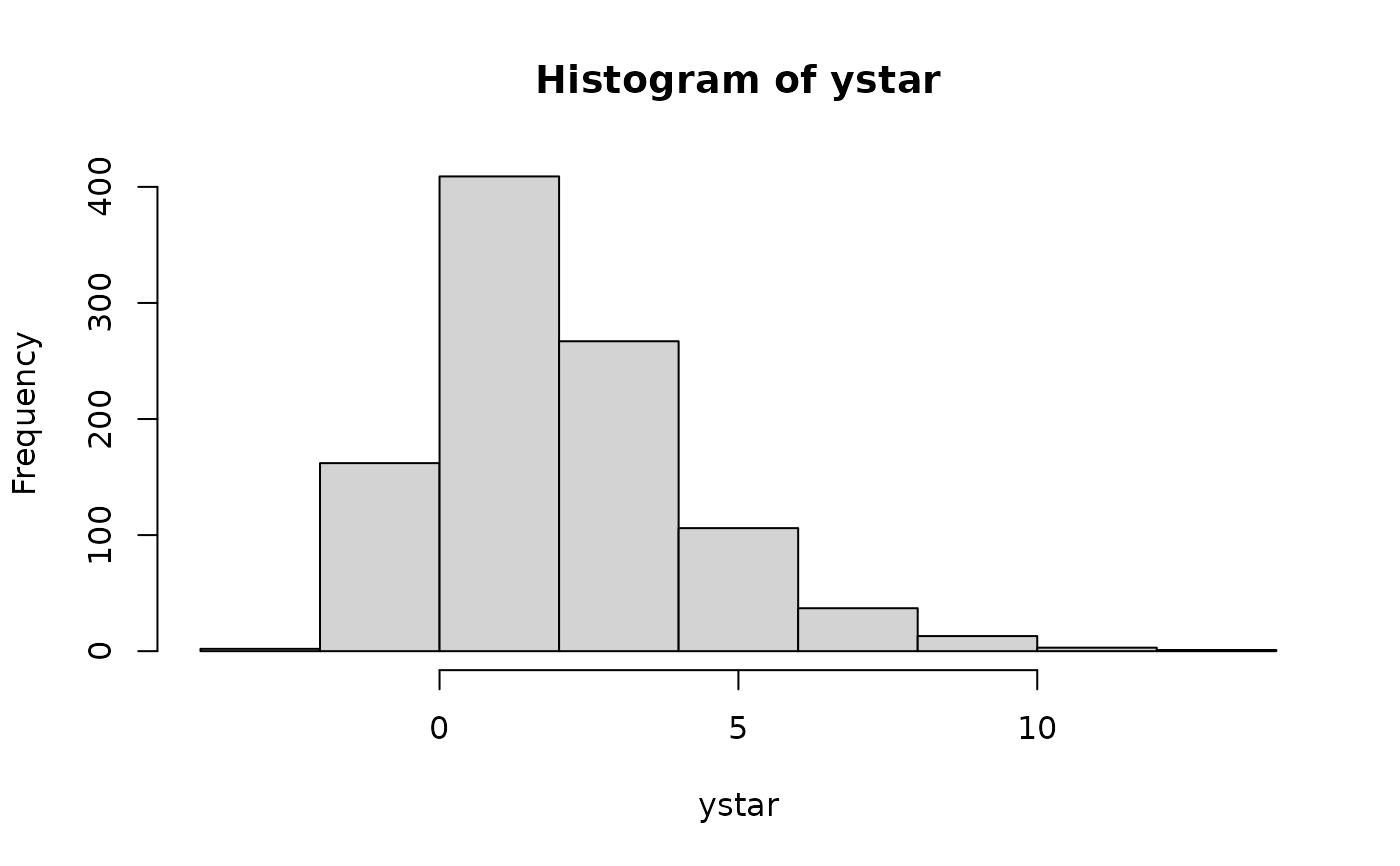
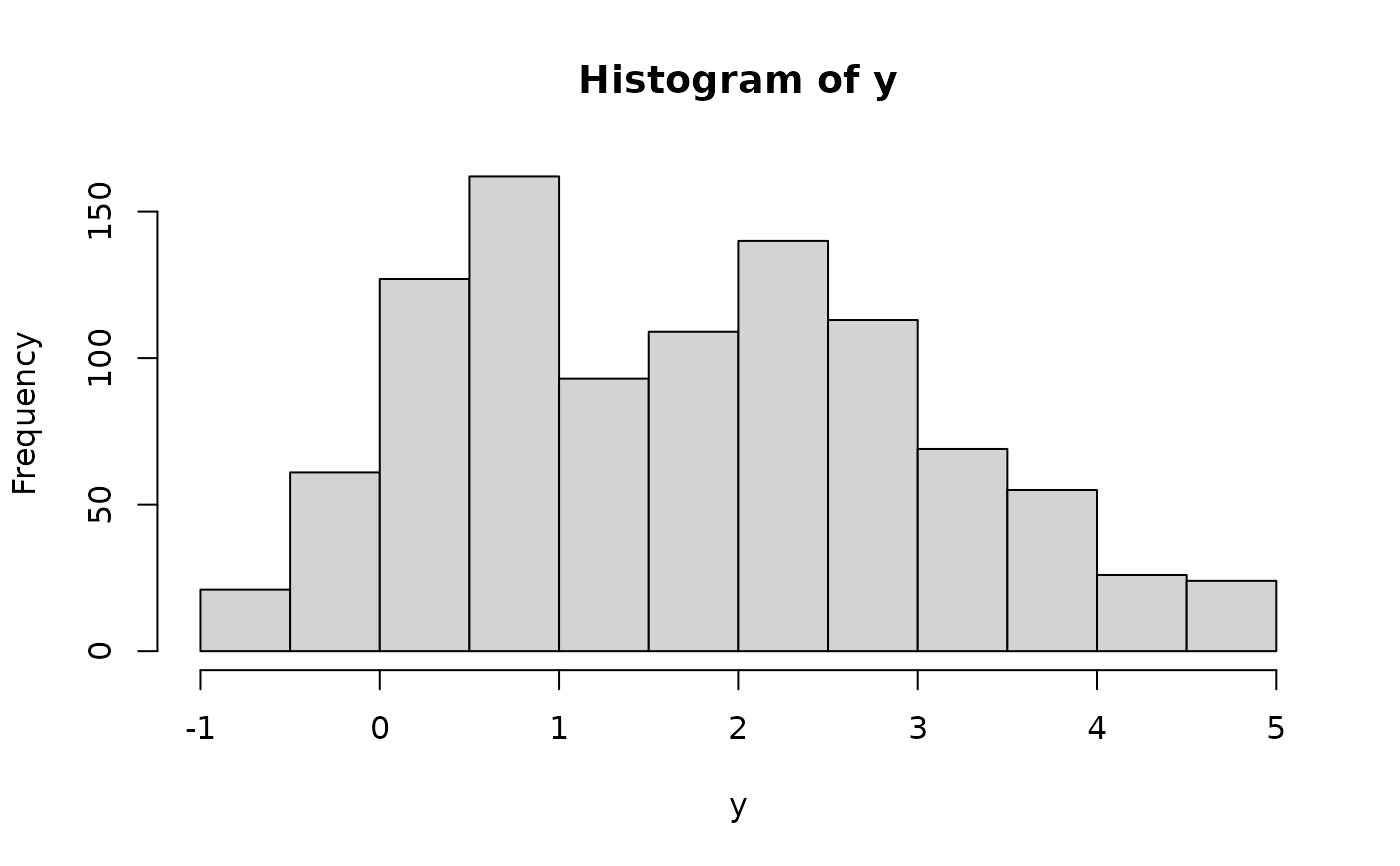 extra <- list(leftcensored = ystar < L, rightcensored = ystar > U)
fit <- vglm(y ~ 1, trace = TRUE, extra = extra, fam = cens.gumbel)
#> Iteration 1: loglikelihood = -1961.5616
#> Iteration 2: loglikelihood = -1640.4276
#> Iteration 3: loglikelihood = -1635.915
#> Iteration 4: loglikelihood = -1634.9063
#> Iteration 5: loglikelihood = -1634.664
#> Iteration 6: loglikelihood = -1634.6097
#> Iteration 7: loglikelihood = -1634.5981
#> Iteration 8: loglikelihood = -1634.5956
#> Iteration 9: loglikelihood = -1634.5951
#> Iteration 10: loglikelihood = -1634.595
#> Iteration 11: loglikelihood = -1634.5949
#> Iteration 12: loglikelihood = -1634.5949
coef(fit, matrix = TRUE)
#> location loglink(scale)
#> (Intercept) 1.014301 0.5136358
extra <- list(leftcensored = ystar < L, rightcensored = ystar > U)
fit <- vglm(y ~ 1, trace = TRUE, extra = extra, fam = cens.gumbel)
#> Iteration 1: loglikelihood = -1961.5616
#> Iteration 2: loglikelihood = -1640.4276
#> Iteration 3: loglikelihood = -1635.915
#> Iteration 4: loglikelihood = -1634.9063
#> Iteration 5: loglikelihood = -1634.664
#> Iteration 6: loglikelihood = -1634.6097
#> Iteration 7: loglikelihood = -1634.5981
#> Iteration 8: loglikelihood = -1634.5956
#> Iteration 9: loglikelihood = -1634.5951
#> Iteration 10: loglikelihood = -1634.595
#> Iteration 11: loglikelihood = -1634.5949
#> Iteration 12: loglikelihood = -1634.5949
coef(fit, matrix = TRUE)
#> location loglink(scale)
#> (Intercept) 1.014301 0.5136358