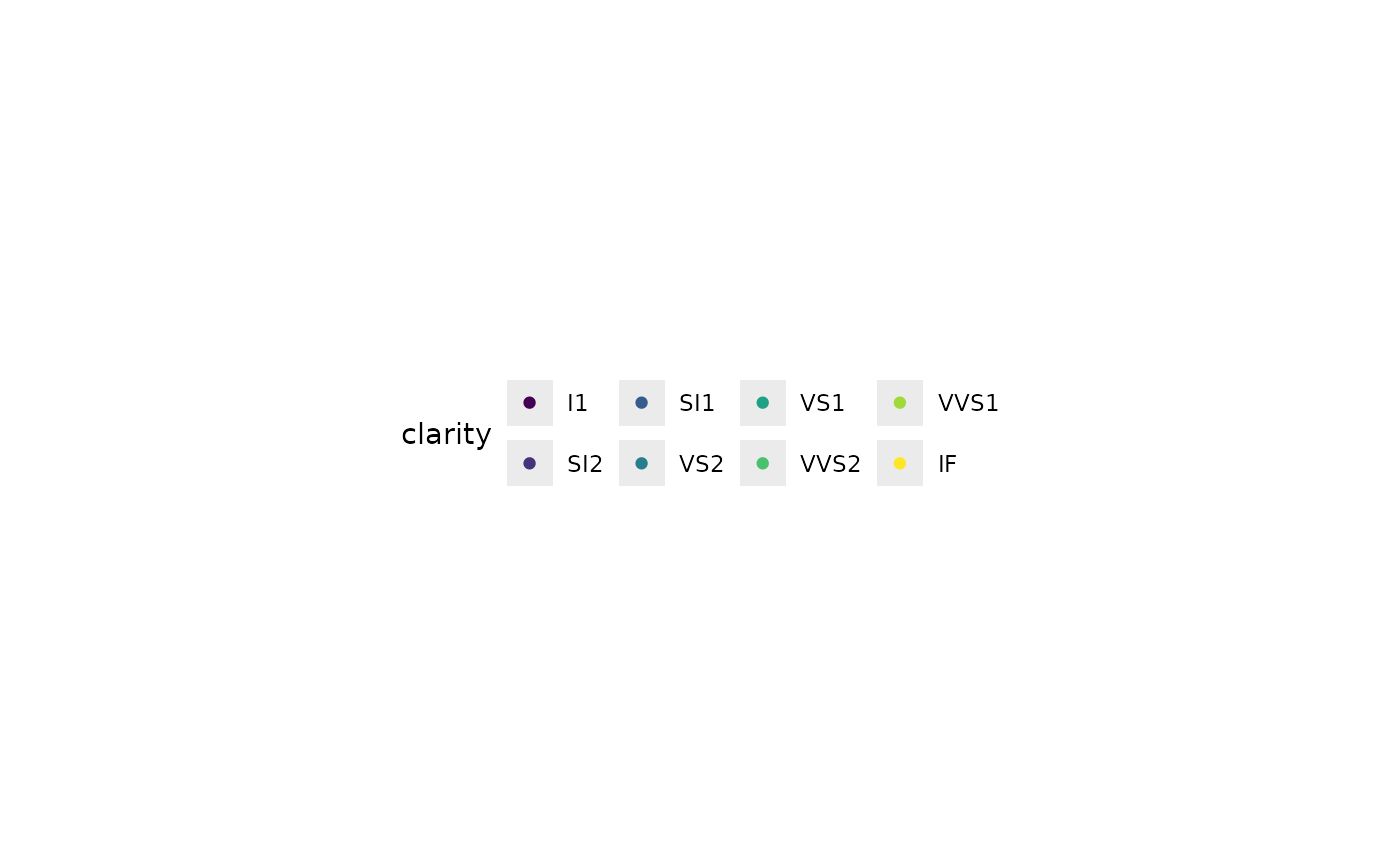
Extracts the legend ('guide-box') from a ggplot2 object.
g_legend(a.gplot)Value
gtable (grob) object. Draw with grid.draw.
Details
The extraction is applied after the plot is trained and themes are
applied. Modifying the legend is easiest by applying themes etc.
to the ggplot2 object, before calling g_legend.
An alternative method for extracting the legend is using
gtable::gtable_filter:
gtable_filter(ggplotGrob(a.ggplot.obj), 'guide-box')This method however returns a gtable object which encapsulates
the entire legend. The legend itself may be a collection of gtable.
We have only noticed a problem with this extra layer when using the returned
legend with arrangeGrob (see examples).
Examples
library(ggplot2)
library(gtable)
library(grid)
library(gridExtra)
library(gtable)
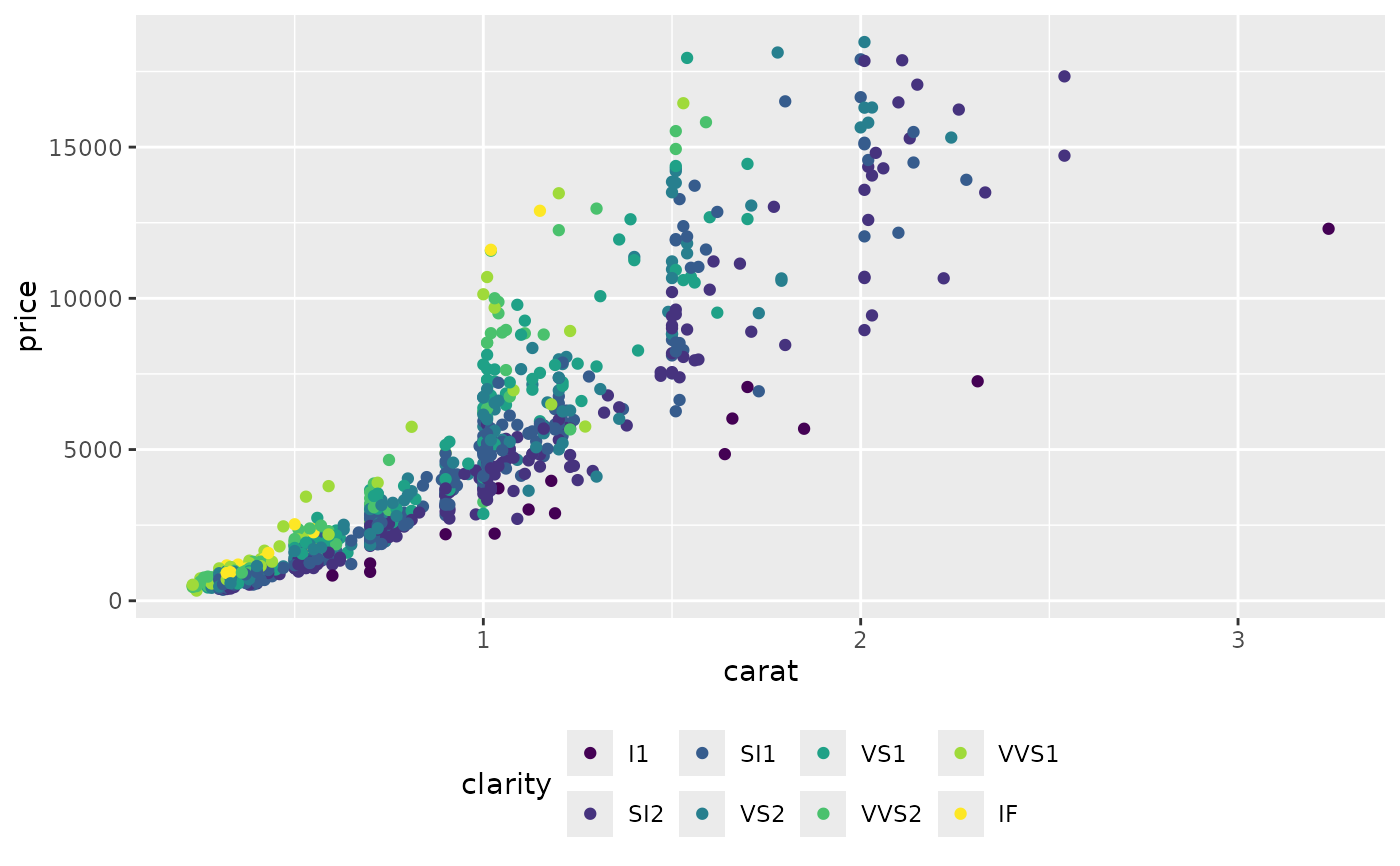
dsamp <- diamonds[sample(nrow(diamonds), 1000), ]
(d <- ggplot(dsamp, aes(carat, price)) +
geom_point(aes(colour = clarity)) +
theme(legend.position='bottom'))
 legend <- g_legend(d)
grid.newpage()
grid.draw(legend)
legend <- g_legend(d)
grid.newpage()
grid.draw(legend)
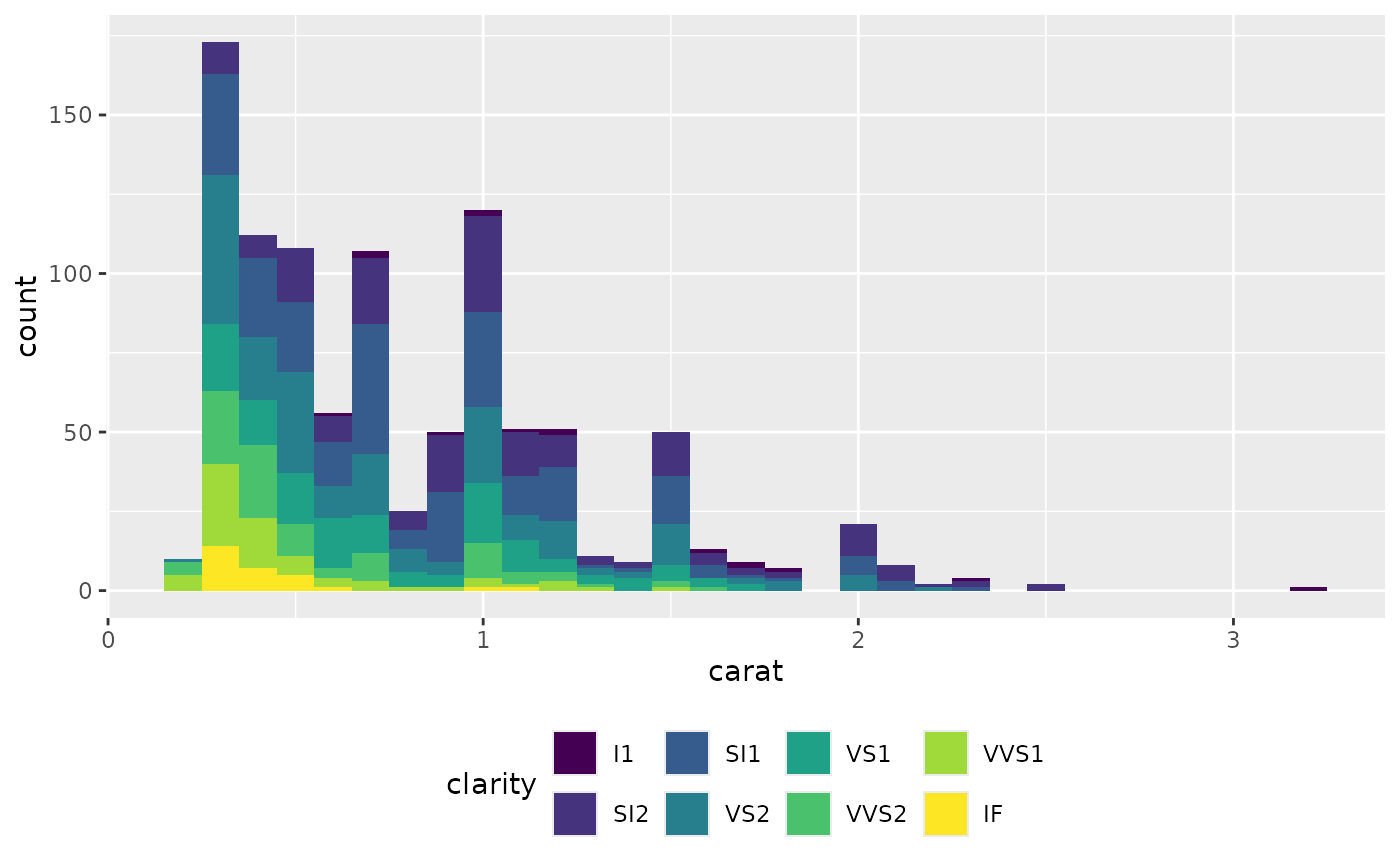
 (d2 <- ggplot(dsamp, aes(x=carat, fill=clarity)) +
geom_histogram(binwidth=0.1) +
theme(legend.position='bottom'))
(d2 <- ggplot(dsamp, aes(x=carat, fill=clarity)) +
geom_histogram(binwidth=0.1) +
theme(legend.position='bottom'))
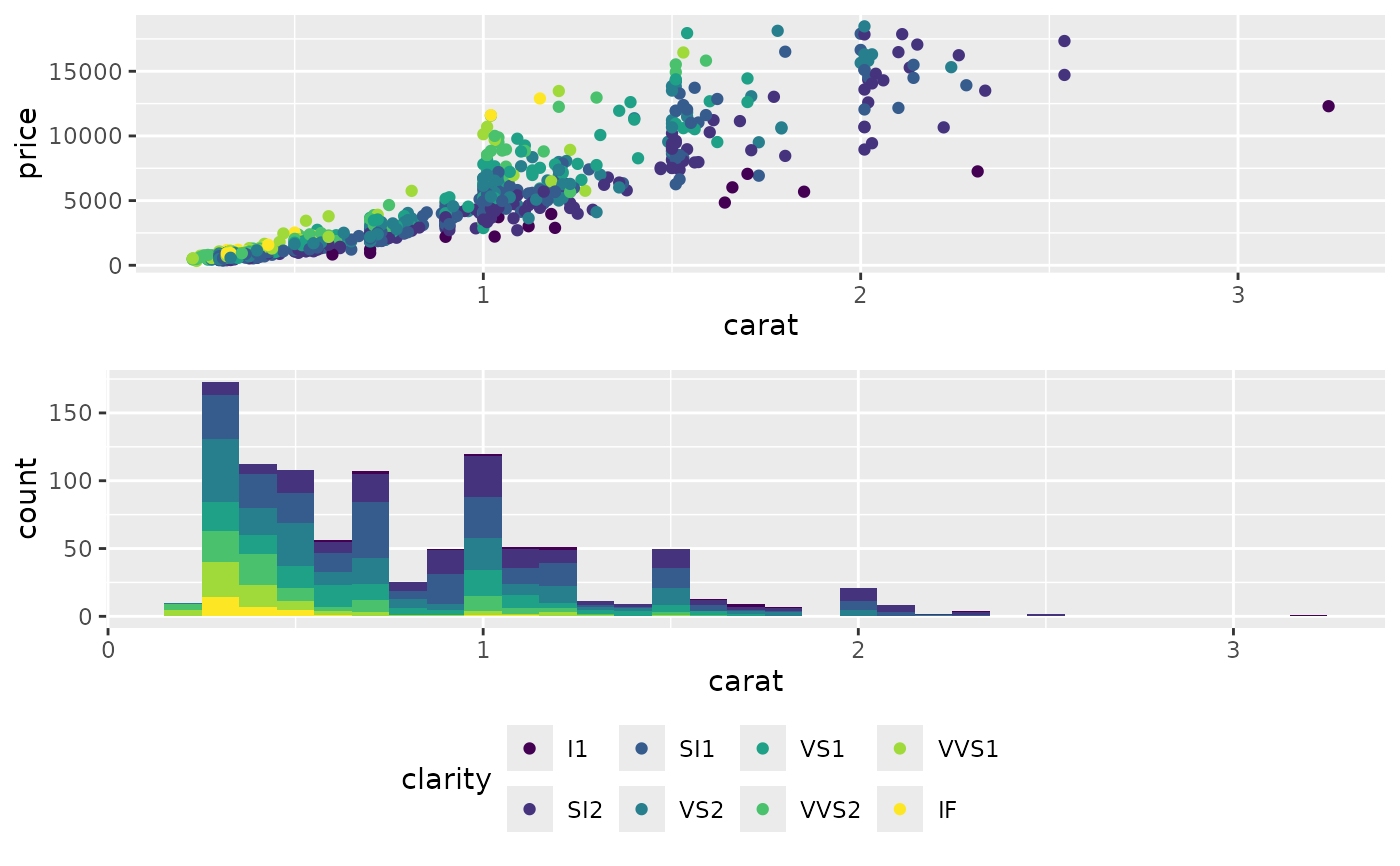
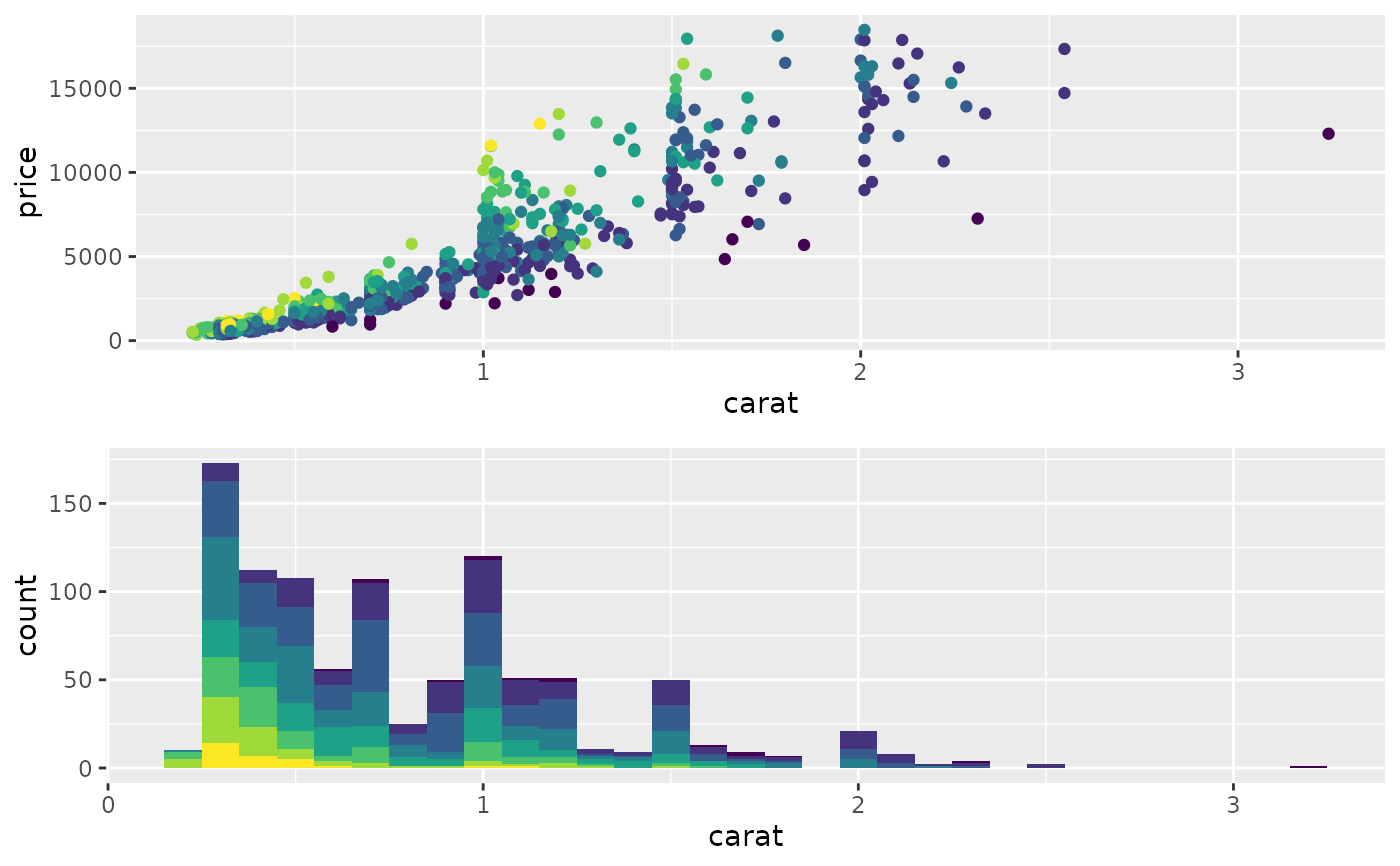
 grid.arrange(d + theme(legend.position='hidden'),
d2 + theme(legend.position='hidden'),
bottom=legend$grobs[[1]])
grid.arrange(d + theme(legend.position='hidden'),
d2 + theme(legend.position='hidden'),
bottom=legend$grobs[[1]])
 # Above fails with more than one guide
legend2 <- gtable_filter(ggplotGrob(d), 'guide-box')
grid.arrange(d + theme(legend.position='hidden'),
d2 + theme(legend.position='hidden'),
bottom=legend2$grobs[[1]]$grobs[[1]])
# Above fails with more than one guide
legend2 <- gtable_filter(ggplotGrob(d), 'guide-box')
grid.arrange(d + theme(legend.position='hidden'),
d2 + theme(legend.position='hidden'),
bottom=legend2$grobs[[1]]$grobs[[1]])
 # Above fails with more than one guide